
Hirzel Dreyfuss & Dempsey, PLLC
NEWS AND INFORMATION

Four AI Companies Said They Should Slow Down. Four Subscribers Called It a Cartel.
The short answer
On September 18, 2026, four paying subscribers sued Anthropic, OpenAI, SpaceXAI and Google, alleging that the four companies agreed with one another to slow the rate at which their competing AI products improve. Two of the four named plaintiffs are Florida residents. The proposed class is nationwide, and on the face of the pleading it includes any Florida consumer who has paid for ChatGPT, Claude, Grok or Gemini since September 12, 2026.
The case is Buist v. Anthropic, PBC, and no defendant has answered. Nothing has been decided.
The rule underneath it is old, and it is worth stating plainly for anyone who runs a business: you may be as cautious as you like on your own, and you may not agree with your competitors about how cautious all of you will be. The complaint says so in as many words. Its theory is that each defendant remains free to slow down, and that the violation is the agreement, not the caution.
What was filed, and a wrinkle in the caption
The complaint is a 29-page class action filed in the Northern District of California by Trial Lawyers for Justice, with Nicholas C. Rowley as lead counsel and Andrew T. Tutt signing. The plaintiffs are Charles Buist and Nick Spetsas, both Florida residents, and Cheyenne Hunt and Christine Bullock, both of California. Each alleges he or she personally bought paid consumer subscriptions during the class period and continues to subscribe. The defendants are Anthropic, PBC; OpenAI OpCo, LLC; SpaceXAI LLC; and Google LLC.
There is a discrepancy worth noting for anyone tracking the docket. The complaint is captioned for the San Francisco Division and bears case number 3:26-cv-10693, and paragraph 40 asserts that assignment under Civil Local Rule 3-2(d). The court's own ECF header stamps the case as 5:26-cv-10693-NC, the San Jose division, assigned to Magistrate Judge Nathanael M. Cousins. Consent to or declination of magistrate jurisdiction is due October 2, 2026. Expect divisional assignment and the magistrate question to be early housekeeping.
The complaint pleads two claims for relief, not one: a Section 1 Sherman Act claim against all defendants, and a separate claim for injunctive relief under Section 16 of the Clayton Act. Jurisdiction is pleaded under 28 U.S.C. sections 1331 and 1337(a), and separately under the Class Action Fairness Act, on allegations that the class exceeds 100 members and the amount in controversy exceeds $5 million.
What the case is about
The public conduct at the center of the case is not in dispute and is easy to check.
On September 12, 2026, Anthropic chief executive Dario Amodei published an essay titled We Must Pace the Frontier. Its central sentence: "We must slow the pace at which we improve the capabilities of AI models." The essay proposes embedded third-party evaluators, coordination among labs in democratic countries, and eventual global coordination. It also anticipates the antitrust problem in its own text, stating that "for antitrust reasons, it's helpful for the US government to mediate or at least enable these discussions," and that the government would "need to issue a narrow waiver for certain kinds of safety conversations." Anthropic committed to the evaluator step unilaterally.
Competitors responded the same day. Elon Musk posted "Dario is right." Sam Altman wrote: "I agree with Dario that we need to pace the frontier," and committed OpenAI to independent evaluators with employee-like access. Demis Hassabis of Google DeepMind endorsed the direction and tied it to an industry standards body he had proposed two months earlier.
The complaint builds from there. It alleges that two days later Altman said AI progress "should be slower than it otherwise could be" and that OpenAI would not wait for an antitrust exemption; that OpenAI's global policy chief confirmed the following day that OpenAI, Anthropic and Google DeepMind had been working together for weeks; and that a working group of company representatives had met regularly since July 2026. It points to a July 2026 statement titled Pacing the Frontier, signed by senior figures at three of the four companies, acknowledging that each firm faces "intense competitive pressure not to unilaterally slow" development.
That last allegation is the load-bearing one. The plaintiffs' theory is that the competitive pressure not to slow alone is precisely the problem an agreement solves, and that solving it collectively is what the Sherman Act forbids.
The legal question is narrower than the headline
The gate is Twombly, and it is a real gate
Section 1 reaches a "contract, combination ... or conspiracy" in restraint of trade. It does not reach unilateral conduct. The threshold question is whether four companies saying similar things in public is an agreement or is parallel conduct.
That question has a governing answer at the pleading stage, and it is Bell Atlantic Corp. v. Twombly, 550 U.S. 544 (2007). Twombly holds that an allegation of parallel conduct, without more, does not state a Section 1 claim; a complaint must contain enough factual matter to suggest that an agreement was made, and conduct "just as much in line with a wide swath of rational and competitive business strategy" will not do. At summary judgment the comparable standard comes from Monsanto Co. v. Spray-Rite Service Corp., 465 U.S. 752 (1984), which requires evidence tending to exclude the possibility of independent action.
This is the pivot of the case. Public essays and public replies have an obvious independent explanation: each company has its own reasons to favor a safety posture, and saying so publicly is ordinary advocacy. The plaintiffs plainly know it, which is why the complaint leans on the private working group meeting since July and on the statement that the companies had already been working together for weeks. Whether those meetings concerned evaluation protocols or the rate of capability improvement is the factual fight, and it is not one that can be resolved from press coverage.
A note for anyone reading other summaries of this case: several cite Copperweld Corp. v. Independence Tube Corp., 467 U.S. 752 (1984), for the parallel-conduct point. Copperweld does not address parallel conduct among independent competitors. It holds that a parent corporation and its wholly owned subsidiary are legally incapable of conspiring under Section 1, because they are a single economic actor. It is an important case and it is not this case's case. Twombly is.
Per se, quick-look, or rule of reason
The complaint pleads all three, in that order. It alleges the agreement is a naked horizontal restraint on output and product quality, unlawful per se; alternatively unlawful under quick-look; alternatively unlawful under the rule of reason. It also pleads that no relevant market or market power showing should be required, and defines a market only "to the extent market definition is required."
That layering is conventional. The characterization fight matters enormously, because per se treatment would relieve plaintiffs of proving market definition and competitive effects, while rule-of-reason treatment gives defendants a forum for the argument that pacing frontier AI has justifications a court should weigh. The complaint tries to foreclose that argument in advance, asserting that every safety objective the defendants have identified can be pursued unilaterally and that only the elimination of competitive pressure requires an agreement.
Standard-setting among competitors is lawful in the ordinary case. It becomes a problem when it stops being about a technical standard and starts being about how much, or how fast, anyone will produce.
The market, as pleaded
The alleged product market is paid consumer subscriptions to general-purpose frontier generative-AI assistants, which the complaint calls the Paid Frontier AI Assistant Subscription Market: the paid tiers of ChatGPT, Claude, Grok and Gemini. The alternative is an innovation market for developing those models. The geographic market is the United States. The complaint alleges, on information and belief, that the four defendants account for at least 80 percent of that market.
Notably, it also alleges that free tiers impose no competitive discipline, on the theory that a free tier cannot constrain a paid market when its owner has agreed to withhold the improvements.
The injury theory is unusual, and the complaint concedes the hard part
This is not a price-fixing case. Nobody alleges the subscription price went up. The theory is that subscribers paid for products that were supposed to keep improving at a competitive rate, and that an agreement to improve more slowly lowers the quality-adjusted value of the subscription. The overcharge is measured in foregone quality.
The complaint then concedes something that defendants will quote back at every stage: because the agreement was formed recently and development cycles run months, its full effect on released products has not yet manifested. The pleading frames that as a reason injunctive relief is appropriate now. Defendants will frame it as an admission that damages are speculative and that no class member can yet show a concrete loss.
That tension, between an ongoing restraint and an unmanifested effect, is where this case will be won or lost on class certification.
What this means for a business that buys or builds with AI
Most Florida businesses are not frontier AI labs. They are franchisees, multi-unit operators, professional firms and mid-market companies that subscribe to these tools and increasingly put them in front of customers. For that audience the lesson has nothing to do with AI and everything to do with who is in the room.
Adopt at your own pace, and decide it by yourself. You may delay a rollout, cap usage, impose your own review requirements, or refuse a model version entirely. What you may not do is agree with competitors on whether, when, or how fast any of you will do those things. "The industry is pacing" is not a defense, it is a description of the alleged violation.
Keep safety work separate from commercial terms. If a trade association or vendor council convenes a shared evaluation protocol, that is ordinary standards work and generally lawful. It stops being ordinary the moment the discussion moves from technical criteria to timing, pricing, capacity or customers. The minutes should show the difference.
Send the charter to counsel before the second meeting, not after the subpoena. This complaint was assembled substantially from public statements plus the allegation that the companies "had been working together for weeks." Private channels do not travel better than public ones; they travel worse, because they are produced in discovery with none of the context.
Read what your vendor actually promised. If a provider slows its update cadence while holding price, your recourse lives in the order form, not the marketing page. Capability tier, model cadence and usage caps belong in the contract if they matter to you.
If you subscribe, you may already be a class member. The proposed class covers United States purchasers of paid individual consumer subscriptions to ChatGPT, Claude, Grok or Gemini from September 12, 2026 forward, with defendant-specific subclasses for each product. Business and enterprise arrangements are outside the class as drafted, which is worth knowing if your subscriptions run through a company account.
What we do not know
No defendant has appeared or answered. No motion has been filed. The case is days old.
The plaintiffs have also reserved the right to move the start of the class period earlier, if discovery shows the agreement was formed before September 12, 2026. That reservation is a signal about where the case is headed: the public statements are the hook, and the private meetings are the target.
And the outcome matters beyond these four companies. If the case is dismissed early, industry safety coordination will be treated as politically costly but legally survivable. If it survives a motion to dismiss, discovery into what was said in those working group meetings becomes the story, and general counsel across every regulated industry will rewrite how their clients participate in standards bodies.
Allegations in a complaint are not findings. This one has not been tested.
Sources
Complaint, Buist v. Anthropic, PBC, No. 5:26-cv-10693-NC (N.D. Cal. filed Sept. 18, 2026), Dkt. 1 (captioned 3:26-cv-10693).
15 U.S.C. 1 (Sherman Act Section 1); 15 U.S.C. 15 and 26 (Clayton Act Sections 4 and 16); 28 U.S.C. 1332(d).
Bell Atlantic Corp. v. Twombly, 550 U.S. 544 (2007).
Monsanto Co. v. Spray-Rite Service Corp., 465 U.S. 752 (1984).
Copperweld Corp. v. Independence Tube Corp., 467 U.S. 752 (1984).
Dario Amodei, We Must Pace the Frontier (Sept. 12, 2026), https://darioamodei.com/post/we-must-pace-the-frontier
Contemporaneous reporting of the September 12, 2026 responses by Sam Altman, Elon Musk and Demis Hassabis.
Disclaimer
This post discusses publicly reported legal developments for general informational purposes. It is not legal advice, it does not create an attorney client relationship, and it does not reflect the firm's position in any pending matter. Outcomes depend on the specific facts and the governing law of the relevant jurisdiction.

When a Franchise System Goes Into Chapter 11, There Are Three Different Problems. Most Owners Only Worry About One.
The short answer
If you are the operator, Chapter 11 in Florida does not let you keep the brand over the franchisor's objection.
If the franchisor files, you usually can keep operating, but only if you affirmatively act. Silence is not safety.
If another multi-unit operator in your system files, the practical risk is not their debt. It is who takes their stores, which leases get rejected, and whether corporate or a discount buyer lands next door.
Most owners collapse all three into one fear. They are three different problems with three different responses, and the 2026 filing wave has now produced a Florida example of each.
Who this is written for
Two groups.
Operators watching the brand. FAT Brands Inc. and its affiliates, including the Johnny Rockets, Twin Peaks and Fazoli's entities, filed Chapter 11 in the Southern District of Texas on January 26, 2026 before Judge Alfredo R. Perez, under lead case number 26-90126. The court confirmed a joint plan of liquidation on July 27, 2026, and the plan went effective on July 31, 2026.
Operators inside systems that already failed at the franchisee level. Popeyes, Applebee's, Moe's, Burger King, Carl's Jr., Hardee's, Subway, and now Wendy's. If you operate in Florida or a neighboring state under one of those marks, the 2026 cases change who your neighbor is, who collects your royalties, and whether the dark boxes in your trade area reopen as corporate stores or as a cheaper competitor.
This is written from that chair, not the debtor's.
Part I: Your franchisor files
What does not happen automatically
A franchisor bankruptcy does not cancel your franchise agreement on the petition date. The agreement is an executory contract. The debtor in possession or trustee may assume it, assume and assign it to a buyer of the brand, or reject it. Until that election is made, you generally must keep performing. Royalties, brand standards, reporting. The non-debtor franchisee is still bound.
Rejection is the scenario owners lose sleep over. It is also the one most often described incorrectly, including by people who should know better.
Rejection is a breach, not a rescission
Start with what rejection is not. Rejection of an executory contract is a breach. It does not undo the contract or claw back rights the contract already granted.
That is now settled at the Supreme Court. In Mission Product Holdings, Inc. v. Tempnology, LLC, 587 U.S. 370 (2019), an 8 to 1 decision written by Justice Kagan, the Court held that a debtor-licensor's rejection of a trademark license does not terminate the licensee's right to use the mark. "A debtor's rejection of an executory contract in bankruptcy has the same effect as a breach outside bankruptcy," the Court wrote. "Such an act cannot rescind rights that the contract previously granted."
For a franchisee, that is the holding that matters most, and it is the reason a rejected franchise agreement does not mean the sign comes down the next morning.
The trap in section 365(n), and why it does not do what most people think
You will read, constantly, that 11 U.S.C. section 365(n) is the franchisee's protection after rejection. Section 365(n) lets the licensee of a rejected intellectual property license elect either to treat the contract as terminated and file a rejection damages claim, or to retain its rights under the license as they existed immediately before the case and keep paying royalties.
That is a real and useful provision. It is also, for the core of a franchise, the wrong statute.
The Bankruptcy Code defines "intellectual property" at 11 U.S.C. section 101(35A), and the list is closed: trade secret; invention, process, design or plant protected under title 35; patent application; plant variety; work of authorship protected under title 17; and mask work. Trademarks, service marks and trade names appear nowhere in it. Congress left them out, and that omission is exactly what produced the circuit split the Supreme Court resolved in Mission Product.
So the trademark license at the center of your franchise agreement is not covered by section 365(n) at all. Your protection there comes from Mission Product, not from the election.
Section 365(n) still has work to do in a franchise case, and it is worth understanding where. A franchise agreement frequently licenses things that are within section 101(35A): the operations manual and training materials as works of authorship, proprietary recipes and supplier terms as trade secrets, and in some systems patented equipment or processes. As to those components, the section 365(n) election is available and should be made in writing. As to the marks, you rely on Mission Product and on your own performance.
The practical instruction is the same either way, and it is the thing franchisees get wrong. Do not go quiet. Keep paying what the agreement requires, put your position in writing, and make the section 365(n) election in writing as to any covered intellectual property. Doing nothing is how operators lose ground while a trustee sells the brand to a buyer with no interest in legacy franchisees. Do not rely on a phone call with brand counsel.
The other limit. Neither Mission Product nor section 365(n) compels a bankrupt franchisor to keep staffing field consultants, fund national advertising at the old level, or run a commissary. You keep the right to use what you licensed. You do not keep the franchisor's future performance. In a system the size of FAT Brands, the practical consequence is that the brand buyer, not the old holding company, is who you will live with, and that buyer will generally try to reset development obligations, remodel calendars and existing default files as the price of a continuing relationship.
Assignment to a new franchisor
When a brand is sold under section 363, your agreement can be assumed and assigned to the purchaser. You will be asked for a cure amount covering unpaid royalties, advertising fund contributions and audit exposure. You can object to the cure figure, to adequate assurance of future performance, and to any attempt to rewrite the bargain inside the sale order.
Read the sale order itself. Watch for language that strips franchisee defenses, or that deems every agreement assumed and assigned unless the franchisee objects by a short deadline buried in a notice.
If your agreement is rejected rather than assigned, expect the franchisor or the buyer to demand that you stop using the marks and de-identify the store. Mission Product says rejection alone does not end your license, so that demand is a position, not a self-executing result. Whether it is correct depends on your agreement and on what the sale order actually provides. This is the point at which a franchisee should have its own counsel rather than reading the brand's letter as the answer.
The first two weeks of a franchisor case
Pull every franchise agreement, development agreement, guarantee and personal guarantee. Note the governing law, the consent provisions, and any clause keyed to the franchisor's own bankruptcy. Such a clause is often unenforceable as an ipso facto provision, but it still gets used as leverage.
Calendar the sale objection and contract assumption deadlines immediately. They run faster than state court instincts expect.
Decide early whether you want to stay with the brand under a buyer. If you do, pay post-petition royalties on time. Nonpayment is the cleanest reason a buyer will have for leaving you off the assumed list.
Do not stop operating on a rumor. And do not prepay royalties to be safe without tracing where the money actually goes. In securitized structures, the entity collecting may not be the operating company you think you are paying.
Part II: You did not file. Another operator in your system did.
This is the wave that actually reached Florida in 2026. These are franchisee bankruptcies. The brand is solvent. Your exposure is contagion: closures, corporate take-backs, insider buyers, and rejected leases sitting empty in your trade area.
A note on sourcing before the numbers. Where a figure below comes from a sworn first-day declaration or a court order, this post says so. Where it comes from trade coverage, it says that too. The distinction matters, because the trade press figures in this area have been wrong often enough to be worth flagging.
Popeyes: Sailormen, Inc.
In re Sailormen, Inc., No. 26-10451, Bankr. S.D. Fla. (Miami), Chapter 11, filed January 15, 2026 before Judge Robert A. Mark. A Miami-based Popeyes operator.
The first-day declaration states the operating facts: 136 Popeyes restaurants in Florida and Georgia, 3,306 employees, fiscal 2025 net sales of $233,458,379, and a net operating loss of $18,769,243. Secured debt was roughly $130 million owed to lenders for whom BMO Bank N.A. serves as administrative agent. That $130 million figure is the secured piece, not the whole balance sheet: the declaration puts total liabilities near $342.6 million against assets near $232.5 million.
The auction was held on June 15, 2026, and the court entered five separate sale orders on June 23, 2026. One of them is worth reading closely if you operate in South Florida: the court approved a sale to Popeyes Louisiana Kitchen, Inc. itself, of sixteen restaurants in the Miami market, for a gross purchase price of $9,600,000. That one is a court record, not a rumor.
The other buyers were The Pulse Restaurant Group, 61 Biscuits, LLC, SBH Foods and RFI Ventures. Trade coverage reports that roughly 97 restaurants sold in total, that Pulse took about 50 stores across Tampa, Jacksonville, Tallahassee and Pensacola for roughly $2.69 million, that 61 Biscuits took a small West Palm Beach package for roughly $1.1 million, and that SBH Foods took Savannah and later Orlando stores. Those allocations are trade press. The buyers and the sale orders are the court record.
The RFI Ventures purchase collapsed, and the fight over it is live. The estate commenced Sailormen, Inc. v. RFI Ventures, LLC, Adv. No. 26-01315, on September 9, 2026, and moved for summary judgment on September 17, 2026. Nothing has been decided.
What happened to the stores nobody bought is the part that reshapes trade areas. The declaration record shows 136 restaurants at the petition and 17 already closed by April 30, 2026, leaving 119 going into the auction. On June 19, 2026 the estate moved on an expedited basis to reject the unbid and master leases effective June 30, 2026, stating plainly that as of July 1 it would no longer have authority to use cash collateral to operate those stores. The rejection exhibit includes Jacksonville, Pensacola, Gainesville, St. Petersburg, Bradenton, and Cairo and Brunswick in Georgia.
If you are a remaining Popeyes franchisee in Florida. Corporate now operates sixteen former Sailormen units in Miami under a court-approved sale. That is an encroachment fact, and Item 17 plus whatever protected territory language exists in your agreement is what governs when corporate sets hours, pricing and promotional cadence from those stores. A buyer who acquired stores at a distressed price does not carry your cost basis. Rejected leases are not permanently dark; they return to landlords who will re-let them, sometimes to a competing brand and sometimes back into Popeyes. And do not treat the debtor's accommodations as precedent for your own file.
Moe's: Quality Fresca I, LLC
In re Quality Fresca I, LLC, No. 26-20345, Bankr. S.D. Fla. (West Palm Beach), Chapter 11, filed August 4, 2026 before Judge Erik P. Kimball.
The chief restructuring officer's declaration, filed the same day, is unusually clear. The debtor acquired 67 Moe's locations across Florida, South Carolina, Virginia, Maryland and the District of Columbia on or about March 9, 2020, and two more Florida units in August 2021, for 69. It closed 19 through the end of 2025 and 12 since, leaving 38 operating at filing. Fiscal 2025 net sales were $58,941,831 against negative EBITDA of $111,204. Year to date through June 15, 2026, revenue was $26,382,413 with EBITDA of $315,254. As of December 31, 2025, assets were roughly $44 million against liabilities of roughly $52 million.
The secured lender is GR Loanco 1 LLC, an affiliate of the debtor's ultimate parent, which purchased the existing PNC credit agreement in May 2026. Aggregate secured exposure is roughly $16 million. Trade payables are approximately $2.1 million, with franchisor royalty and advertising claims acknowledged but not quantified in the record.
The date other Moe's operators should note is not the petition date. It is the default. On August 5, 2025, the franchisor, Moe's Franchisor SPV LLC, an affiliate of GoTo Foods, notified the debtor that it was in default under all of its franchise agreements. A month later the parties entered Multi-Unit Addendum No. 1, under which the franchisor deferred amounts owed. That was a forbearance, not a second default. The debtor complied and the addendum expired on its own terms. The Chapter 11 came a year after the default letter.
On the petition date the debtor moved on an emergency basis to reject sixteen leases, fourteen of them in Florida, effective as of the petition date. Final first-day orders were entered September 4, 2026; the case remains open with no plan on file.
If you are a remaining Moe's franchisee. The system-wide default letter is how Item 17 actually operates when a large operator slips, and it arrived a full year before anyone filed anything. Fourteen Florida closures redraw trade areas, and landlords in those centers will re-tenant. Affiliate debtor in possession financing also means the parent may end up owning what survives, so the question worth asking is who your neighbor will be after confirmation.
Applebee's: Neighborhood Restaurant Partners Florida
In re NRPF Group Two, LLC, No. 26-53945, Bankr. N.D. Ga., Chapter 11, filed March 24, 2026 before Judge Sage M. Sigler, with the affiliated Neighborhood Restaurant Partners Florida entities at No. 26-53946.
The chief restructuring officer's declaration states that the debtors closed nine restaurants in fiscal 2025 and five more in the first quarter of 2026, leaving 53 operating across Florida, Georgia and Alabama with roughly 2,000 employees and independent contractors. Equity Bank is the secured lender.
The prepetition sale process is the detail worth keeping. An investment bank ran it beginning in March 2025 for four to five months and contacted more than 83 groups, of which 17 showed some form of initial interest. In February 2026 the debtors reached a tentative agreement in principle with an affiliate of the franchisor, a subsidiary of Dine Brands Global, Inc., to acquire roughly 53 restaurants, but the out-of-court structure could not be finalized with the secured lender before the petition date.
A settlement with Equity Bank was approved in late May 2026, clearing the path for a sale to the brand. Trade coverage reports the split as $1.05 million allowed secured and $12.57 million unsecured.
What has not been established is that the sale closed. The court's own memorandum opinion of June 12, 2026 still described the transaction prospectively. No closing notice, plan or dismissal appears on the docket, and the case remains open with monthly operating reports running into September 2026. Anyone telling you the franchisor already owns those restaurants is ahead of the record.
If you are a remaining Applebee's franchisee in Florida. A franchisor absorbing fifty-plus boxes is precisely the encroachment scenario Item 17 describes and generally does not protect against. Pricing, staffing and remodel capital at those stores get set at the brand, not by a peer operator. Reported Florida closures run through Casselberry, Celebration, Daytona Beach, Kissimmee, two Orlando sites, Ormond Beach, Panama City and Panama City Beach, which changes your competitive set even while the dining rooms stay dark. And the failed out-of-court process is the lesson for anyone who may someday be the distressed seller: eighty-three contacts and seventeen interested parties is not a deal.
Burger King: Consolidated Burger Holdings
In re Consolidated Burger Holdings, LLC, No. 25-40162, Bankr. N.D. Fla. (Tallahassee), Chapter 11, filed April 14, 2025, jointly administered with Consolidated Burger A, LLC (No. 25-40160) and Consolidated Burger B, LLC (No. 25-40161).
The declaration describes 57 Burger King restaurants in Florida and southern Georgia, roughly $179,000 of unrestricted cash at filing, and total prepetition debt of about $36.6 million, of which roughly $28.8 million was funded debt. The only secured debt was an Auxilior facility of about $14 million.
The sequence that ended this operator is the part worth memorizing. Burger King sued the debtors and a principal in the Southern District of Florida in January 2024; the parties settled that September. Then, on February 20, 2025, the franchisor declared defaults under all of the franchise agreements and forbore only through April 14, 2025 at 5:00 p.m. The Chapter 11 petition was filed the same day the forbearance expired.
A section 363 sale followed in June 2025, under three separate sale orders, with the assets going to four purchasers rather than a single brand-side buyer. Debtor in possession financing of $1.6 million came from Auxilior, the prepetition secured lender, not from the brand. Operations ceased in late June 2025.
The ending is unusual enough to state precisely. The debtors moved to dismiss in May 2026, and the court entered an order of dismissal on July 31, 2026; the clerk closed the cases in mid-August. There was no confirmed plan and no conversion. A dismissal after a completed 363 sale is a real outcome, and it is not the one most operators picture when they hear "Chapter 11."
If you are a remaining Burger King franchisee in Florida. A mandated remodel calendar and an image default are not brand standards you can negotiate later. Here the franchisor's system-wide default declaration, and a forbearance that ran out to the hour, are what put the operator into court. After a 363 sale, the buyers' remodel and hours obligations are frequently reset in the sale documents, which can put refreshed, well-capitalized stores directly next to operators still carrying the old image.
Wendy's: Meritage Hospitality Group
In re Meritage Hospitality Group Inc., No. 26-02947, Bankr. W.D. Mich., Chapter 11, filed September 17, 2026, reassigned to Judge James W. Boyd the same day, with fourteen affiliated debtors. Joint administration has been requested but not yet ordered.
This is a national case, not a Florida one, and it is one day old as this is written, which limits what can responsibly be said about it.
What the record shows: fifteen Chapter 11 petitions, an estimated asset range and an estimated liability range each checked on the petition form at $10,000,001 to $50 million, and schedules not due until October 1, 2026. Those checkbox ranges are estimates on a pre-printed form and do not reconcile with the reported secured facility, so do not treat them as the company's balance sheet. The court also entered a notice of defective filing on the petition itself.
From the company's own announcement and its second quarter release: 314 Wendy's restaurants, one Bojangles and five independently branded restaurants; roughly 9,000 employees across fifteen states; roughly 60 Wendy's already closed; second quarter 2026 sales of $150.0 million against $163.5 million a year earlier, with a net loss of $13.6 million including one-time restructuring and closing costs. Store-level EBITDA of $36.2 million, down 48 percent, is a fiscal 2025 figure, not a 2026 one. Trade coverage reports a $150 million facility with City National Bank, a default notice in September 2025 and a franchisor default notice in October 2025.
On the brand side, Wendy's reported U.S. same-restaurant sales down 7.0 percent in the second quarter of 2026, and net closures of 245 restaurants in the U.S. system in the first half of 2026, against 44 openings and 289 closings.
As of this writing there has been no first-day hearing, and no debtor in possession financing motion appears on the docket.The company says it is pursuing financing. Nothing has been approved.
If you are a Wendy's franchisee, including in Florida. This is not your bankruptcy, but it is the largest operator-side shock the brand has absorbed this year. Expect corporate or third-party takeovers of closed Meritage boxes and pressure on remaining operators to absorb development the system just lost. Watch, too, whether the brand uses the moment to accelerate defaults against otheroperators who are behind on royalties or image. Large operator filings tend to tighten enforcement everywhere else.
Other 2026 filings that can still reach your trade area
Carl's Jr. Friendly Franchisees Corporation and its subsidiaries filed Chapter 11 in the Central District of California on April 2, 2026 before Judge Scott C. Clarkson, with the affiliated cases administered under Sun Gir Incorporated, No. 8:26-bk-11056. Trade coverage reports roughly 65 California units, 49 of them offered for sale, and management attributing the distress in part to California's $20 fast-food minimum wage. Not a Florida matter, but a preview of the labor-cost narrative brands will recycle.
Hardee's, twice. ARC Burger, LLC, No. 26-55202, Bankr. N.D. Ga., filed Chapter 7 on April 20, 2026 after closing its 77 stores in December 2025. The franchisor had terminated the franchise agreements in September 2025, terminated the operator's authority in December, and sued in the Middle District of Tennessee in November 2025 seeking more than $6.5 million in unpaid royalties, rent and advertising contributions. A second Hardee's operator, Superior Star, LLC, No. 26-31809, Bankr. W.D. Ky., filed Chapter 11 on July 9, 2026 and is litigating against StarCorp LLC, the seller it bought its units from, not the franchisor, in adversary proceedings in Kentucky and Arizona that remain pending.
Subway. MTF Enterprises, LLC, No. 26-10237, and MTF Holdings, LLC, No. 26-10236, Bankr. E.D. Pa., Chapter 11, filed January 21, 2026. Roughly 43 stores. The filing itself identifies "weekly and daily payments drawn by the MCA lenders" as the primary cause of the financial problems. If a fellow operator in your state is on merchant cash advance financing, that is frequently the last chapter before the stores go dark or get re-franchised near you.
Part III: If you are the distressed multi-unit franchisee in Florida
The 2026 files also show what not to expect from your own Chapter 11.
Section 365(c)(1) bars a debtor in possession from assuming an executory contract where, first, applicable non-bankruptcy law excuses the counterparty from accepting performance from an entity other than the debtor, and second, the counterparty does not consent. The Eleventh Circuit framed that first condition as a hypothetical question in In re James Cable Partners, L.P., 27 F.3d 534 (11th Cir. 1994), aligning it with the Third Circuit's hypothetical test and against the actual test used in the First and Fifth Circuits.
Read James Cable carefully before assuming it decides your problem, because it cuts both ways. The Eleventh Circuit allowedassumption there. Its holding was that a general contractual prohibition on assignment is not "applicable law" within the meaning of section 365(c)(1). To be excused, the counterparty must point to non-bankruptcy law that makes the performance nondelegable, the classic example being a personal services contract. A no-assignment clause in your franchise agreement, standing alone, is not enough.
What supplies the applicable law in a franchise case is the trademark license, and there is now a decision applying exactly that reasoning to a franchisee. In In re Pinnacle Foods of California, LLC, No. 24-11015 (Bankr. E.D. Cal. Oct. 10, 2024), a six-unit Popeyes franchisee sought to assume its franchise agreements. It was not trying to assign them to anyone. The court held that Popeyes could block assumption anyway, because applicable law, in the form of the non-assignability of trademark licenses and the state franchise relations statute, would excuse the franchisor from accepting performance from a hypothetical assignee. The court acknowledged that the rule "often has devastating effects on the ability of Chapter 11 debtors to reorganize."
Pinnacle Foods is an Eastern District of California case, so it binds nobody in Florida, and the Ninth Circuit rather than the Eleventh supplies its framework. But the reasoning is the reasoning a Florida franchisee should expect to meet, and the outcome is the one to plan around: no consent, no assumption. Note the asymmetry with Part I as well. Trademark law is strong enough to block a franchisee from assuming its own agreements, while the Bankruptcy Code's definition of intellectual property is narrow enough to leave trademarks out of section 365(n) entirely. Franchisees end up on the wrong side of both.
The practical consequence is that a Florida franchisee filing is usually one of three things: a section 363 sale of stores the brand will approve, a lease-rejection-and-shrink case, or a brand take-back. It is not a standalone plan that keeps the same owner in the same agreements over a franchisor's "no."
Cure of royalties, advertising fund, audits and often remodel and image defaults is the price of any consent. An insider buyer still has to be approved as a new franchisee. Cash collateral drop-dead dates, not plan confirmation, are when unsold stores actually go dark, as the Sailormen leases showed at the end of June. And merchant cash advance financing can make Chapter 11 too late to matter.
Do not file on the theory that bankruptcy freezes Item 17. The automatic stay freezes collection. It does not write the franchisor's consent for you.
Part IV: A practical checklist
The brand looks unsteady
Inventory every license grant, guaranteed obligation and supply contract, and separate the trademark license from the operations manual, trade secrets and any patented equipment, because they are governed by different rules. Prepare a section 365(n) election letter as to the covered intellectual property now, and send it if rejection is noticed. Put your Mission Product position in writing as to the marks. Object to cure amounts and to sale orders that treat your agreement as assumed and assigned without a real adequate assurance showing. Keep paying post-petition royalties if you intend to stay, and stop only on advice and with a paper trail.
A peer operator in your brand files
Map every store they operate inside your trade area and every store already closed. Read your territorial, encroachment and right-of-first-refusal language before corporate or a distressed buyer takes those boxes. Expect the franchisor to tighten transfers and defaults system-wide after a large filing. If a rejected location sits in your center or across the street, talk to the landlord early, because you may want that real estate more than a new competing franchisee does. And do not copy the debtor's pricing or its unpaid-royalty posture. Its estate is playing a different game than you are.
You are the one slipping
Treat a system-wide default letter as the opening of a sale process, not a negotiation that can wait a year. Both Quality Fresca and Consolidated Burger received one well before they filed. Remodel and image mandates are default events, not suggestions. Get a transfer package in front of the franchisor while you still have a going concern, because bankruptcy does not improve their underwriting of your buyer. And stay off merchant cash advance financing if there is any path to an orderly transfer.
The point
The story is not that restaurants are dying. It is narrower and more useful than that. Franchise agreements in this circuit move only with the franchisor's consent. Rejected leases redraw trade areas whether or not you were a party to anything. And a franchisor bankruptcy is survivable, because rejection is a breach and not a rescission, but only if the franchisee acts on that in writing and then makes its peace with whoever bought the brand.
Sources
Mission Product Holdings, Inc. v. Tempnology, LLC, 587 U.S. 370 (2019).
In re James Cable Partners, L.P., 27 F.3d 534 (11th Cir. 1994).
In re Pinnacle Foods of California, LLC, No. 24-11015 (Bankr. E.D. Cal. Oct. 10, 2024).
11 U.S.C. sections 101(35A), 365(a), 365(c), 365(f) and 365(n).
In re Sailormen, Inc., No. 26-10451, Bankr. S.D. Fla. (Chapter 11, filed Jan. 15, 2026); Sailormen, Inc. v. RFI Ventures, LLC, Adv. No. 26-01315 (filed Sept. 9, 2026).
In re Quality Fresca I, LLC, No. 26-20345, Bankr. S.D. Fla. (Chapter 11, filed Aug. 4, 2026).
In re NRPF Group Two, LLC, No. 26-53945, and In re Neighborhood Restaurant Partners Florida, LLC, No. 26-53946, Bankr. N.D. Ga. (Chapter 11, filed Mar. 24, 2026).
In re Consolidated Burger Holdings, LLC, No. 25-40162, Bankr. N.D. Fla. (Chapter 11, filed Apr. 14, 2025), jointly administered with Nos. 25-40160 and 25-40161.
In re Meritage Hospitality Group Inc., No. 26-02947, Bankr. W.D. Mich. (Chapter 11, filed Sept. 17, 2026).
In re FAT Brands Inc., No. 26-90126, Bankr. S.D. Tex. (Chapter 11, filed Jan. 26, 2026; plan confirmed July 27, 2026, effective July 31, 2026).
In re Sun Gir Inc., No. 8:26-bk-11056, Bankr. C.D. Cal. (Chapter 11, filed Apr. 2, 2026); In re ARC Burger, LLC, No. 26-55202, Bankr. N.D. Ga. (Chapter 7, filed Apr. 20, 2026); In re Superior Star, LLC, No. 26-31809, Bankr. W.D. Ky. (Chapter 11, filed July 9, 2026); In re MTF Enterprises, LLC, No. 26-10237, Bankr. E.D. Pa. (Chapter 11, filed Jan. 21, 2026).
Disclaimer
This post discusses publicly reported legal developments for general informational purposes. It is not legal advice, it does not create an attorney client relationship, and it does not reflect the firm's position in any pending matter. Outcomes depend on the specific facts and the governing law of the relevant jurisdiction.

The IFA World Franchise Show Is in Fort Lauderdale This Month. Here Is How to Walk the Floor Without Buying a Lawsuit
The short answer
A franchise trade show is a sales floor. Two days, free admission, hundreds of brands, and a room full of development representatives whose compensation depends on getting a deposit or a signature. None of that is improper. But almost none of the legal protection that matters to a franchise buyer operates on a show floor. It operates on paper, on a clock, and in the weeks after you go home. Understand which is which and the show is genuinely useful. Do not, and it becomes the most expensive two days of your year.
What the event is
The IFA World Franchise Show runs Friday, September 25 and Saturday, September 26, 2026 at the Broward County Convention Center, 1950 Eisenhower Boulevard, Fort Lauderdale, Florida 33316. Hours are 10:00 a.m. to 4:00 p.m. both days. Attendee registration is free.
The show is produced by the International Franchise Association together with Business Show Media. It is not the show's debut. The first edition ran May 9 and 10, 2025 at the Miami Beach Convention Center. This is the South Florida event moving up the coast, not a new venture arriving.
The numbers in the marketing deserve a word. The organizer's home page advertises more than three hundred brands, more than one hundred fifty seminars, and an audience of more than five thousand entrepreneurs. The organizer's own attendee page advertises more than one hundred seminars. Those are projections written to sell exhibit space and fill a hall, not audited figures, and the organizer's pages do not agree with one another. Treat every number you encounter at a franchise show, including the ones in this paragraph, as a marketing claim until somebody puts it in writing.
Who is on the program
The announced speaker lineup includes Jon Taffer, described by the organizer as a hospitality expert, entrepreneur, and founder of Taffer's Tavern; Randy Sharpe, Chief Executive Officer of Wahlburgers; Bradford Reynolds, Chief Executive Officer of Gold's Gym at RSG Group; Sean Oatney, CFE, Director of Franchise Sales at Planet Fitness; and Tara Fry Vigil, Franchise Developer at American Dairy Queen Corporation.
Trade show lineups change without notice. Confirm the schedule the morning you go.
The seminar room is not the problem. The booth is.
Seminars are lectures. Booths are sales conversations, and sales conversations are where the federal rule that governs franchise sales actually bites.
The FTC Franchise Rule prohibits a franchisor, a franchise broker, or anyone selling on the franchisor's behalf from making any claim about the financial performance of a franchise, whether about the system as a whole or about a single outlet, unless two conditions are met. The seller must have a reasonable basis and written substantiation for the claim at the time it is made, and the claim must be included in Item 19 of the franchisor's disclosure document. See 16 C.F.R. 436.9(c). The same subsection requires that any financial performance representation be accompanied by a clear and conspicuous admonition directing the prospective franchisee to the disclosure document. See 16 C.F.R. 436.9(c)(2).
It is a separate violation to disclaim or contradict information contained in the disclosure document. See 16 C.F.R. 436.9(a).
Read that against what a show floor sounds like. "Our top operators clear well over two hundred thousand." "Most of our owners are in the black inside eighteen months." "The Broward stores do better than the national average." Each of those is a financial performance representation. Each is lawful only if it already appears in Item 19 and the seller can substantiate it in writing right now.
You do not need to litigate this at the booth. You need to do one thing: write down what was said, who said it, and when. A sentence in your notes at 11:40 a.m. on Saturday is worth more eighteen months later than your recollection, the brochure, or the representative's memory. If the statement is not in Item 19, you have a documented problem. If it is in Item 19, you have a benchmark you can hold the franchisor to.
What Item 19 actually has to tell you
Item 19 is codified at 16 C.F.R. 436.5(s). A franchisor is not required to make a financial performance representation at all. Many do not. But a franchisor that chooses to make one must state the basis and assumptions for it and, for a representation about a subset of outlets, must identify the number of outlets whose data were used, the number that attained or exceeded the stated result, and that number as a percentage. See 16 C.F.R. 436.5(s)(3)(ii)(B) through (E).
That denominator is the detail that gets misread most often, including by people who read Item 19 carefully. The percentage is calculated against the outlets whose data went into the representation, not against the whole system. A franchisor with six hundred outlets may present figures drawn from the ninety that supplied data, and a statement that "sixty percent attained this result" then means sixty percent of those ninety. It says nothing about the other five hundred ten. Ask which outlets were excluded and why. The answer is frequently more informative than the figures.
The fourteen day rule, stated correctly
The Franchise Rule requires the franchisor to furnish the disclosure document at least fourteen calendar days before the prospective franchisee signs any binding agreement with, or makes any payment to, the franchisor or an affiliate in connection with the proposed franchise sale. See 16 C.F.R. 436.2(a).
Two points follow, and both are routinely lost.
First, the fourteen day period must have elapsed before the earlier of signing or payment. It is not a period that begins on the earlier of those events. The clock runs before you commit, not after.
Second, a deposit is a payment. "Refundable" does not change that, and neither does the label on the form. A show floor is built to produce exactly that commitment, on the day, with a discount attached to doing it now. If a brand will not sell you the same franchise on October 15 on the same terms, the discount is not a discount.
The honest use of the show is to collect disclosure documents and leave. Nothing about the Rule prevents you from taking an FDD home. Everything about the Rule assumes you will.
Florida law: what it adds, and what it does not
Florida does not register or review franchise offerings. A prospective franchisee who assumes some Tallahassee office has vetted the brand is mistaken.
What Florida requires is thinner than that. A franchisor claiming the federal exemption from Florida's sale of business opportunities law files an exemption notice with the Department of Agriculture and Consumer Services and pays a one hundred dollar fee. See sections 559.801 and 559.802, Florida Statutes. The filing is a notice, not an approval. Nobody reads the disclosure document on your behalf. Its practical value to a buyer is that you can check whether the franchisor bothered to file.
Two other Florida provisions matter more to franchisees than the registration point, and both concern what happens when you want out.
Restrictive covenants. Section 542.335, Florida Statutes, governs enforcement of non-competes, and it treats franchisees specifically. Against a former franchisee, or a former licensee of a trademark or service mark, a court presumes reasonable in time any restraint of one year or less, and presumes unreasonable in time any restraint of more than three years, leaving a middle band in which the party seeking enforcement carries the burden. See section 542.335(1)(d)2, Florida Statutes.
The shorter figures of six months and two years that appear throughout general non-compete commentary come from section 542.335(1)(d)1, which governs former employees, agents, and independent contractors. They do not apply to a franchisee, and applying them to one understates by half how long a franchise covenant will presumptively hold.
Florida courts will also modify an overbroad restraint rather than strike it, so a covenant that looks unenforceable on its face often is not.
The CHOICE Act. Florida's Contracts Honoring Opportunity, Investment, Confidentiality, and Economic Growth Act became law in July 2025 and is codified at sections 542.41 through 542.45, Florida Statutes. It creates a separate and considerably more employer friendly regime for covered garden leave and covered non-compete agreements, including a presumption in favor of injunctive relief.
It does not reach most franchisees, and the reason is the definition. A covered employee is one whose salary exceeds twice the annual mean wage of the Florida county in which the employer has its principal place of business, or in which the employee resides if the employer is outside Florida. See section 542.43, Florida Statutes. "Salary" is defined to exclude discretionary incentives and similar items. A franchisee is generally not an employee at all, and franchise royalty income is not salary.
The Act also contains a savings clause preserving the enforceability of agreements under other law, including section 542.335. See section 542.45(5)(e). The practical effect for a franchise buyer is that the covenant in your franchise agreement will almost certainly be measured under section 542.335, not under the CHOICE Act, and the reporting that treats the CHOICE Act as having changed Florida non-compete law across the board is overbroad.
What Congress is doing, and what it has not done
You will hear about the American Franchise Act on the floor. Here is where it stands.
H.R. 5267 was introduced in the House on September 10, 2025. The Committee on Education and the Workforce ordered it reported with an amendment on July 21, 2026 by a party line vote of 18 to 15. It was reported on September 8, 2026 as House Report 119-802 and placed on the Union Calendar as Calendar No. 702.
No House floor vote has occurred. The Senate companion, S. 3525, was introduced December 17, 2025 by Senator Roger Marshall. The Senate Committee on Health, Education, Labor and Pensions held hearings on March 19, 2026. There has been no committee vote and no floor action in the Senate.
A bill on the Union Calendar is a bill eligible to be called up. It is not law, it changes nothing about the disclosure document in your hand this weekend, and a representative who describes it as settled is telling you something about the representative.
Before you go
Four things, and they take less than an hour.
Decide your number before you walk in. Total investment, including the capital you will need after opening and before the business carries itself. Item 7 gives a range. The top of that range is the planning figure, not the bottom.
Bring a notebook, not just a phone. Write down performance claims verbatim with the name of the person who made them and the time.
Ask every brand you are serious about for the disclosure document and the franchise agreement, and ask when the document was last issued. Then leave without signing anything and without paying anything.
Have the disclosure document reviewed before the fourteen days run, not after. The waiting period is the only part of this process that is built for your benefit, and it is the part people most often waive by accident.
Two IFA webinars before the show
The International Franchise Association is running two webinars on Tuesday, September 22, 2026.
"When Crisis Hits: Managing Disruption, Risk, and Regulatory Scrutiny in Franchise Systems" runs from 1:00 to 1:30 p.m. Eastern. Registration is free and it carries 0.5 CFE LIVE credit. The panel is four Greenberg Traurig shareholders.
"The Consultant-Franchisor Partnership: What Drives Mutual Success" runs from 2:00 to 3:00 p.m. and carries 1 CFE credit. The IFA listing does not state a time zone for this one.
Sources
International Franchise Association, IFA World Franchise Show, https://www.ifafranchiseshow.com/
International Franchise Association, https://www.franchise.org/
Broward County Convention Center, 1950 Eisenhower Boulevard, Fort Lauderdale, Florida 33316
16 C.F.R. Part 436 (FTC Franchise Rule), https://www.ecfr.gov/current/title-16/chapter-I/subchapter-D/part-436
H.R. 5267, 119th Congress, https://www.congress.gov/bill/119th-congress/house-bill/5267
S. 3525, 119th Congress, https://www.congress.gov/bill/119th-congress/senate-bill/3525
Sections 542.335, 542.41 through 542.45, 559.801, and 559.802, Florida Statutes, http://www.leg.state.fl.us/statutes/
Disclaimer
This post discusses publicly reported legal developments for general informational purposes. It is not legal advice, it does not create an attorney client relationship, and it does not reflect the firm's position in any pending matter. Outcomes depend on the specific facts and the governing law of the relevant jurisdiction.
A House Bill Would Freeze the Joint Employer Standard. The Reason Is That It Has Moved Six Times in Ten Years.
The short answer
The American Franchise Act, H.R. 5267, was reported to the House on September 8, 2026. It would write the narrow joint employer standard into the National Labor Relations Act and the Fair Labor Standards Act, so that a franchisor is a joint employer of its franchisee's employees only where it possesses and exercises substantial direct and immediate control over specified terms of employment. The case for it is not really about the standard. It is about the fact that the standard keeps changing while franchise agreements run ten to twenty years.
Why joint employer status matters in a franchise system
Two consequences, and they are large.
Wage and hour exposure. Joint employers are jointly and severally liable for unpaid minimum wages and overtime under the FLSA, plus liquidated damages and attorney's fees. For a franchisor, a joint employer finding turns one franchisee's payroll practices into system-wide exposure and makes the franchisor the deep-pocket defendant in a collective action spanning hundreds of locations.
Labor relations. A joint employer must bargain over the terms it controls, can be named in unfair labor practice charges, and loses neutral-employer protection against secondary activity. Under a broad standard, a union can seek a bargaining unit spanning multiple franchisees with the franchisor at the table.
The history, which is the actual argument for the bill
2015. In Browning-Ferris Industries, 362 NLRB No. 186, the Board held that indirect control and reserved but unexercised authority count toward joint employer status.
2017 and 2018. The Board overruled Browning-Ferris in Hy-Brand, then vacated that decision months later over a member's conflict, reviving Browning-Ferris.
December 2018. In Browning-Ferris Industries v. NLRB, 911 F.3d 1195, the D.C. Circuit upheld the Board's authority to consider indirect and reserved control as consistent with common law agency, but vacated in part and remanded.
February 2020. The Board issued a final rule at 85 Fed. Reg. 11184, codified at 29 C.F.R. 103.40, requiring possession and exercise of substantial direct and immediate control over one or more of eight essential terms.
October 2023. The Board issued a new final rule at 88 Fed. Reg. 73946 returning to a common law approach in which authority to control counts whether or not exercised and whether exercised directly or indirectly.
March 2024. In Chamber of Commerce v. NLRB, No. 6:23-cv-00553 (E.D. Tex.), the court vacated the 2023 rule in its entirety, including its rescission of the 2020 rule.
February 2026. The Board published a withdrawal at 91 Fed. Reg. 9707 conforming the regulatory text to the vacatur and restoring the 2020 rule language, describing the action as ministerial.
So the 2020 rule governs today. It never actually lapsed, because the court vacated the rescission along with the replacement.
What the bill would do
H.R. 5267 was introduced September 10, 2025 by Representative Kevin Hern, with Representative Don Davis as lead Democratic cosponsor and thirteen original cosponsors. It was referred to the Committee on Education and Workforce and reported to the House on September 8, 2026 as House Report 119-802. A Senate companion, S. 3525, was introduced December 17, 2025 by Senator Roger Marshall.
The bill adds a new section to the NLRA, with a parallel FLSA provision. A franchisor is a joint employer only if it possesses and exercises substantial direct and immediate control over one or more essential terms and conditions of employment. Those terms are an exhaustive list of eight: wages, benefits, hours of work, hiring, discharge, discipline, supervision and direction. Control must have a regular or continuous consequential effect; sporadic, isolated or de minimis involvement does not count. Franchise terms are defined by cross-reference to 16 C.F.R. 436.1, the FTC Franchise Rule. It applies prospectively only.
It also lists conduct that does not constitute direct and immediate control, including establishing operating hours, setting minimum staffing levels to meet service standards, bringing employee misconduct to the franchisee's attention while leaving the decision to the franchisee, setting brand standards, offering training materials, and offering optional scheduling and task-assignment tools.
The language is lifted nearly verbatim from the 2020 Board rule. The bill's contribution is not a new standard. It is putting the existing one in statute, beyond the reach of Board rulemaking and, because it also amends the FLSA, beyond Department of Labor rulemaking.
Our take: the volatility is the injury, and the FLSA side is worse
The strongest argument for codification has nothing to do with whether the narrow standard is correct. It is that a franchisor calibrating its system to the 2020 rule was exposed under the 2023 rule, and a franchisor calibrated to the 2023 rule is now back under the 2020 rule. Franchise agreements run ten to twenty years. Regulatory standards have changed or attempted to change roughly six times since 2015.
The FLSA side is the underappreciated half. The Department of Labor's 2020 joint employer rule had its vertical joint employment provisions vacated in New York v. Scalia in September 2020, and the Department rescinded the rule entirely effective September 28, 2021, removing and reserving 29 C.F.R. part 791. There has been no operative FLSA joint employer regulation for about five years. FLSA joint employment is governed by case law, which means the economic reality test as each circuit applies it. In the Eleventh Circuit that is the Aimable, Antenor, Layton line. A Department NPRM published April 23, 2026 at 91 Fed. Reg. 21878 proposes to restore part 791, and comments closed June 22, 2026, but no final rule has issued.
So a multi-state franchisor today faces one standard under the NLRA, set by a rule a future Board can rescind, and a different and circuit-dependent standard under the FLSA, set by nothing at all.
The honest limits of the bill. It has been reported out of committee, not passed. No floor vote has occurred, and the Senate companion has had no action. Bills reported to the House frequently go no further. And the narrow standard it would codify has never been tested on the merits in a court of appeals; the D.C. Circuit's 2018 reasoning that the common law requires consideration of indirect and reserved control sits in real tension with it.
What does not change either way. The practical guidance for a franchisor is the same under every version of the standard, because every version looks at what you actually do. Control the brand and the product, not the people. Do not set wages or benefits, participate in hiring or firing decisions, discipline employees, schedule individuals, or supervise directly. Keep handbooks, compliance materials and scheduling software optional rather than mandated. Route personnel communications through the franchisee and never to the franchisee's employees. Shared HR and payroll services are the single most common fact pattern that converts advisory support into control.
What it means practically
Franchisors should not restructure a system around a bill that has not passed.
Franchisees should understand that the bill is franchisor-protective. It reduces the likelihood that a franchisor is on the hook for a franchisee's wage and hour violations, which means the franchisee's own exposure is undiluted.
Both sides should note that the bill would make franchisor-imposed compliance and safety standards affirmatively non-probative of control, which addresses a genuine problem: under a broad standard, a franchisor that polices legal compliance across its system generates evidence against itself.
When to call a lawyer
Before a franchisor rolls out any program touching franchisee employees, including shared HR services, mandated scheduling software, or system-wide employment policies. That is where joint employer facts are created.
Why this is not a do-it-yourself problem
Joint employer status is not decided by what the franchise agreement says. Every version of the standard, narrow and broad, looks at conduct, and under the broader versions even unexercised contractual authority counts. That means the exposure is built by operational decisions made by people who are not lawyers: the field consultant who tells a franchisee to fire someone, the corporate program that puts franchisee employees on the franchisor's scheduling system, the compliance initiative that looks like supervision. A disclaimer in the agreement does not fix any of it, and the standard governing it may be different by the time anyone sues.
Talk to us
HDD Law Firm represents franchisees and franchisors in franchise and employment disputes in the Florida state courts, the Southern, Middle and Northern Districts of Florida, and the Eleventh Circuit. If you are evaluating a program that touches franchisee employees, contact us to discuss your matter.
Sources
● House bill seeks to lock in narrow joint employer standard for franchises, QSR Magazine
● H.R. 5267, American Franchise Act, 119th Congress (congress.gov)
● H.R. 5267, reported version, full text (GovInfo)
● S. 3525, American Franchise Act (congress.gov)
● Joint Employer Status Under the National Labor Relations Act, 85 Fed. Reg. 11184 (February 26, 2020)
● Standard for Determining Joint Employer Status, 88 Fed. Reg. 73946 (October 27, 2023)
● Browning-Ferris Industries v. NLRB, 911 F.3d 1195 (D.C. Cir. 2018) (CourtListener)
● Chamber of Commerce v. NLRB, No. 6:23-cv-00553 (E.D. Tex.), docket (CourtListener)
● Rescission of Joint Employer Status Under the FLSA Rule, 86 Fed. Reg. 40939 (July 30, 2021)
● Joint Employer Status Under the FLSA, FMLA and MSPA, NPRM, 91 Fed. Reg. 21878 (April 23, 2026)
● Antenor v. D & S Farms, 88 F.3d 925 (11th Cir. 1996) (CourtListener)
● Layton v. DHL Express (USA), Inc., 686 F.3d 1172 (11th Cir. 2012) (CourtListener)
● Arrington v. Burger King Worldwide, Inc., 47 F.4th 1247 (11th Cir. 2022)
● CRS Report R47943, Joint Employment and the National Labor Relations Act
Disclaimer
This post discusses publicly reported legal developments for general informational purposes. It is not legal advice, it does not create an attorney client relationship, and it does not reflect the firm’s position in any pending matter. Outcomes depend on the specific facts and the governing law of the relevant jurisdiction.

A $250,000 Deposit, a $2.5 Million Escrow, and Why a Sale Order Could Not Settle the Difference
A buyer who walks away from a court-approved sale of restaurants does not automatically forfeit its deposit, and the seller does not automatically keep it. On September 11, 2026, in the Chapter 11 case of one of Popeyes' largest domestic franchisees, Judge Robert A. Mark declined to resolve a $2.5 million escrow dispute on a motion in the main bankruptcy case. He denied the buyer's motion to enforce the sale order and compel turnover, and directed that the fight proceed as a separate adversary proceeding.
THE SHORT ANSWER
A buyer who walks away from a court-approved sale of restaurants does not automatically forfeit its deposit, and the seller does not automatically keep it. On September 11, 2026, in the Chapter 11 case of one of Popeyes' largest domestic franchisees, Judge Robert A. Mark declined to resolve a $2.5 million escrow dispute on a motion in the main bankruptcy case. He denied the buyer's motion to enforce the sale order and compel turnover, and directed that the fight proceed as a separate adversary proceeding.
The underlying disagreement is one every buyer and seller of a distressed franchise portfolio should read closely. The asset purchase agreement defined the deposit as $250,000. The escrow account holds $2.5 million, the entire purchase price. Whether the seller may keep all of it turns on whether an unwritten agreement, reached while the parties negotiated a two-week closing extension, enlarged the contract's defined term.
That is a Florida contract question. A section 363 sale order did not answer it, and the court would not treat it as though it had.
WHAT HAPPENED
Sailormen, Inc., a Miami-based operator of Popeyes Louisiana Kitchen restaurants, filed Chapter 11 in the Southern District of Florida on January 15, 2026. Case No. 26-10451-RAM. We covered the filing and the auction that followed in an earlier post on two Florida restaurant franchisee bankruptcies.
The June auction produced five buyers for 97 of the debtor's 136 restaurants, and the court entered a separate sale order for each buyer on June 23, 2026. The Orlando package, 23 restaurants at $2,500,000, went to RFI Ventures, LLC under the sale order at ECF No. 718.
What happened next is drawn from the parties' own filings.
The APA was executed the same day as the sale order. Section 2.4(b) defined the "Deposit" as $250,000, payable on execution into a non-interest-bearing escrow. Section 7.2 provided that on termination for the purchaser's breach, failure to close, or failure of a condition within the purchaser's control, "the Deposit shall be retained by Seller as liquidated damages and not as a penalty." Section 2.1(iii) sold the assets "AS IS, WHERE IS, and WITH ALL FAULTS." Section 8.5 made the agreement subject to Florida law.
The original closing date was June 30, 2026. As it approached, the buyer sought more time. The seller agreed to extend, and the parties executed a First Amendment on June 30 that moved the closing date to July 12, 2026 and deleted the defined term "Outside Date." By then the escrow held the full $2,500,000 purchase price.
The buyer did not close on July 12. It delivered a letter purporting to terminate under Section 7.1(c), citing an inoperable HVAC system at a Colonial Drive store, an equipment repossession matter, and alleged equipment and water-intrusion conditions at certain stores.
The estate did not return the money. It sold the same 23 Orlando restaurants again, filing an expedited private sale motion on July 17, 2026 (ECF No. 796) and obtaining an order approving that sale on July 22, 2026 (ECF No. 804). Trade press reported the replacement buyer as SBH Foods PLK, which already held five Savannah restaurants from the June auction, at roughly $2.7 million.
On August 10, 2026, the buyer moved to enforce the sale order and compel turnover of the $2,500,000 (ECF No. 858). On September 9, the debtor filed an adversary complaint against RFI Ventures, LLC and RFIV Orlando Foods, LLC (ECF No. 925, Adv. Pro. No. 26-01315-RAM). Summonses issued September 10, with answers due October 13, 2026.
THE TWO ARGUMENTS
Both sides agree on the documents and the dates. They disagree about what the word "Deposit" means. Neither position has been adjudicated, and what follows is each party's contention, not a finding.
The estate's position, as alleged in its complaint, is that the buyer "manufactured post-hoc pretexts to walk away from the deal." It alleges that the seller had no obligation to grant an extension, that it conditioned the extension on the buyer placing the entire purchase price into escrow as a deposit at risk, that the buyer agreed and wired the funds, and that the buyer's own wire confirmation described the money as "DEPOSIT." It alleges the parties orally amended the agreement and that the First Amendment ratified that amendment, leaving Section 7.2's liquidated damages clause operative as to the enlarged deposit.
On the termination itself, the estate alleges the buyer failed to follow Section 7.1(c)'s mandatory notice and cure procedure, which permits termination only if an alleged default "is not cured on or before the fifth (5th) business day after the date written notice is given." It alleges the buyer terminated on the closing date itself without affording any cure period, that the "as is" and anti-reliance provisions allocated physical conditions to the buyer, and that the equipment repossession had been authorized by a publicly docketed order entered before the buyer accepted the extension.
The buyer's position, as stated in its motion, is that the case "reduces to a single question of contract text, and the answer is not close." It argues that Section 2.4(b) defines the Deposit as $250,000 and nothing more, and that Section 7.2 permits the seller to retain exactly that. It argues the estate's theory rests on "an alleged oral understanding that appears in no writing, in no amendment, on no docket, and in no order of this Court."
Its strongest point is structural, and it uses the court's own sale order. Paragraph 12 of the sale order permits the purchase agreement to "be modified, amended, or supplemented by the parties thereto in a writing signed by the parties." Section 8.6 of the APA says the agreement "may be amended only by a writing signed by the Parties." The only signed amendment, the buyer argues, did two narrow things and expressly ratified everything else. On that reading, the sale order itself forbids giving effect to the unwritten arrangement the estate relies on.
WHAT THE COURT ACTUALLY DECIDED
Very little, and that is the point.
The September 11 order is captioned "Order Denying Motion of RFI Ventures, LLC and RFIV Orlando Foods, LLC to Enforce Sale Order and Compel Turnover of $2,500,000 in Escrowed Funds and Directing Commencement of Adversary Proceeding."
It denied the buyer's motion. It did not hold that the estate may keep the money. It did not rule on whether an oral modification occurred, whether the termination was proper, or whether the escrow is property of the estate. It decided the vehicle, not the merits.
That distinction matters more than it may appear. The buyer framed its request as enforcement of an order the court had already entered, which is the kind of relief a bankruptcy court can grant by motion. The court treated the dispute instead as what it substantively is: a contested claim to property, and a request for a declaration of rights, which Bankruptcy Rule 7001 channels into an adversary proceeding with a complaint, an answer, discovery, and the ordinary apparatus of litigation.
For anyone holding escrowed funds after a failed closing, the practical translation is that a sale order is not a self-executing forfeiture mechanism. Getting to an answer takes months, not a hearing.
WHAT THIS MEANS IF YOU ARE BUYING OR SELLING A DISTRESSED FRANCHISE PORTFOLIO
The lessons here are drafting lessons, and they are cheap to apply in advance and expensive to litigate afterward.
Amend in a signed writing, every time. Whatever the eventual outcome, the estate is in this fight because the enlargement of the deposit was not reduced to a signed amendment saying so. A wire memo reading "DEPOSIT" is evidence, but it is not a contract term. When a sale order itself requires signed writings for amendments, an oral side arrangement is not merely weaker proof, it runs against the order governing the sale.
Say what the escrowed money is. There is a real difference between a deposit at risk, a prepayment of the purchase price held for convenience, and liquidated damages. If a seller demands the full price in escrow as the price of an extension, the amendment should state in terms that the entire sum constitutes the Deposit for purposes of the liquidated damages clause. One sentence would have removed the question.
Liquidated damages clauses are read against a defined term. Section 7.2 did not say "the escrowed funds." It said "the Deposit." Defined terms are where these disputes live. Check that every remedy provision points at the amount you actually intend to put at risk.
Follow the notice and cure provision even when you are sure you are right. The estate's first argument is not about HVAC units or water intrusion. It is that the buyer terminated without giving the five business days the contract required. A party with a good substantive complaint can lose it by skipping a procedural step that takes a week.
Diligence the docket before you accept an extension. The estate alleges the equipment repossession the buyer later cited had already been authorized by a publicly docketed order entered days earlier. In a bankruptcy sale, the docket is running while you negotiate, and what it shows on the day you sign is chargeable to you.
"As is, where is" means what it says. In a distressed sale, physical condition is ordinarily the buyer's risk. If specific conditions matter, they belong in a closing condition or a specific representation, not in a later termination letter.
Price the possibility of not closing. The Orlando package was small relative to its unit count. Walking away still put the entire purchase price in dispute, funded litigation on both sides, and left the buyer with neither the restaurants nor the money while the case proceeds.
WHAT IS STILL OPEN
Answers were due October 13, 2026. As of this writing there has been no ruling on any of the four counts, which are breach of contract, declaratory judgment, turnover of estate property under 11 U.S.C. section 542, and breach of the implied covenant of good faith and fair dealing under Florida law. No court has found that the buyer breached, that the termination was pretextual, or that the escrow belongs to the estate. Nor has any court found the opposite.
We will follow the adversary proceeding. The contract questions in it are the ordinary questions in any failed closing, which is precisely why the answer will be worth reading.
SOURCES
● Adversary Complaint, Sailormen, Inc. v. RFI Ventures, LLC, Adv. Pro. No. 26-01315-RAM (Bankr. S.D. Fla. Sept. 9, 2026), filed at ECF No. 925 in Case No. 26-10451-RAM
● Order Denying Motion to Enforce Sale Order and Compel Turnover and Directing Commencement of Adversary Proceeding, ECF No. 929 (Sept. 11, 2026)
● Order Authorizing and Approving the Sale, RFI Ventures, ECF No. 718 (June 23, 2026)
● Expedited Motion to Sell the Orlando Region, ECF No. 796 (July 17, 2026), and Order Approving Sale of the Orlando Region, ECF No. 804 (July 22, 2026)
● Sailormen, Inc. case docket, Stretto (court-appointed claims and noticing agent)
● Nation's Restaurant News, Bankrupt Popeyes franchisee is selling most of its restaurants
● 11 U.S.C. sections 363, 541, 542; Fed. R. Bankr. P. 7001
Disclaimer
This post discusses publicly reported legal developments for general informational purposes. It is not legal advice, it does not create an attorney client relationship, and it does not reflect the firm's position in any pending matter. Outcomes depend on the specific facts and the governing law of the relevant jurisdiction.

AI Prompts in Discovery: What Florida Businesses and Litigants Should Do Now
THE SHORT ANSWER
AI prompts, outputs, account settings, and related records can become relevant in litigation. That does not make every AI interaction discoverable. The ordinary rules still control: relevance, proportionality, possession or control, preservation, attorney-client privilege, work product, expert discovery, and any governing protective order.
The reported decisions are early and fact-specific. They do not establish a single rule that all AI material is protected or that all of it must be produced. They do show that the result can depend on choices made before a discovery request arrives: who used the tool, at whose direction, for what purpose, what information was entered, what the provider could do with it, whether the material was preserved, and whether anyone later relied on it in a filing or expert opinion.
As of September 11, 2026, our research identified no reported federal circuit or Florida appellate decision squarely deciding the privilege or work-product status of generative-AI prompts and outputs. Businesses should not mistake the absence of appellate authority for the absence of risk.
START WITH FOUR DIFFERENT QUESTIONS
Disputes over AI records often become confused because several legal questions are treated as one. They should be separated.
Is the material within the permissible scope of discovery? A stored prompt, output, chat history, export, or related record may be electronically stored information. A requesting party must still connect it to a claim or defense and satisfy the governing proportionality requirements. The responding party must also determine whether the material is within its possession, custody, or control. The fact that someone used AI does not automatically make every interaction relevant or producible.
Does attorney-client privilege apply? Privilege ordinarily protects confidential communications between lawyer and client for the purpose of requesting or providing legal advice. An AI provider is not the client's lawyer. A separate issue arises when a user puts privileged information into a third-party system. The provider's terms, retention practices, training practices, access rights, and contractual confidentiality obligations can affect whether confidentiality was reasonably preserved. Product labels such as “enterprise” or “closed” are useful starting points, not legal conclusions.
Is the material work product? In federal civil litigation, Rule 26(b)(3) can protect documents and tangible things prepared in anticipation of litigation by or for a party or its representative. Materials revealing counsel's mental impressions receive especially strong protection. Work-product waiver is not identical to attorney-client-privilege waiver; disclosure must ordinarily be assessed by asking whether it was made to an adversary or substantially increased the likelihood that an adversary would receive the material.
Did a testifying expert use the material? Expert discovery has its own rules. Draft reports and many attorney-expert communications receive protection, while facts or data considered by the expert and the basis and methodology of the opinion may be discoverable. An AI prompt used to filter evidence, select documents, or perform analysis can generate a dispute over which side of that line it occupies.
WHAT THE REPORTED DECISIONS ACTUALLY SHOW
A represented client using a public chatbot independently
In United States v. Heppner, No. 25 Cr. 503 (JSR), 2026 WL 436479 (S.D.N.Y. Feb. 17, 2026), a represented criminal defendant independently used the consumer version of Claude to analyze the investigation and possible defenses. Counsel did not direct the searches. The court held that the resulting documents were protected by neither attorney-client privilege nor work product.
The court reasoned that Claude was not an attorney, the interactions were not confidential attorney-client communications, and giving the resulting documents to counsel later did not create privilege retroactively. The work-product claim also failed because the defendant acted independently rather than at counsel's direction and the materials did not reflect counsel's strategy. The court additionally considered the consumer platform's data-use and disclosure terms.
Heppner should not be read as deciding the status of lawyer-directed work performed through a system with materially different confidentiality protections. The opinion expressly arose from a public consumer tool and a client acting apart from counsel.
Pro se litigants preparing their own cases
Two federal civil decisions reached more protective results for self-represented litigants.
In Warner v. Gilbarco, Inc., No. 2:24-cv-12333-GAD-APP, 2026 WL 373043 (E.D. Mich. Feb. 10, 2026), the defendants sought broad discovery concerning a pro se plaintiff's use of third-party AI tools. The court denied the request as untimely and also found relevance and proportionality problems. Alternatively, it held that litigation-preparation materials could receive work-product protection and that use of ChatGPT did not automatically waive that protection because work-product waiver generally requires disclosure to an adversary or conduct likely to place the material in an adversary's hands.
In Morgan v. V2X, Inc., No. 1:25-cv-01991-SKC-MDB (D. Colo. Mar. 30, 2026), the court concluded that Rule 26(b)(3) can protect a pro se party's AI-assisted litigation preparation. But the result was not complete protection. The plaintiff had to identify the AI tool used with confidential discovery because he failed to show that the tool's identity revealed protected strategy. The court also amended the protective order to restrict the use of confidential material in AI systems unless specified contractual security, non-training, non-disclosure, and deletion protections were present.
These decisions do not establish that attorney supervision is unnecessary in a represented party's case. They concern the distinct position of a pro se litigant, who is both the party and the advocate. They also show that an underlying analysis may receive protection even when the tool's identity, security practices, or handling of confidential discovery remains discoverable.
AI work performed by a nonlawyer third party
In Shealy v. Seaside Investments, LLC, No. 2684CV00799-BLS2 (Mass. Super. Ct. June 16, 2026), a represented party sent dispute-related documents to his romantic partner, who put them into ChatGPT and returned generated drafts. Counsel did not direct that work. The Massachusetts trial court concluded that neither the partner's AI queries nor the resulting output was protected work product because the partner was not the party's representative within the meaning of the applicable rule and did not act at counsel's direction.
The important fact was not simply that ChatGPT was used. The person conducting the work was neither counsel nor a qualifying representative, while the party was represented by lawyers who had no role in directing the exercise.
Lawyer-created prompts used to investigate a claim
In Tremblay v. OpenAI, Inc., No. 23-cv-03223-AMO, 2024 WL 3748003 (N.D. Cal. Aug. 8, 2024), plaintiffs' counsel tested ChatGPT while investigating copyright claims. The plaintiffs relied on favorable prompt-output pairs in their complaint but withheld other testing that did not support their allegations.
The district court treated the undisclosed, attorney-crafted prompts as opinion work product because they reflected counsel's mental impressions about how to test the system. It declined to compel the withheld negative testing. Materials affirmatively used in the complaint were a different matter. The case supports a careful distinction between private attorney-directed investigation and material selected for affirmative public reliance. It does not support a rule that every disclosure of AI output waives all related work product.
AI prompts used in a testifying expert's document review
In Conservation Law Foundation, Inc. v. Shell Oil Co., No. 3:21-cv-00933 (VDO), ECF No. 970 (D. Conn. May 18, 2026), a magistrate judge ordered revised discovery responses concerning prompts or queries used by a testifying expert and her team to narrow a document production. The magistrate judge treated that process as part of the expert's methodology and concluded that the parties' agreement protecting expert notes, drafts, and communications did not clearly protect the prompts.
That is not the end of the procedural history. On June 3, 2026, the district court stayed the production order pending resolution of the plaintiff's Rule 72(a) objection. The order therefore remains a significant warning about expert workflows, but it should not be presented as settled or controlling law. It is a stayed magistrate-judge discovery order under review.
FLORIDA'S CURRENT RULES
Florida's state-court requirements changed during 2026. Any discussion that stops with the early circuit administrative orders is now incomplete.
Florida state courts
In May 2026, the Florida Supreme Court amended Florida Rule of General Practice and Judicial Administration 2.515(d)(2). Effective June 15, 2026, a signer of a document filed in a Florida court represents, among other things, that the legal authorities identified in the filing exist and are accurately cited. The rule authorizes sanctions after notice and an opportunity to be heard, including striking the document, costs, attorneys' fees, contempt, or dismissal.
The statewide rule does not require disclosure that generative AI was used. In Administrative Order AOSC26-12, the Florida Supreme Court explained that Rule 2.515 replaced the varied circuit AI-disclosure and certification requirements. Effective June 15, state courts may not impose those separate requirements through local administrative orders, court policies, or judicial practices.
The earlier Miami-Dade and Broward circuit orders are therefore important history, but they do not describe the present statewide filing requirement.
Individual federal judges
Florida's federal courts are separate systems. Some individual federal judges have adopted their own AI-related filing requirements. For example, Judge Wendy Berger's April 2, 2026 standing order requires parties appearing before her to certify whether generative AI was used in preparing a filing and, if it was, that a human personally reviewed the language for accuracy and verified the citations.
That is an individual judge's order, not a district-wide Middle District of Florida rule. Counsel should check the assigned judge's current orders and practices in every case rather than assume one judge's requirement applies throughout the district.
Florida lawyers' ethical duties
Florida Bar Ethics Opinion 24-1 is an advisory, nonbinding opinion, but it provides important guidance. A Florida lawyer using generative AI must protect client confidentiality, understand relevant data-retention and data-sharing practices, supervise the work, verify its accuracy, charge reasonable fees, and comply with advertising rules.
The opinion recommends obtaining informed client consent before using a third-party generative-AI system when the use would disclose confidential information. The precise duty depends on Rule 4-1.6, any applicable exception, the nature of the system, and the information involved. An in-house or otherwise isolated system may mitigate some confidentiality concerns, but the lawyer remains responsible for understanding how the system handles client information.
A PRACTICAL CONTROL PLAN
The emerging cases do not justify preserving or producing every AI interaction in every dispute. They do justify adding AI to the existing process for identifying, preserving, protecting, and reviewing potentially relevant information.
1. Map actual use before litigation
Identify which employees, lawyers, consultants, and experts use AI; which products and account types they use; what kinds of information they enter; whether chat histories or logs are retained; and whether administrators or providers can retrieve them. Do not assume that a product's marketing label answers questions about training, human review, retention, deletion, or disclosure.
2. Put legal work under a defined workflow
When AI will be used for litigation strategy or legal analysis, counsel should define the purpose, authorized users, approved systems, permitted information, and review requirements. Direction by counsel can strengthen a work-product argument, but it does not guarantee protection. The content, purpose, confidentiality controls, and later use still matter.
3. Preserve relevant material proportionately
When litigation is reasonably anticipated, determine whether relevant AI prompts, outputs, logs, exports, or settings exist and fall within the organization's possession, custody, or control. A legal hold should address AI expressly when the facts make AI activity a likely source of relevant evidence. The preservation instruction should be tailored to the claims and custodians rather than collecting unrelated AI histories indiscriminately.
4. Address confidential discovery in protective orders
Protective orders and ESI protocols should state whether confidential discovery may be put into an AI system and, if so, under what safeguards. Relevant terms may include isolation of customer data, no training on submitted material, limits on provider and subcontractor access, encryption, deletion rights, breach notice, audit documentation, and restrictions on onward disclosure.
5. Establish expert rules before substantive work begins
An expert engagement should address whether AI may be used, what may be entered, what must be preserved, how outputs will be validated, and how the workflow will be described if challenged. Counsel should consider the expert-discovery rules and the pending posture of Conservation Law Foundation rather than promise that all prompts will be protected or assume that all must be produced.
6. Make discovery requests specific
A request for every AI interaction may be irrelevant, disproportionate, and vulnerable to a work-product objection. When AI use is genuinely connected to a claim, defense, filing, investigation, or expert opinion, requests should identify the relevant custodians, subjects, time period, systems, and categories of records. The same discipline should govern objections and privilege logs.
7. Treat affirmative reliance as a separate decision
Before quoting or relying on AI output in a pleading, report, declaration, or presentation, consider what related prompts, settings, and testing may become discoverable. Selective public reliance can create disclosure and fairness arguments that would not exist if the material remained part of a private litigation-preparation process.
OUR TAKE
AI does not require courts to abandon ordinary discovery doctrine. It creates new records, new custodians, and new third-party systems to which familiar doctrine must be applied. The reported cases disagree in part because their facts are different: a represented client acting independently, a pro se litigant preparing a civil case, a romantic partner generating drafts, a lawyer testing a claim, and an expert filtering evidence are not equivalent situations.
The sound response is not to assume that all AI use is discoverable or that an enterprise account makes it privileged. It is to create a defensible record of purpose, direction, confidentiality, preservation, and human review. Organizations that can explain those choices will be better positioned to protect legitimate work product, comply with discovery obligations, and challenge requests that go too far.
WHEN TO CALL US
Counsel should be involved before confidential business information, client information, or protected discovery is introduced into a new AI workflow. Legal review is also appropriate when a litigation hold may need to reach AI systems, an expert proposes to use AI, a protective order is silent about AI, or an opposing party serves AI-specific document requests or deposition topics.
Hirzel Dreyfuss & Dempsey represents clients in commercial litigation and discovery disputes in Florida state and federal courts. More information is available on our commercial litigation page.
SOURCES
United States v. Heppner, No. 25 Cr. 503 (JSR), 2026 WL 436479 (S.D.N.Y. Feb. 17, 2026); Washington Legal Foundation case discussion
Warner v. Gilbarco, Inc., No. 2:24-cv-12333-GAD-APP, 2026 WL 373043 (E.D. Mich. Feb. 10, 2026); copy of the court's order
Morgan v. V2X, Inc., No. 1:25-cv-01991-SKC-MDB, Document 65 (D. Colo. Mar. 30, 2026)
Shealy v. Seaside Investments, LLC, No. 2684CV00799-BLS2 (Mass. Super. Ct. June 16, 2026); Nixon Peabody case discussion
Tremblay v. OpenAI, Inc., No. 23-cv-03223-AMO, 2024 WL 3748003 (N.D. Cal. Aug. 8, 2024); Akin case summary
Conservation Law Foundation, Inc. v. Shell Oil Co., No. 3:21-cv-00933 (VDO), ECF No. 970 (D. Conn. May 18, 2026); Arnold & Porter report and June 3 stay update
Florida Bar Ethics Opinion 24-1 (Jan. 19, 2024)
Standing Order of Judge Wendy Berger on Generative AI (M.D. Fla. Apr. 2, 2026)
Gregory D. Speier, Don't Wait for Appellate Courts to Set Your AI Discovery Tactics, Bloomberg Law (Sept. 11, 2026)
DISCLAIMER
This post is provided for general informational purposes only and does not constitute legal advice or create an attorney-client relationship. The decisions discussed above are trial-level rulings and do not bind Florida state courts, the Eleventh Circuit, or other trial courts. The Conservation Law Foundation production order was stayed pending district-court review. Whether particular AI records are relevant, preserved, discoverable, privileged, or protected work product depends on the governing law and the specific facts, including who created the material, for what purpose, under whose direction, in which system, and how it was later used.

Two Franchisees, Two Ways to Close a Restaurant, and the Decisions That Separate Them
The short answer
One multi-brand franchisee closes underperforming units on its own schedule, rebuilds on land it owns, and grows revenue by more than a third. Another files Chapter 11 and puts forty-nine of its sixty-five restaurants up for sale through a liquidation firm. Both are closing restaurants. Only one of them still controls the outcome, and the difference traces back to decisions about real estate, leases and defaults made long before either closure.
The operator that closed by choice
Franchise Times reported on August 28, 2026 on a Kansas-based operator that runs fifty-two Burger King and forty Denny's restaurants across two entities, with revenue up 34.3 percent since 2023 to $135 million.
The described strategy is unsentimental. The chief executive put it this way: "We're growing by adding locations and we're growing by getting rid of losers." The chief financial officer described closing or declining to renew locations that are not performing while opening replacements that do better. In 2024 the company tore down and rebuilt an aging Burger King on a site it had acquired, and sales improved more than 25 percent. This year it closed a location when the lease expired and is rebuilding on separate space it owns.
The financial officer identified the structural reason this works: owning the real estate means "you're not getting hit with increased rents on the properties you own like you do with the other ones." The operator owns much of the real estate under its more than ninety stores.
The operator that ran out of choices
On April 2, 2026, a franchisee operating sixty-five Carl's Jr. restaurants in California, together with five affiliates, filed Chapter 11 in the United States Bankruptcy Court for the Central District of California. Forty-nine of the sixty-five have been put up for sale, marketed by a firm that specializes in liquidations. Reporting attributes the distress in part to California's $20 fast food minimum wage, per a statement by the company's chief executive in a court filing.
The detail that matters most is buried in the filing. The company is in default under its franchise agreements at a number of locations for failure to timely pay rent, royalties and other required charges. Those defaults could result in termination of the franchise agreements, which would end the ability to operate and generate revenue at all.
Reporting also quotes a bankruptcy analysis for the proposition that even where a debtor is not assigning a franchise agreement, assumption without franchisor consent is barred in the Ninth Circuit, which gives franchisors substantial leverage over whether a distressed franchisee continues under existing agreements.
Our take: the franchise agreement is the asset, and it is the one you can lose fastest
Read the two stories together and the same variable appears in both.
Real estate ownership is the difference between a decision and an emergency. The healthy operator closes a location when a lease expires and rebuilds on land it owns. It is not negotiating with a landlord in distress, and its occupancy cost does not reset at renewal. The distressed operator is in default on rent, which is what put its franchise agreements at risk. Two operators facing the same cost environment ended in different places largely because one controls its occupancy cost and the other does not.
A franchise default is faster and more dangerous than a lease default. A landlord that is not paid must generally evict, which takes time and produces a claim. A franchisor that is not paid can terminate, and termination ends the business rather than the tenancy. Once bankruptcy is filed, the franchisee's ability to keep the agreement is constrained in ways an ordinary contract is not. The Ninth Circuit position described in the reporting means the franchisor's consent may be required even to keep an agreement the franchisee is not trying to sell.
Closing units is not itself a distress signal, and closing them late is. The healthiest operator in these two stories closed more locations by choice than many struggling ones close under pressure. The failure mode is not the closure, it is subsidizing an underperforming location out of the cash flow of the good ones until there is no cushion left. The operating discipline and the balance sheet are the same subject.
We would add a candid caveat about the minimum wage explanation. A wage increase applies to every operator in the state, and many of them did not file. It is a real cost pressure and it is rarely the whole story. The default on rent and royalties is the more proximate cause of the loss of control, and it is the part a franchisee can actually manage.
What it means practically
If you are a franchisee: know which of your locations lose money and what each one costs to exit. Model lease expirations against unit economics so that closures happen at renewal rather than in default. Understand that missing rent and missing royalties are not the same kind of problem, because only one of them can terminate the business. If a franchise agreement default notice arrives, the cure period is the last point at which you control the outcome.
If you are a franchisor: the reporting shows both sides of the leverage. Consent rights are real and enforceable, and they are worth exercising deliberately rather than reflexively, because a terminated agreement produces a dark location and a rejection damages claim rather than an operating royalty stream.
If you are a landlord to a franchisee: the franchisor's consent rights can determine whether your tenant survives, and you may have no seat at that table.
When to call a lawyer
Before signing or renewing a lease at a marginal location, on the first missed royalty payment, and immediately on receiving a default or termination notice under a franchise agreement.
Sources
Disclaimer
This post discusses publicly reported legal developments for general informational purposes. It is not legal advice, it does not create an attorney client relationship, and it does not reflect the firm's position in any pending matter. Outcomes depend on the specific facts and the governing law of the relevant jurisdiction.
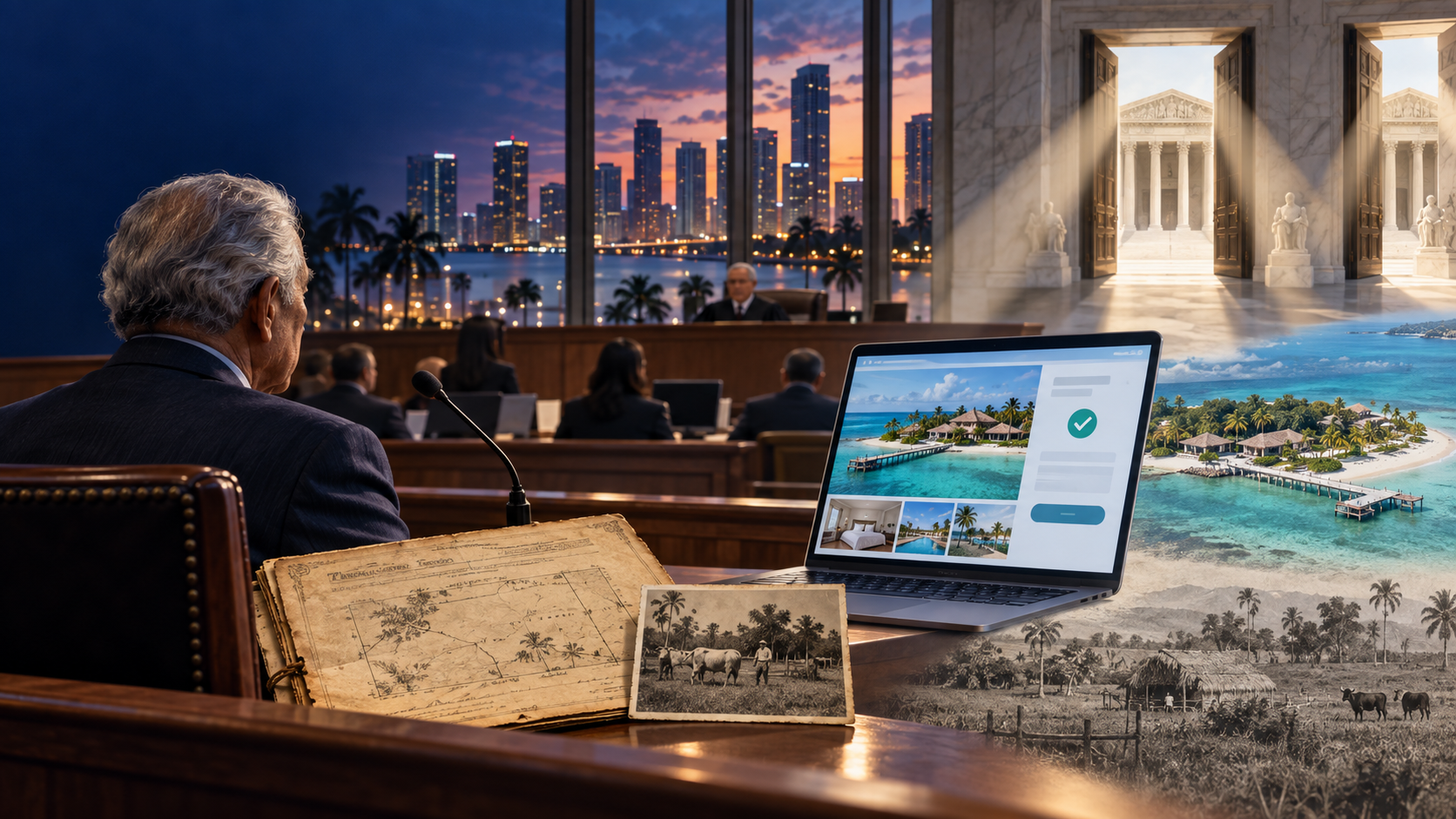
A Title III Trial in Miami Shows What the Supreme Court's Two Rulings Actually Unlocked
The short answer
A Helms-Burton Title III case went to trial in Miami federal court in late August 2026 against a travel booking company, over hotel reservations on Cuban land confiscated from the plaintiff's family in 1960. It is the second such trial against that defendant in eighteen months. This is what the Supreme Court's May and June decisions look like on the ground.
What happened
The New York Times reported that Mario Echevarria, now ninety-one, is seeking damages against Expedia Group for failing to obtain his permission when reserving rooms in hotels built on Cayo Coco, a cay off Cuba's north coast where his father ran a cattle and charcoal business before the property was confiscated in 1960. Asked at trial who had authorized the bookings, he testified that authorization came from "the dictatorship."
Expedia's position, as reported, is that the company believed it was acting lawfully. It entered Cuba in 2017, after the Obama administration issued rules permitting American hotel chains to operate there. The Times describes the case as one of a surge of claims by Cuban families over assets confiscated since 1959, and reports that dozens of such suits have been filed since the right to sue was restored in 2019.
Our take: the defendants are ordinary companies, and the defense is reliance
Two things about this case deserve attention from anyone assessing exposure.
The defendant profile. The public conversation about Helms-Burton tends to focus on the Cuban government and its state enterprises. The litigation does not. The defendants are American companies that made commercial decisions during a period of federal encouragement: cruise lines that docked in Havana, hotel operators, and now a travel booking platform that never touched Cuban soil at all. The alleged trafficking is the reservation, not the occupation.
The defense is reliance, and its strength is now the central question. Every one of these defendants entered Cuba under authorizations issued by the United States government during the 2016 to 2019 opening. Title III excludes uses of property "incident to lawful travel to Cuba," and the Supreme Court's May remand in the cruise line case put that exclusion squarely before the lower courts. How it is construed will do more to determine outcomes across this docket than either of the two decisions the Court has already issued.
The candid point is that reliance on a federal authorization is not obviously a defense to a private statutory claim. The authorization permitted the transaction under the sanctions regime. It did not purport to extinguish a private right of action Congress created in 1996 and left dormant. Defendants will argue the two cannot be squared. Plaintiffs will argue Congress wrote a specific exclusion and courts should not enlarge it. That is a genuinely open question, and a defendant who assumes the answer is favorable is making an expensive assumption.
Note also what a second trial against the same defendant in eighteen months tells you. These claims are not consolidating into a single global resolution. They are being tried family by family, property by property, which means the cost of defense is a function of the number of claimants rather than the number of properties.
What it means practically
If your company had commercial contact with Cuban property during or after the 2016 opening, the questions to answer now, before a demand letter arrives, are what property was involved, whether a certified claim exists against it, what federal authorization you relied on, and whether you can document that reliance contemporaneously. Certification matters because it drives treble damages, and documentation matters because the reliance defense is only as good as the record supporting it.
When to call a lawyer
Before responding to a Title III demand. These claims can carry enhanced damages, but not automatically. Under 22 U.S.C. 6082(a)(3), the enhanced measure applies where the claimant holds a claim certified by the Foreign Claims Settlement Commission, or where the claimant gave the statutory written notice at least 30 days before suit and the defendant continued trafficking after that period. Even then the statute trebles the value of the claim and adds the interest component rather than trebling the whole figure. Which route applies changes the exposure substantially, so establish it before pricing the demand.
Sources
Disclaimer
This post discusses publicly reported legal developments for general informational purposes. It is not legal advice, it does not create an attorney client relationship, and it does not reflect the firm's position in any pending matter. Outcomes depend on the specific facts and the governing law of the relevant jurisdiction.
UPDATE, September 10, 2026. This post was published while the trial described below was underway. The jury returned a verdict for Expedia on August 31, 2026. According to reporting on the verdict, the jury found that the claimants had not proved ownership of the confiscated land, and therefore never reached the defense that the bookings were incident to lawful travel authorized by the federal government. The significance of the outcome is that the case turned on proof of title rather than on whether booking hotel rooms constitutes trafficking. A claim certified by the Foreign Claims Settlement Commission is conclusive proof of ownership and amount by statute; an uncertified claimant must prove ownership of Cuban property as it stood in 1960. That evidentiary burden, rather than the merits of the trafficking theory, is what decided this case. The analysis below remains accurate as to the law; the reliance defense discussed in it is still undecided and is pending on remand in the cruise line litigation.

The Question the Supreme Court Did Not Answer Is the One That Decides the Cruise Line Cases
The short answer
When the Supreme Court decided the Havana Docks case in May, it resolved what counts as confiscated property and left three defenses undecided. The most important is whether use of confiscated property incident to lawful travel to Cuba is excluded from liability. That question is now before the Eleventh Circuit on remand, and it, not the Supreme Court's holding, will determine whether roughly $439 million in judgments is ever collected.
Why it comes up
Between 2016 and 2019, American companies entered Cuba under federal authorizations issued during a deliberate opening of relations. Cruise lines docked in Havana. Hotel and booking platforms sold rooms. Those authorizations are the entire factual predicate for the largest Title III cases now pending, and Congress wrote an exclusion into the statute for uses of property incident to lawful travel to Cuba.
What the Supreme Court did and did not decide
The Court held, 8 to 1, that Title III reaches the confiscated property itself and not merely the claimant's interest in it, so the expiration of Havana Docks' 1905 concession in 2004 did not defeat liability. Justice Thomas wrote for the Court. Justice Sotomayor concurred, joined by Justice Kavanaugh, flagging the arithmetic of a certified loss of roughly $9 million producing recoveries measured in the hundreds of millions. Justice Kagan dissented alone.
Justice Thomas expressly reserved the lawful travel question, noting that the cruise lines had argued their use of the docks fell within the exception for uses of property incident to lawful travel, and that the district court had rejected that argument based on the general ban against travel to Cuba for tourist activities. The judgment was vacated and the case remanded to the Eleventh Circuit. The Court's judgment issued June 22, 2026, and the record was returned to the Southern District of Florida on August 5, 2026.
Our take: this is the heart of the case now
Nearly everything else in the cruise line litigation has been decided against the defendants. The principal unresolved question is one of statutory construction that has never been resolved by an appellate court, and the stakes could not be more lopsided: if the exclusion applies, the judgments disappear entirely.
The competing readings are both serious.
The claimants' reading is that Congress wrote a narrow exclusion for travel, that a cruise line's commercial use of a pier is not travel by the cruise line, and that reading the exclusion broadly would let any company launder trafficking through a licensed travel program.
The defendants' reading is that the United States government affirmatively authorized precisely this conduct, that the exclusion exists to protect people and companies operating under those authorizations, and that imposing treble damages for doing what federal regulators permitted is not a result Congress intended.
Our own view is that the defendants have the better of the equities and the harder textual argument. The exclusion is written in terms of uses of property incident to lawful travel, and a cruise line docking to disembark authorized travelers is a plausible fit. But the district court has already rejected it once, and the Eleventh Circuit has not been notably receptive to Title III defendants this year.
Two other defenses also survive for the remand: whether the concession was nonexclusive and limited to cargo services, and other defenses not reached below.
What it means practically
If your company operated in Cuba during the 2016 to 2019 opening, preserve now, in an organized form, every federal authorization you relied on, every legal opinion you obtained, and the contemporaneous record showing what you understood the authorization to permit. That record is the reliance defense, and it is worth nothing if it cannot be produced.
When to call a lawyer
Before responding to a Title III demand, and before assuming that a federal authorization resolves the question. It has not been resolved.
Sources
● Havana Docks Corp. v. Royal Caribbean Cruises, Ltd., No. 24-983, Supreme Court docket
● Havana Docks Corp. v. Royal Caribbean Cruises, Ltd., opinion via Justia
Disclaimer
This post discusses publicly reported legal developments for general informational purposes. It is not legal advice, it does not create an attorney client relationship, and it does not reflect the firm's position in any pending matter. Outcomes depend on the specific facts and the governing law of the relevant jurisdiction.

Two Florida Restaurant Franchisees, Two Chapter 11 Filings, One Pattern Worth Understanding
The short answer
Two large Florida restaurant franchisees filed Chapter 11 in the Southern District of Florida within seven months of each other. Sailormen Inc., a Miami based Popeyes franchisee with 136 locations, filed January 15, 2026. Quality Fresca I, a Palm Beach based Moe's Southwest Grill franchisee, filed August 4, 2026. Neither case is unusual on its facts. Both illustrate how quickly a franchisee's Chapter 11 converts from a reorganization into a sale, and what that means for the landlords, vendors and franchisors left behind.
Why it comes up
Franchisee bankruptcies rarely stay reorganizations. A franchise agreement is an executory contract, and a franchisee's ability to assume its own franchise agreement is constrained in ways that a typical debtor's contract rights are not. That structural fact pushes distressed franchisees toward a sale of the going concern rather than a stand alone plan, and it pushes creditors toward a compressed timeline.
What happened
Sailormen. Court filings reported by Franchise Times put liabilities at $342 million against $232 million in assets, with BMO Bank owed $112 million in unpaid principal plus $17 million in interest and fees. Sailormen attributed its position in part to a failed 2023 sale of sixteen Georgia restaurants. By June, an auction had produced buyers for 97 of the 136 locations, and 52 had drawn no bidder. Nation's Restaurant News reported the results: Pulse Restaurant Group took 50 locations for $2.69 million, RFI Ventures 23 for $2.5 million, Popeyes corporate 16 Miami area locations for $9.6 million, 61 Biscuits three West Palm Beach locations for $1.11 million, and SBH Foods five in Savannah for $650,000. The USA Today Network reported that a June 27 order extended the list of locations to be vacated to 22, with a June 30 deadline, and quoted the debtor's filing that the unsold stores "now constitute a burden on the Debtor's estate."
Quality Fresca. The Real Deal reported the petition listed liabilities between $10 million and $50 million, assets between $1 million and $10 million, and 200 to 999 creditors. Approximately $16 million is owed to secured lender GR Loanco 1, which holds liens on all assets. Revenue was $58.9 million last year and $26.4 million through mid June. Among the first day motions was a request to reject the leases at sixteen closing locations retroactive to the filing date, affecting centers owned by Brixmor, Regency Centers, Publix and Benderson. Fast Company published the full closing list, fourteen in Florida plus one each in Virginia and Georgia.
Our take: the auction is the case
Read the two dockets together and the same shape appears. A first day motion rejects the leases at the locations nobody will buy. An auction runs on a short timeline. The going concern locations transfer. The unsold locations become rejection damages claims, and the landlords who held those leases move from collecting rent to standing in line as general unsecured creditors.
Two observations that follow, neither of which is obvious from the headlines.
First, the franchisor is a bidder, not a bystander. Popeyes corporate paid $9.6 million for sixteen Miami area locations, which is more than three of the four other buyers paid combined for far more units. A franchisor that wants to protect a market will buy into it, and that changes the auction dynamics for everyone else.
Second, insider affiliated purchasers are common and are not automatically improper. Nation's Restaurant News reported that Pulse Restaurant Group, which acquired 50 locations, was established by Sailormen's chief executive. That structure invites scrutiny under the Bankruptcy Code's provisions governing sales to insiders, and creditors who intend to object need to be organized before the bid procedures order, not after the auction.
What it means practically
● If you are a landlord, the window to protect yourself is the first day motions, not the claims bar date. Rejection is frequently sought retroactive to the petition date, which affects the administrative rent you can recover.
● If you are a vendor, examine payments received in the ninety days before filing. Preference exposure in these cases is real and it arrives long after the case appears to be over.
● If you are a franchisee considering a filing, understand before you file that your franchise agreement may not be yours to keep.
● If you are a franchisor, decide early whether you intend to consent to an assumption and assignment, because that decision drives the entire sale process.
When to call a lawyer
The moment a franchisee in your system stops paying, or the moment you receive a bankruptcy notice naming a tenant, customer or franchisee. Nearly every meaningful right in these cases is exercised in the first thirty days.
Sources
● Franchise Times, 136-unit Popeyes franchisee files for bankruptcy (January 16, 2026)
● The Real Deal, Moe's Southwest Grill franchisee bankruptcy to close stores (August 6, 2026)
● Fast Company, Moe's Southwest Grill closing locations, full list (August 10, 2026)
Disclaimer
This post discusses publicly reported legal developments for general informational purposes. It is not legal advice, it does not create an attorney client relationship, and it does not reflect the firm's position in any pending matter. Outcomes depend on the specific facts and the governing law of the relevant jurisdiction.