
This is Part 1 of a two-part series. Part 1 explains what current AI models can do with a large body of documents and why that matters in litigation and investigations. Part 2 is the practical guide: how to prepare the documents, how to work with a set too large for any single conversation with a model, how to verify what the model reports, and how to protect confidential and privileged material throughout.
The short answer
A famous unsolved mathematics problem, an anonymous sketchbook from 1808 and a large document production have one thing in common. Each involves far more material than a person can keep in mind, and AI models are now very good at that kind of problem.
In November 2026, a researcher working with an AI model released a proof of the Riemann Hypothesis, and independent checkers confirmed it the next day. In the same month, an AI model took 22 minutes to identify the anonymous artist of the sketchbook. A history professor had spent years on the same question without success. The model then told him where to find an unpublished diary that proved the answer.
The historian had a few clues, a large and scattered record, and a key document that looked ordinary until it was read alongside others. A document production presents the same problem, and so does an internal investigation.
Current AI models can do this kind of investigative work. A law firm that uses them will find the important documents sooner, will find connections that traditional review does not find, and can test a theory of the case in days instead of months. The lawyer must still verify the evidence and prove the case. Getting these results also takes preparation, because the model can only work with documents it can read and reach. Part 2 of this series explains how to do that.
This post describes what the model did with the sketchbook and why a person could not do it. It then compares the traditional review methods, works through an example in a trade secret dispute, identifies the kinds of matters where the capability helps most, and explains what the advantage is worth to a client.
What the model did
Mark Humphries, a history professor, published the account on November 24, 2026 in his newsletter, Generative History.
The puzzle. Yale's Beinecke Library holds an anonymous sketchbook of an 1808 canoe journey from Montreal to Fort William and back. It has 84 pages, 34 of them illustrated, and only three of the images are dated. Hundreds of canoes made that trip every year. In Humphries's words, the artist "could literally be any one of several thousand people." He had "spent many hours over the years trying to figure out who made the sketches with no luck."
The test and the answer. Humphries gave the images to GPT-6.2 Astra, an OpenAI model he was testing before release, along with one of his own articles as background, and asked it to identify the artist. After 22 minutes and 1 second, the model named Louis-Guy-Charles-Guillaume de Rohan-Chabot, vicomte de Chabot, a French aristocrat who was serving as a British Army officer in Canada in 1808.
The unknown source. The model then pointed to a journal Chabot kept on the trip. Its only published trace was one footnote in a 2014 University of Leeds doctoral thesis on aristocratic families who fled the French Revolution. The journal is on microfilm at Cleveland State University. Humphries writes that none of the fur-trade experts he consulted had given Chabot much thought, "if they've even heard of him."
The proof. Humphries ordered the microfilm. The handwriting matched. The itinerary "aligned perfectly with the dated drawings." In the entry for June 18, 1808, at Fort St. Joseph, Chabot wrote "I took a sketch" and described the view that appears in the sketchbook.
The model did three things in sequence. It formed a hypothesis from thin evidence, it located a source that could confirm or defeat the hypothesis, and it predicted what the source would say. The source then confirmed the prediction.
Why a person could not do this
Humphries explains why years of skilled effort failed. The connection ran through a diary entry about a Montreal dinner that had no apparent link to the sketchbook, and through an obscure letter written by someone else. A researcher would have had to read both, remember both, and connect them to the sketchbook. He calls that "exceedingly improbable" without luck.
The model did not depend on luck. Humphries writes that it worked "from both ends at once," forward from the few facts in the sketchbook and backward across the surviving record of 1808.
The advantage is not that the model skims quickly. It reads the entire record and can relate any part of it to any other part.
The result is not isolated
The same pattern has appeared this year in history, in mathematics and in criminal investigations.
History and archives
A second model reached the same answer. Humphries ran the same test on Anthropic's Fable 5.2. It also named Chabot, in about 35 minutes, although it did not find the diary. The identification therefore did not depend on one product or one fortunate run.
A Napoleonic cipher. Euronews reported on October 2, 2026 that Carter Church, an engineer at the security company SentinelOne, used OpenAI's GPT-6 Astra to decipher an encrypted 1809 military dispatch sent on Napoleon's orders to General Marmont. No full decipherment had been published in 217 years. Working from an image of the document, the model transcribed the symbols, analyzed the cipher, wrote its own code and checked the result against historical records in about six hours. Church published his tables and scripts so that others could reproduce the work, and he reports that a specialist in historical ciphers reviewed the solution and marked it solved.
Latin inscriptions. Google DeepMind's Aeneas model, published in Nature on July 23, 2025, was trained on more than 176,000 Latin inscriptions. It finds "parallels," meaning other inscriptions with similar wording or context, across that entire collection in seconds. Scholars of inscriptions have traditionally found parallels from memory. DeepMind reports that the 23 historians who tested the model did their best work when they used its suggestions.
Newton's sources. Historian Benjamin Breen reported on September 24, 2026 that a model worked through more than 5,000 files from the Hartlib archive. It found that Isaac Newton and Samuel Hartlib had each disguised the same ingredient with similar wordplay, and it found a marginal note in Hartlib's manuscript that names the ingredient. Breen calls this good, though preliminary, evidence that Hartlib's manuscript was one of Newton's sources.
Mathematics
On November 20, 2026, Anthropic researcher Levent Alpöge released a proof of the Riemann Hypothesis, one of the most famous unsolved problems in mathematics. He wrote, "I believe I have, working with Claude, discovered a proof." The proof is written in Lean, a language that lets a computer check each logical step, and runs to about 17 million lines.
The next day, the organizations that maintain Lean and its mathematics library stated that they have "full confidence that Alpöge's proof of the Riemann Hypothesis is correct." Dozens of people had compiled it, and several independent checking programs had accepted it. A full explanation for human readers is still being written.
Alpöge's account of how the proof was found is the part most relevant to lawyers. He says he chose the direction, and that Claude then supplied a key step and "far outpaced me near the finish line." He describes the argument as a descendant of a method from 1969 that had worked in a simpler setting, extended by combining established tools from across the field. His statement names more than two dozen of those tools and says the argument draws on "all of number theory." He also says he has not yet mastered some of the mathematics the model brought in. His timeline for the main steps runs from October 6 to November 16, 2026, about six weeks. By his account, the result depended on combining a very large number of existing results, more than he had mastered himself.
Investigations
According to a July 9, 2026 announcement by the software vendor CentralSquare, the Madison County Sheriff's Office in Illinois used the company's AI tool to review more than 2,000 pages of records in a 1993 killing. The company says the tool helped rebuild timelines, organize witness information and flag evidence for DNA testing. It says detective work, DNA evidence and genetic genealogy then identified a suspect, who later confessed. The company's own description is that the tool "is not a replacement for detective work."
In each of these examples, the record or the problem was too large for one person to keep in mind, the model worked with all of it, and the result was something no one had produced before. In each, the result also counted only after it was checked. A historian checked the microfilm, independent programs checked the proof, and detectives and a laboratory checked the leads.
What traditional review does well, and where it stops
Each established method solves a real problem. None was designed to do what the model did for Humphries.
Keyword search quickly finds documents that contain known names, terms and phrases. It finds only what someone already thought to search for, and it misses documents that use different words.
Document-by-document review applies human judgment to each document for relevance and privilege. Each reviewer sees a portion of the production, so a link between documents in two reviewers' batches is found only by chance.
Technology-assisted review learns from a lawyer's coding decisions and ranks or sorts the remaining documents by likely relevance, so far fewer need to be read by hand. It answers one question, whether a document resembles those already marked relevant, and it does not explain how documents relate to one another.
All three methods decide which documents to read. None of them reads the documents together and reports what they show in combination. The Chabot result came from that second kind of work.
The scale of that second kind of work explains why people cannot do it by hand. A production of 400,000 documents contains about 80 billion possible pairs of documents, before counting connections that run through three or four. A review team can examine only a small sample of those combinations. A model working through a well-built retrieval system can examine far more of them and return a short list of the connections worth a lawyer's time.
A worked example
The following dispute is invented to illustrate the point. It does not describe a real case or a real result.
A software company sues its former vice president of sales and the competitor that hired her, alleging that she took confidential customer pricing. The defendants produce 400,000 documents from fourteen custodians. The plaintiff's lawyers have a theory, that she planned the move for months and took the pricing with her, but no single document says so.
A team using traditional methods runs searches for the competitor's name, "pricing," and similar terms, and reviewers work through the results. They find her resignation letter, some emails about the job offer, and a large number of routine pricing emails.
A team using a capable model asks different questions, and the model answers them from the whole production.
The timeline. The model assembles every dated event involving the vice president from email, calendars, chat messages and file-access logs across all fourteen custodians. It reports that her first contact with the competitor was eleven weeks before she resigned, not three weeks as she stated in her interrogatory answers.
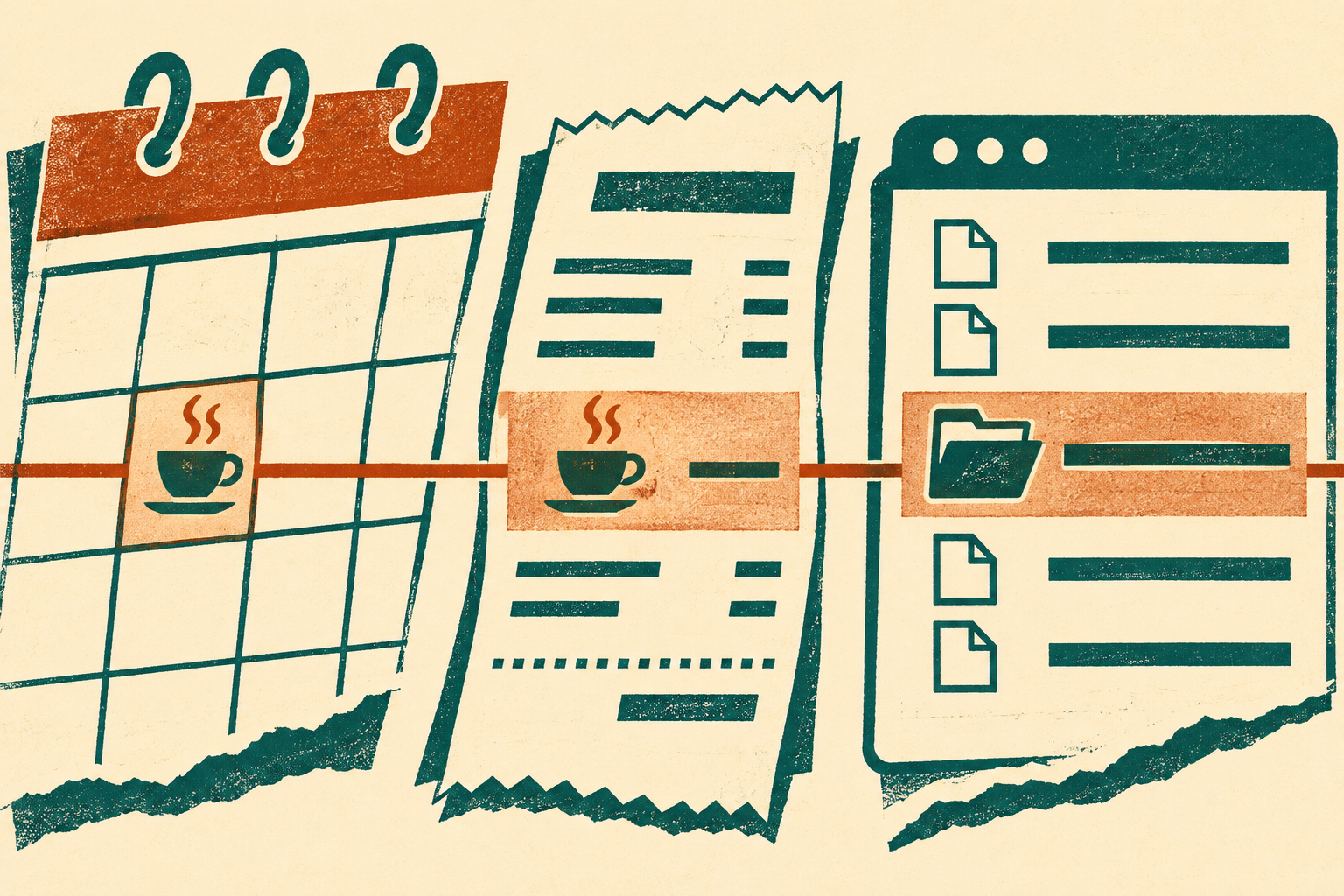
The document that looks ordinary. The model flags a calendar entry titled only "coffee," with no attendees listed. It matters for two reasons. A competitor employee's expense report, produced by a different custodian, records a coffee meeting at the same place and time. That evening, the vice president opened the master pricing file for the first time in six months.
Testimony compared to the record. She testified that she never discussed specific customers with the competitor before leaving. The model lists four messages in which she did, including one that names three accounts.
An unsigned document. The competitor produced an unsigned "market entry" memo that it says its own staff wrote. The model reports that the memo uses the vice president's distinctive abbreviations for customer tiers, which appear in her emails and in no one else's.
A source that was not produced. One message refers in passing to "the folder I shared from my personal drive." No personal cloud account was collected or produced. The lawyers now know to ask for it.
A test of the theory. The lawyers ask what documents should exist if she transferred the pricing file. The model answers that there should be an upload or an outgoing attachment within days of the file access. It then identifies an email to her personal address that evening with a large attachment that had been renamed.
A traditional team could find each of these items. Finding them would depend on the right reviewer reading the right two documents and remembering both. The model reads all of them together.
The example assumes two things that do not happen by themselves. First, every document must be readable by the model, which means scanned pages need accurate text recognition and attachments, calendars and logs need to be included. Second, 400,000 documents cannot be pasted into a conversation with a model, so the firm needs a system that lets the model search and retrieve from the whole production. Part 2 explains both.
Every item in this example is a lead. A lawyer must still open each document, confirm what it says, and decide what it proves. In this example the lawyers would do that before amending their requests, confronting the witness or moving to compel.
Where this capability helps most
The capability is most valuable when the record is large and spread across many people or systems. Productions with many custodians, long date ranges or several data types benefit the most.
It is also valuable when the key facts concern knowledge, timing or coordination, because questions about who knew what, and when, are answered by combining documents. The same is true when authorship or origin is disputed, since unsigned, anonymous or altered documents can be compared to known writing.
Two other situations favor it. When a lawyer suspects that a production is incomplete, the model can find references to people, accounts and files that were never produced, which are easy to miss in a document-by-document review. When time is short, as in injunction proceedings, expedited discovery and internal investigations, the side that understands the record first has the advantage.
The capability adds less where the dispute turns on a handful of documents that both sides already have, or on a purely legal question.
What the advantage is worth
Time. The model took 22 minutes on a question that had resisted years of effort. In litigation, that speed lets a lawyer know the case before the first deposition instead of learning it during the last one.
Completeness. The model reads the whole production, including the attachments, with the same attention on the last document as on the first. This depends on the quality of the underlying data, which Part 2 addresses.
Better questions. A lawyer who knows the record early drafts more precise requests, takes better depositions and identifies a deficient production while there is still time to move to compel.
Leverage for smaller teams. Large document cases have required large teams. A small team supervising a strong model can now cover a record that once required dozens of reviewers. How well a firm uses these tools matters more than its size.
Cost. Hours not spent on document-by-document review are hours the client does not pay for, or hours the team can spend on strategy, depositions and motions.
The reverse is also true. If an opponent uses these tools and you do not, the opponent will know your client's documents better than you do.
The models are improving
Humphries compares the moment to mathematics, where AI models began solving open research problems about eleven months earlier, and says historians are now in "a similar position." He describes a change from models that read and summarize to models that investigate, meaning that they pursue a question over a long period, use tools, follow leads and return with new information. The Napoleonic cipher took a model six hours of continuous work, and the Riemann Hypothesis proof runs to millions of lines.
Litigation depends on investigation, so each improvement in that capability directly improves what these tools can do for a case.
What comes next
The model produced a lead, and Humphries produced the proof. He ordered the microfilm, compared the handwriting and read the entry himself. Litigation requires the same division of work, and it adds a duty that a historian does not have, which is to keep the client's information confidential.
Part 2 of this series is the how-to guide. It begins with preparing the documents, including text recognition for scanned pages and the other steps that determine whether the model can read what was produced. It then explains how to work with large document sets, including the retrieval systems that let a model search a production far larger than it can read at once, and how to verify what a model proposes before relying on it.
Part 2 also covers confidentiality. It explains what to require of an AI provider before giving it client documents, how to handle material designated highly confidential, and when a firm should consider running a model on its own hardware.
This post is for general information and is not legal advice. The worked example is hypothetical.
Sources
Mark Humphries, "GPT 6.2 Astra Solves a Historical Mystery," Generative History (Nov. 24, 2026), https://generativehistory.substack.com/p/gpt-62-astra-solves-a-historical
Google DeepMind, "Aeneas transforms how historians connect the past" (July 23, 2025), https://deepmind.google/blog/aeneas-transforms-how-historians-connect-the-past/
Benjamin Breen, "AI labs need to start funding historical research," Res Obscura (Sept. 24, 2026), https://resobscura.substack.com/p/ai-labs-need-to-start-funding-historical
Pascale Davies, "AI decodes 217-year-old Napoleonic letter in 6 hours," Euronews (Oct. 2, 2026), https://www.euronews.com/2026/10/02/ai-decodes-217-year-old-napoleonic-letter-in-6-hours
Levent Alpöge, statement on the Riemann Hypothesis (Nov. 20, 2026), https://alpo.ge/remark.pdf
Lean community, "Lean verification of the Riemann Hypothesis" (Nov. 21, 2026), https://leanprover-community.github.io/blog/posts/riemann-hypothesis/
Michael Rubinstein, "Alpöge/Claude proof of the Generalized Riemann Hypothesis," University of Waterloo, https://www.math.uwaterloo.ca/~mrubinst/alpoge_claude_grh/
CentralSquare Technologies, press release (July 9, 2026), https://centralsquare.com/news-and-events/press/centerline-ai-solves-33-year-illinois-cold-case
"Unlocking the e-discovery TAR blackbox," Judicature (June 11, 2018), https://judicature.duke.edu/articles/unlocking-the-e-discovery-tar-blackbox/