
Hirzel Dreyfuss & Dempsey, PLLC
NEWS AND INFORMATION
Two Franchisees, Two Ways to Close a Restaurant, and the Decisions That Separate Them
The short answer
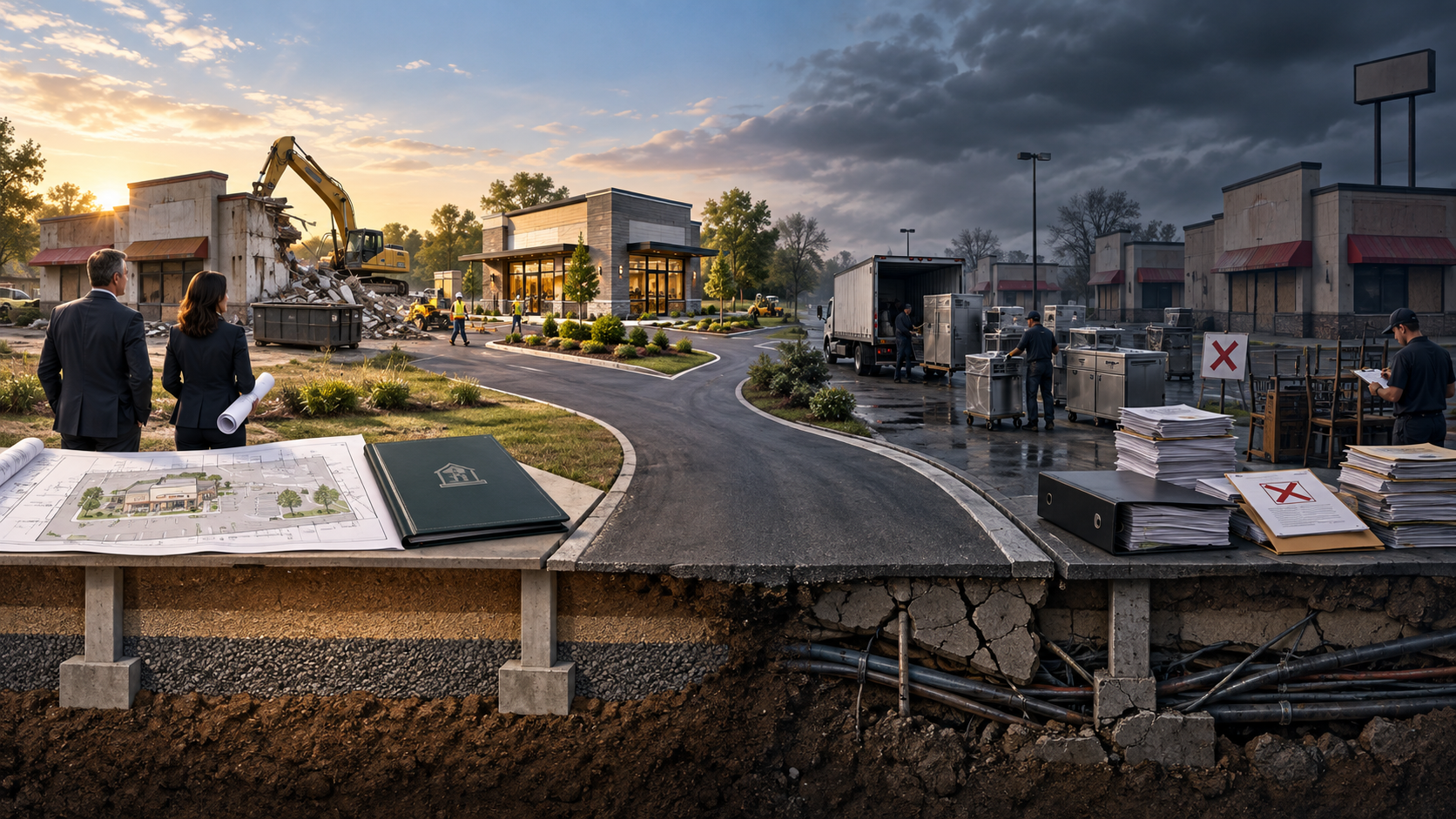
One multi-brand franchisee closes underperforming units on its own schedule, rebuilds on land it owns, and grows revenue by more than a third. Another files Chapter 11 and puts forty-nine of its sixty-five restaurants up for sale through a liquidation firm. Both are closing restaurants. Only one of them still controls the outcome, and the difference traces back to decisions about real estate, leases and defaults made long before either closure.
The operator that closed by choice
Franchise Times reported on August 28, 2026 on a Kansas-based operator that runs fifty-two Burger King and forty Denny's restaurants across two entities, with revenue up 34.3 percent since 2023 to $135 million.
The described strategy is unsentimental. The chief executive put it this way: "We're growing by adding locations and we're growing by getting rid of losers." The chief financial officer described closing or declining to renew locations that are not performing while opening replacements that do better. In 2024 the company tore down and rebuilt an aging Burger King on a site it had acquired, and sales improved more than 25 percent. This year it closed a location when the lease expired and is rebuilding on separate space it owns.
The financial officer identified the structural reason this works: owning the real estate means "you're not getting hit with increased rents on the properties you own like you do with the other ones." The operator owns much of the real estate under its more than ninety stores.
The operator that ran out of choices
On April 2, 2026, a franchisee operating sixty-five Carl's Jr. restaurants in California, together with five affiliates, filed Chapter 11 in the United States Bankruptcy Court for the Central District of California. Forty-nine of the sixty-five have been put up for sale, marketed by a firm that specializes in liquidations. Reporting attributes the distress in part to California's $20 fast food minimum wage, per a statement by the company's chief executive in a court filing.
The detail that matters most is buried in the filing. The company is in default under its franchise agreements at a number of locations for failure to timely pay rent, royalties and other required charges. Those defaults could result in termination of the franchise agreements, which would end the ability to operate and generate revenue at all.
Reporting also quotes a bankruptcy analysis for the proposition that even where a debtor is not assigning a franchise agreement, assumption without franchisor consent is barred in the Ninth Circuit, which gives franchisors substantial leverage over whether a distressed franchisee continues under existing agreements.
Our take: the franchise agreement is the asset, and it is the one you can lose fastest
Read the two stories together and the same variable appears in both.
Real estate ownership is the difference between a decision and an emergency. The healthy operator closes a location when a lease expires and rebuilds on land it owns. It is not negotiating with a landlord in distress, and its occupancy cost does not reset at renewal. The distressed operator is in default on rent, which is what put its franchise agreements at risk. Two operators facing the same cost environment ended in different places largely because one controls its occupancy cost and the other does not.
A franchise default is faster and more dangerous than a lease default. A landlord that is not paid must generally evict, which takes time and produces a claim. A franchisor that is not paid can terminate, and termination ends the business rather than the tenancy. Once bankruptcy is filed, the franchisee's ability to keep the agreement is constrained in ways an ordinary contract is not. The Ninth Circuit position described in the reporting means the franchisor's consent may be required even to keep an agreement the franchisee is not trying to sell.
Closing units is not itself a distress signal, and closing them late is. The healthiest operator in these two stories closed more locations by choice than many struggling ones close under pressure. The failure mode is not the closure, it is subsidizing an underperforming location out of the cash flow of the good ones until there is no cushion left. The operating discipline and the balance sheet are the same subject.
We would add a candid caveat about the minimum wage explanation. A wage increase applies to every operator in the state, and many of them did not file. It is a real cost pressure and it is rarely the whole story. The default on rent and royalties is the more proximate cause of the loss of control, and it is the part a franchisee can actually manage.
What it means practically
If you are a franchisee: know which of your locations lose money and what each one costs to exit. Model lease expirations against unit economics so that closures happen at renewal rather than in default. Understand that missing rent and missing royalties are not the same kind of problem, because only one of them can terminate the business. If a franchise agreement default notice arrives, the cure period is the last point at which you control the outcome.
If you are a franchisor: the reporting shows both sides of the leverage. Consent rights are real and enforceable, and they are worth exercising deliberately rather than reflexively, because a terminated agreement produces a dark location and a rejection damages claim rather than an operating royalty stream.
If you are a landlord to a franchisee: the franchisor's consent rights can determine whether your tenant survives, and you may have no seat at that table.
When to call a lawyer
Before signing or renewing a lease at a marginal location, on the first missed royalty payment, and immediately on receiving a default or termination notice under a franchise agreement.
Sources
Disclaimer
This post discusses publicly reported legal developments for general informational purposes. It is not legal advice, it does not create an attorney client relationship, and it does not reflect the firm's position in any pending matter. Outcomes depend on the specific facts and the governing law of the relevant jurisdiction.
The American Franchise Act Clears Committee, and the Vote Tells You More Than the Bill Does
The short answer
A bill that would fix the federal joint employer standard for franchising cleared the House Committee on Education and Workforce on July 23, 2026, by a vote of 18 to 15. It now goes to the House floor. Franchisors should not change anything yet, because a bill out of committee is not law, and because the vote itself suggests the durable fix the industry wants may not arrive on this pass.
Why it comes up
The joint employer question is the single largest unresolved liability exposure in franchising. It asks when a franchisor becomes legally responsible for the employment decisions of an independent franchisee, and therefore exposed to that franchisee's wage and hour claims, discrimination claims and union obligations. According to Franchise Times, the standard has changed four times in thirteen years, moving with each change in presidential administration. The 2023 rule was struck down in federal court, and the National Labor Relations Board reaffirmed the 2020 standard in February 2024.
That instability is the actual problem. A franchisor cannot build a brand standards program around a test that changes every few years.
What the bill does
The American Franchise Act, H.R. 5267, would codify a control-based test. As reported, a franchisor would be a joint employer only if it "possesses and exercises substantial, direct and immediate control" over essential terms of employment, which the bill identifies as wages, benefits, hours, hiring, discipline, supervision and direction.
Two amendments offered by ranking member Bobby Scott failed, each by 15 to 18. One would have preserved the Board's ability to consider indirect control. The other would have given franchisees a right of action against franchisors. Representatives James Moylan and Virginia Foxx spoke in support of the bill. Representative Scott said it would "radically rewrite" the law and "severely curtail workers' ability to enforce their rights." The International Franchise Association, the American Association of Franchisees and Dealers, and the Coalition of Franchisee Associations support the bill.
Our take: read the vote, not the co-sponsor list
The bill was introduced in September 2025 by Representative Kevin Hern with six Republican and seven Democratic sponsors, and it now carries 142 co-sponsors. That is a genuinely bipartisan face. But the committee vote was straight party line, and both minority amendments failed on the same party line split.
That gap matters, and it is the part of this story worth a franchisor's attention. A statute enacted on a party line vote is a statute that a future Congress can repeal on a party line vote. The industry's complaint is not that the current standard is wrong. The complaint is that the standard keeps moving. A narrowly partisan enactment addresses the first problem and leaves the second one intact.
What it means practically
Nothing about a franchisor's operating posture should change on the strength of a committee vote. The operative standard today remains the Board's 2020 standard, and the practical protections remain the ones a franchisor builds itself:
● Reserve authority over brand standards, which protect the trademark and the customer experience. Recipes, approved vendors, hours of operation and system specifications are ordinarily defensible.
● Leave hiring, scheduling, supervision, discipline and compensation with the franchisee, in the franchise agreement and, more importantly, in actual practice. Courts look at what a franchisor does, not only at what the agreement says it may do.
● Audit the gap between the two. The exposure in most systems is not in the agreement. It is in the field consultant who tells a franchisee to fire someone.
When to call a lawyer
Before a system-wide rollout of any program that touches franchisee personnel practices, and immediately upon service of any charge or complaint naming both the franchisor and a franchisee as joint employers. The pleading stage is where the joint employer question is usually won or lost.
Sources
Disclaimer
This post discusses publicly reported legal developments for general informational purposes. It is not legal advice, it does not create an attorney client relationship, and it does not reflect the firm's position in any pending matter. Outcomes depend on the specific facts and the governing law of the relevant jurisdiction.
A Franchisee Says the Franchisor's Mandatory AI Cost It $100 Million. The Claim Is About Contract, Not Technology.
The short answer
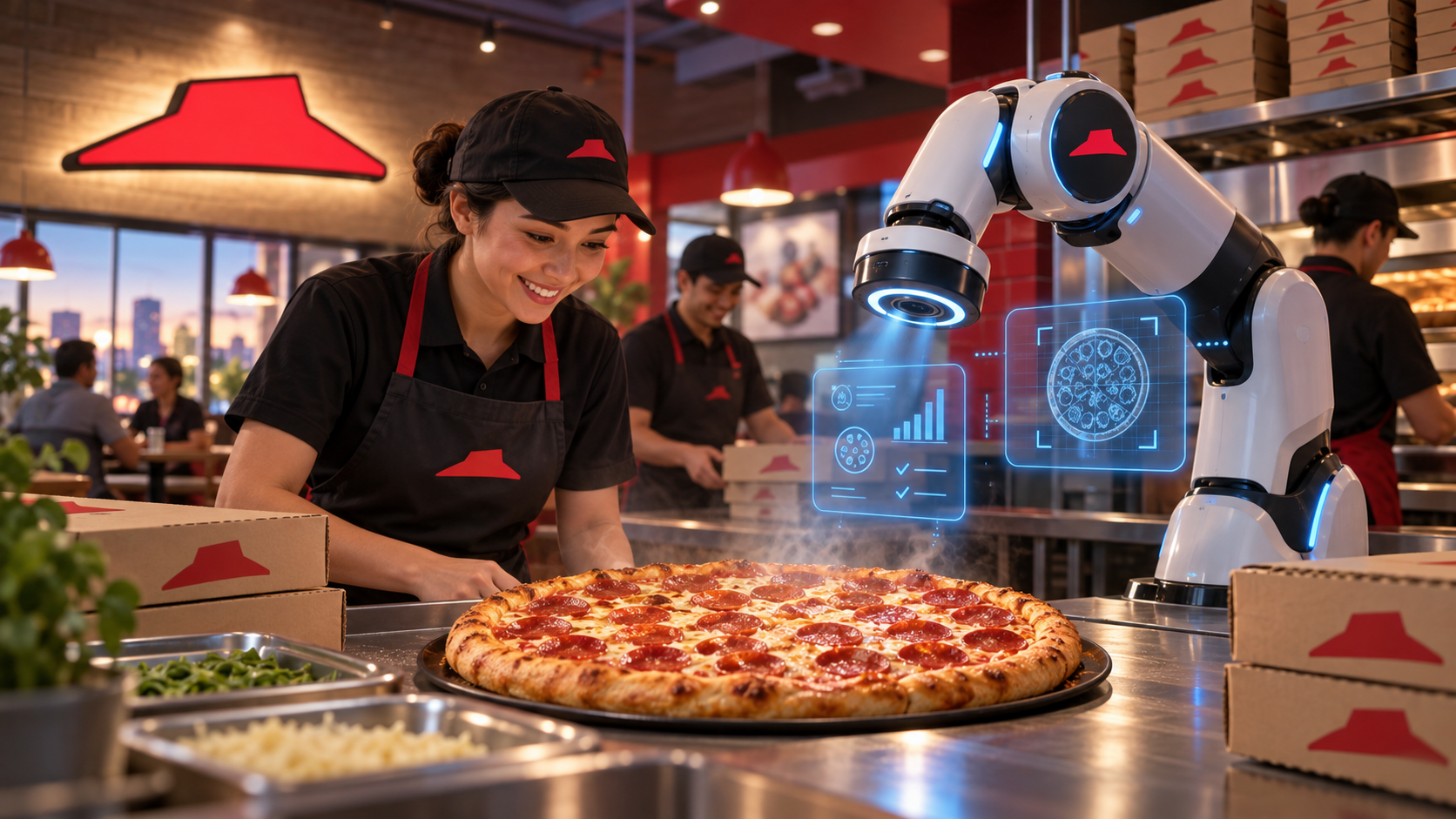
A Pizza Hut franchisee operating approximately 111 restaurants filed suit on May 6, 2026, in the Texas Business Court, alleging that a delivery management platform the franchisor required it to adopt destroyed its delivery performance and more than $100 million in business value. The legal theory is ordinary breach of the franchise agreement. The fact pattern is not, and it is going to recur.
Why it comes up
Franchise agreements routinely give the franchisor authority to specify required systems and technology. That authority was uncontroversial when it meant a point of sale terminal. It is considerably less so when it means an algorithmic system that reorders how the franchisee's business actually runs, and when the franchisee bears the entire economic consequence of a decision it did not make.
What is alleged
Chaac Pizza Northeast operates roughly 111 Pizza Hut restaurants across New York, New Jersey, Maryland, Washington D.C. and Pennsylvania. As reported by Business Insider, the complaint alleges that before the rollout more than ninety percent of its deliveries arrived within thirty minutes, with double digit sales growth and guest satisfaction above system averages.
The franchisee alleges that the Dragontail platform gave DoorDash drivers real time visibility into kitchen workflows and order timing, including when pizzas would come out of the oven. Drivers responded, according to the complaint, by waiting "up to fifteen (15) minutes" to batch additional orders rather than departing with a completed one. The complaint is also reported to allege that drivers could see tip amounts and whether an order was cash, making them selective about which deliveries to accept. In the New York City market, year over year sales growth is alleged to have moved from positive 10.19 percent to negative 9.78 percent.
The pleaded theory, as reported, is that the franchisor breached the franchise agreement by mandating continued use of the software while failing to exercise "reasonable business judgment" or to modify the system to accommodate the franchisee's reliance on third party delivery drivers. A Pizza Hut spokesperson said the company was reviewing the claims and would respond "through the appropriate legal channels."
Our take: this is a mandated systems case, and the AI is incidental
Strip out the word artificial intelligence and what remains is a claim that has existed in franchise law for decades. A franchisor exercised a contractual right to require a system. The system did not work for this franchisee's operating model. The franchisee absorbed the loss. The question is whether the franchisor's exercise of that reserved discretion was subject to any standard at all.
That question, not the technology, is where the case will be decided. Most franchise agreements grant technology mandates in broad, unqualified language. Franchisees will argue that the implied covenant of good faith and fair dealing constrains how that discretion is exercised. Franchisors will argue that an express, unqualified grant of discretion cannot be narrowed by an implied covenant. Courts have gone both ways on that proposition, and the answer is heavily dependent on the governing law the agreement selects.
The genuinely novel element is the causal chain. The system did not fail. It worked as designed, and the harm came from how a third party, the delivery driver, responded to the information the system disclosed to him. Proving that chain requires system wide data, and a franchisee alleging it will need comparative performance evidence across the system that only the franchisor possesses. Expect the real fight to be about discovery.
We should be candid about the weaknesses. Correlation between the rollout and the sales decline is not causation, and 2024 through 2026 was a difficult period for the brand generally. Business Insider reported that Yum! Brands has been exploring strategic options for Pizza Hut after consecutive quarters of declining same store sales, and announced plans to close 250 U.S. locations in the first half of the year. The franchisor will point at that record, and it is a serious defense.
What it means practically
For franchisees, before a mandated technology rollout: document baseline performance, put objections in writing at the time and not in hindsight, and preserve the operating data. A performance claim two years later is only as good as the contemporaneous record.
For franchisors: an unqualified mandate right is not the same as an unqualified mandate. Pilot the system, document that you evaluated operating models that differ from the norm, and respond in writing when a franchisee reports degradation. The reported allegation that the franchisor "refused requests for support" and "ignored worsening delivery metrics" is the allegation that turns a contract dispute into a damages case.
When to call a lawyer
Before you sign an amendment adopting a new required system, and at the first documented sign that a mandated system is degrading your operations. Not after a year of losses.
Sources
● Business Insider, Pizza Hut faces lawsuit from franchisee over AI system (May 2026)
● PMQ Pizza Magazine, Disgruntled franchisee slaps Pizza Hut with $100 million lawsuit (May 21, 2026)
● L'Express Franchise, Pizza Hut franchisee sues for $100 million (May 28, 2026)
Related coverage: this dispute sits inside a broader pattern of franchise-system control litigation, including how franchisors’ earnings claims are regulated and how territorial protections are tested in court.
Disclaimer
This post discusses publicly reported legal developments for general informational purposes. It is not legal advice, it does not create an attorney client relationship, and it does not reflect the firm's position in any pending matter. Outcomes depend on the specific facts and the governing law of the relevant jurisdiction.

When a Franchisor's Earnings Claims Cross the Line
The short answer
A franchisor may tell you what its units earn in exactly one place: Item 19 of the Franchise Disclosure Document. Making the disclosure is optional, and many franchisors make none. If a salesperson, a broker, a webinar, or a spreadsheet gave you numbers that are not in Item 19, that is a violation of federal law, and it is a violation whether or not the numbers were accurate.
Why it comes up
Nobody buys a franchise without forming a view of what it will earn. If Item 19 is blank, that view came from somewhere. It came from a conversation, a pro forma emailed during diligence, a figure mentioned at discovery day, or a bank loan projection someone helped prepare.
Franchisors know this, which is why their FDDs say no one is authorized to make such representations. Whether that disclaimer protects them is the whole question.
What the rule requires
Under 16 C.F.R. 436.9(c), it is an unfair or deceptive act to disseminate any financial performance representation unless the franchisor has a reasonable basis and written substantiation for it at the time it is made, and the representation is included in Item 19. Three independent conditions. Subject to the two narrow exceptions noted below, a representation can be perfectly accurate and still unlawful because it is not in Item 19.
Section 436.9(a) separately prohibits making any claim or representation, orally, visually, or in writing, that contradicts information required to be disclosed. Note "orally" and "visually." That reaches sales conversations, slide decks, and webinars.
Section 436.9(d) requires the franchisor to make written substantiation available to prospects on reasonable request, and to the FTC.
If a franchisor does make an Item 19 disclosure, it must state whether the figures are historical performance or a forecast; for historical data, disclose the date range, the number of outlets included, the total number of outlets, the number and percentage that actually attained or surpassed the stated results, and the material characteristics of the measured outlets that may differ from the outlet being offered to you. That last requirement is what exposes cherry-picking. A franchisor may lawfully report only its top quartile, but it must tell you that is what it did, how many units are in the group, and how many hit the number.
If it makes none, Item 19 must contain prescribed language stating that the franchisor does not make representations about future financial performance or past performance of its outlets, does not authorize its employees or representatives to make such representations orally or in writing, and that if you receive any other financial performance information or projections of your future income, you should report it to the franchisor's management, the FTC, and the appropriate state regulator.
Read that last sentence again. The FDD itself tells you what to do if someone gives you numbers outside Item 19.
The prohibitions run to the "franchise seller," not only the franchisor, and the FTC's guidance treats a broker under contract with the franchisor and compensated on sales as within that definition. A broker's oral projection is squarely covered.
How to read an Item 19 number, against Items 20 and 21
An Item 19 figure in isolation is close to meaningless, because the disclosure reports revenue far more often than profit, and because the outlets behind it may look nothing like yours. Three questions make it readable.
Ask what the number measures. Average unit volume is gross sales. It says nothing about food cost, labor, rent, royalty, advertising contribution, debt service, or what the owner takes home. A system can report a strong average unit volume and still have unprofitable units.
Ask which outlets are in it. The Rule requires disclosure of the subset. Read it. A figure drawn from mature company-operated locations in dense markets tells a prospective owner-operator of a new suburban unit very little.
Ask how many hit the number. The Rule requires the percentage that attained or surpassed the stated result. If forty percent of the reported group hit an average, the average is being carried by the top of the distribution.
Then read Item 20. It gives outlet counts by state for three years, including terminations, non-renewals, reacquisitions and closures. A system reporting healthy averages while churning units is telling you two different things, and the turnover table is the more reliable one. Item 20 also carries the contact list for franchisees who left the system in the last fiscal year. Those are the people with no incentive to sell you anything.
And read Item 21. Audited financial statements. The FTC poses the diagnostic question directly: does the franchisor make more of its income from royalties paid by successful existing franchisees, or from selling franchises to new prospects?
What an unlawful earnings claim looks like
The FTC's own enforcement complaints supply the taxonomy. In its case against a burger franchisor, the agency pleaded a stand-alone count for dissemination of financial performance representations not included in the FDD, alleging that the defendants made verbal representations about the financial performance of existing locations and prospective franchisees' likely performance, including estimates for weekly or monthly sales figures and break-even points, and that they not only failed to include those in Item 19 but contradicted them by stating in the FDD that no such representations had been made.
That pattern, oral numbers plus a "no representations" Item 19, is the classic fact pattern. The others look like this: spreadsheets, pro formas, or loan projection templates handed over outside the FDD; "you'll make X in year one" or "most of our owners clear six figures"; and claims on the franchisor's website, on franchise broker portals, in webinars, on discovery day slides, or on social media.
In FTC v. Minuteman Press, 53 F. Supp. 2d 248 (E.D.N.Y. 1998), a franchisor's sales force told prospects specific expected monthly gross sales and profit figures while the offering circular disclaimed earnings claims. The court found gross sales claims made without contemporaneous substantiating documentation, and reasoned from the common-sense net impression prospects received rather than from the written disclaimer.
Our take: you cannot sue under the Franchise Rule, and that changes everything
There is no private right of action to enforce the FTC Franchise Rule. Courts have said so consistently, and the FTC said so itself in the Federal Register when it adopted the amended rule. A franchisee cannot walk into court with a Rule violation as a cause of action.
What the Rule supplies is the standard. The claim travels through other vehicles.
State franchise investment statutes, in the registration states, create private remedies for untrue statements of material fact and material omissions in connection with the offer or sale of a franchise.
State deceptive trade practices statutes. In Florida, FDUTPA is the vehicle, and courts have litigated 16 C.F.R. 436.9 through it. Florida's own section 817.416 separately makes it unlawful to intentionally misrepresent the prospects or chances for success of a franchise, with a remedy of all moneys invested plus costs and, at the court's discretion, fees. For a Florida franchisee, that statute is frequently the strongest claim available, and our post on franchisee rights in Florida covers it.
Common-law fraud and negligent misrepresentation, where the fight is usually about reliance.
The disclaimer, integration clause, and questionnaire are the battleground. The franchisor's standard package is an Item 19 disclaiming representations, an integration clause, an express non-reliance representation, and a pre-closing compliance questionnaire in which the buyer certifies that nobody said anything about sales, costs, income, or profits. The purpose is to convert a later fraud claim into an unreasonable-reliance loser.
Courts split on whether it works, and the split runs along state lines more than along facts. In Hetrick v. Ideal Image Development Corp., 758 F. Supp. 2d 1220 (M.D. Fla. 2010), franchisees had signed a compliance questionnaire certifying that no agent made revenue statements, and the disclosure document said the franchisor did not authorize salespersons to furnish information concerning actual or potential sales, costs, income, or profits. A jury nonetheless found the franchisees were not precluded from relying on the statements despite their certifications, and the court granted summary judgment against the franchisor's affirmative defense premised on the questionnaire.
In Teng Moua v. Jani-King of Minnesota, Inc., 810 F. Supp. 2d 882 (D. Minn. 2011), the court reached the opposite result, holding it unreasonable as a matter of law to rely on a representation completely contradicted by the terms of a written agreement, and giving effect to an acknowledgment form on which a plaintiff had written "none" in answer to whether any representations about sales, income, or profit levels had been made.
Some states have removed the question from the courts. California voids as contrary to public policy any provision disclaiming representations made to a prospective franchisee or disclaiming reliance on them. Washington and New York require addendum language providing that no questionnaire or acknowledgment signed at the commencement of the relationship waives claims under state franchise law, including fraud in the inducement, or disclaims reliance on statements by the franchisor.
Florida has no such statute, which is why the Florida answer depends on a fact-bound reliance analysis rather than on a legislative rule. Hetrick is a Florida decision and it is a good outcome for franchisees, but it is a district court decision resolving a specific record, not a rule.
One note on federal law's limit here. Section 436.9(h) prohibits requiring a prospect to waive reliance on any representation made in the disclosure document. By its terms that protects reliance on the FDD. It does not, on its face, reach a questionnaire aimed at oral statements made outside the FDD. That textual gap is exactly what the California, Washington, and New York provisions close, and exactly what Florida leaves open.
What it means practically
Write it down before you sign. Every specific number, who gave it, when, and in what form. Keep the emails and the attachments. A contemporaneous record is the difference between a claim and a recollection.
Ask for the substantiation. If a franchisor makes an Item 19 claim, section 436.9(d) requires it to make written substantiation available on reasonable request. Making that request, in writing, is free and highly informative.
If you were given numbers that are not in Item 19, say so in writing before you sign the compliance questionnaire, rather than certifying that nothing was said. That single step preserves more than any argument made afterward.
And note what the FDD itself tells you to do: report earnings information received outside Item 19 to the franchisor's management, the FTC, and the state regulator. The same prescribed legend carries one carve-out worth knowing: if you are purchasing an existing outlet, the franchisor may give you the actual records of that outlet. Section 436.5(s)(4) and (5) set out that exception and a second one for a written supplemental representation about a particular location or variation. The FTC's 2024 policy statement makes clear that contract terms prohibiting franchisees from reporting potential law violations to the government are unfair, unenforceable, and illegal.
When to call a lawyer
Before you sign the compliance questionnaire, if numbers were given to you that are not in Item 19. Afterward, promptly, because limitations periods run from events that are easy to misdate.
Why this is not a do-it-yourself problem
The violation is easy to identify and hard to convert into a recovery. There is no federal claim, so the case has to be built under a state statute or a common-law theory, each with different elements, different damages measures, and, in Florida, different fee exposure, one of which runs both ways. Layered on top is a signed questionnaire certifying that the very conversation you are describing never happened, and whether that certification defeats you is a state-specific question that courts have answered both ways on similar facts. The single most valuable thing anyone can do about an improper earnings claim happens before signing, which is why this is a post about diligence rather than about litigation.
Talk to us
HDD Law Firm represents franchisees and franchisors in disputes involving disclosure, misrepresentation, and the sale of franchises, in the Florida state courts, the Southern, Middle and Northern Districts of Florida, and the Eleventh Circuit. If you were given earnings figures that do not appear in Item 19, contact us to discuss your matter.
Sources
● 16 C.F.R. 436.9, Additional prohibitions (eCFR)
● 16 C.F.R. 436.5, Contents of the disclosure document, including Item 19 (eCFR)
● FTC, Franchise Rule Compliance Guide
● FTC, Amended Franchise Rule FAQs
● FTC, Issue Spotlight: Risks to Small Business Success in Franchising (2024)
● FTC, Policy Statement on Franchisors' Use of Contract Provisions (July 2024)
● United States v. Burgerim Group USA, Inc., Complaint (C.D. Cal. 2022)
● FTC v. Minuteman Press, 53 F. Supp. 2d 248 (E.D.N.Y. 1998) (CourtListener)
● Hetrick v. Ideal Image Development Corp., 758 F. Supp. 2d 1220 (M.D. Fla. 2010) (CourtListener)
● Teng Moua v. Jani-King of Minnesota, Inc., 810 F. Supp. 2d 882 (D. Minn. 2011) (CourtListener)
● A Love of Food I, LLC v. Maoz Vegetarian USA, Inc., 70 F. Supp. 3d 376 (D.D.C. 2014) (CourtListener)
● Fla. Stat. 817.416, Franchises and distributorships; misrepresentations
● California DFPI, What's New in 2023 for Franchisors (AB 676)
● FTC, A Consumer’s Guide to Buying a Franchise
Disclaimer
This post discusses publicly reported legal developments for general informational purposes. It is not legal advice, it does not create an attorney client relationship, and it does not reflect the firm’s position in any pending matter. Outcomes depend on the specific facts and the governing law of the relevant jurisdiction.
Related coverage: earnings-claims disputes sit inside a broader pattern of franchise-system control litigation, including how mandated technology systems shift risk to franchisees and how territorial protections are tested in court.

Your Territory Was Drafted for One Brand. What Happens When the Franchisor Opens Two?
The short answer
One of the largest operators in a national restaurant system sued its franchisor in March 2026, alleging that the franchisor authorized co-branded restaurants combining two of its brands inside the operator's protected development territories. It is the clearest test yet of a question every legacy franchise agreement left unanswered: whether a hybrid unit is the brand your territory protects, or a different brand entirely.
Why it comes up
Territorial protection is the franchisee's core bargain. The development agreement says the franchisor will not open, or authorize another franchisee to open, a unit of the brand within a defined area. That language was drafted when a restaurant was one restaurant.
Franchisors under pressure to grow have turned to dual branding, putting two concepts under one roof. From the franchisor's side that is a new format. From the franchisee's side it is a competing location with the protected brand's sign on it.
What is alleged
The operator entities, affiliated with a large multi-brand restaurant company, filed suit on March 19, 2026, in the United States District Court for the District of Kansas, and amended the complaint on April 17. The defendants are the franchisor and its parent.
Plaintiffs allege the franchisor "secretly plotted over the last two years" to authorize dual-branded units inside their exclusive Dallas and Houston development territories, pointing to a location that opened in February and additional locations planned in three counties. They seek a declaration that the development agreements remain valid, an injunction against further openings and against termination, and damages.
The franchisor's reported position is that the development agreements were already terminated for failure to open and for improper closures, and it has separately objected to the operator's acquisition of another restaurant chain as a breach of a competitive activity provision.
Our take: the counter-theory is the tell
The encroachment question is genuinely open, and the answer will turn on the specific words of the specific agreement rather than on any general principle. If the protected right is defined by reference to a named brand, a unit bearing that brand's name is within it regardless of what else is under the roof. If the protection is defined by reference to a standard unit format or a defined restaurant type, the franchisor has a real argument that a hybrid is neither.
What is more instructive for a franchisee reading this is the shape of the franchisor's response. The reported defense is not primarily that dual branding is permitted. It is that the development agreements were terminated for the franchisee's own breaches, and that the franchisee independently breached a competitive activity restriction by acquiring another chain.
That is the standard pattern when a large operator pushes back on a franchisor, and franchisees should plan for it. A system that wants to defeat an encroachment claim will look for every default in the file: unmet development schedules, closures taken without consent, transfers, competing investments, late reports. Most large operators have some of these, because most development schedules are aspirational and most operators own other things.
Two practical consequences.
Before asserting an encroachment claim, audit your own compliance. The franchisor will. A development schedule that was quietly missed three years ago becomes the centerpiece of the franchisor's answer.
Read the competitive activity clause before you buy anything. A multi-unit operator acquiring a second concept may be creating the defense to its own future claim.
For franchisors, the drafting lesson is prospective and simple: define the protected right in terms broad enough to cover formats that do not exist yet, or expect to litigate whether they are covered.
When to call a lawyer
Before a franchisor opens anything inside your territory, and before you acquire an interest in a competing concept.
Why this is not a do-it-yourself problem
Encroachment claims are won and lost on the specific words of a specific territorial provision, read against a system's actual development history. That analysis requires reading the development agreement, the franchise agreements, the amendments and the correspondence together, and it requires anticipating the defaults the franchisor will assert in response. A franchisee who raises the claim without that preparation hands the franchisor the opening move. A franchisor drafting a new form needs the same analysis run forward, against formats that do not exist yet.
Talk to us
This firm represents franchisees and franchisors in territorial, encroachment, termination and development agreement disputes across the country. If a franchisor is opening inside your protected area, or you are evaluating a new format against your existing agreements, contact us to request a free consultation.
Sources
● Restaurant Dive, Applebee's dual-branding exclusivity lawsuit
● Restaurant Business, Applebee's sued by franchisee over co-branded restaurants
Related coverage: this dispute sits inside a broader pattern of franchise-system control litigation, including how mandated technology systems shift risk to franchisees and how franchisors’ earnings claims are regulated.
Disclaimer
This post discusses publicly reported legal developments for general informational purposes. It is not legal advice, it does not create an attorney client relationship, and it does not reflect the firm's position in any pending matter. Outcomes depend on the specific facts and the governing law of the relevant jurisdiction.

You Received a Notice of Default. Here Is What Happens Next.
The short answer
A notice of default starts a clock, defines the dispute, and represents the last point at which the outcome is fully within your control. What you do in the first few days matters far more than what you do in the following few months. The most common response, a letter explaining why the franchisor is wrong, is the one response that accomplishes nothing.
Why it comes up
The notice arrives in the middle of an ordinary week. It cites contract sections, states a deadline, and reads like the opening move in a negotiation. It is not. In most systems it is a procedural prerequisite the franchisor is completing in order to terminate, and the deadline in it is real.
What the notice should contain, and why that matters to you
Where a state statute applies, the recurring requirement is that the notice state all of the reasons. Minnesota requires written notice setting forth all the reasons at least 90 days in advance. New Jersey requires the same at least 60 days in advance. Wisconsin requires that the notice state all the reasons, gives 60 days to rectify, and provides that if the deficiency is rectified within 60 days, the notice is void.
Two consequences follow, and both favor the franchisee.
A franchisor that omits a ground from the notice may be barred from relying on it later. The notice defines the battlefield.
And curing everything actually listed can void the notice outright. That is what Wisconsin says by statute, and most contractual cure provisions are structured the same way.
A well-drafted notice will identify the specific contract sections breached, the specific facts constituting each breach, the cure period and the exact cure deadline, precisely what cure requires, and the consequence of failing to cure. If yours does not, that is worth noting, though courts have been relatively forgiving of technical defects in notices and franchisors have been permitted to correct deficient ones.
Where the default is classified as non-curable, the document you received is a termination notice, not a default notice, and the analysis in our post on franchise defaults and terminations applies immediately.
Our take: five things to do in the first week
Read the notice against the contract, not against the facts. The first question is not whether the franchisor is right. It is what the cited sections say, whether the alleged breach is classified as curable or non-curable in Item 17, and what the cure period is. Everything else follows from those three answers.
Calendar the deadline the day the notice arrives, and check the notice provision. Whether a mailed notice is effective on deposit or on receipt can move the cure deadline by days. The notice article of the agreement controls, not intuition. So does the list of who must be copied.
Cure to the letter, in writing, with proof. Partial or informal cure loses. In one reported case, evidence that a franchisee had handed menus to some guests was held insufficient, without more, to establish cure. Document what was done and when, and send the documentation through the contractual notice channel.
Do not withhold anything while you dispute the default. This is the single most expensive instinct in franchise law, and the case law is unambiguous. In S & R Corp. v. Jiffy Lube International, Inc., 968 F.2d 371 (3d Cir. 1992), the court held that a franchisor's right to terminate exists independently of any claims the franchisee might have against the franchisor, and that a terminated franchisee's remedy for wrongful termination is an action for money damages, not continued unauthorized use of the marks. Withholding royalties to protest franchisor conduct is the fact pattern that loses.
Preserve your claims separately. If you believe the franchisor is in breach, or that the default was manufactured, that is a claim. It is not a defense to the cure obligation, and it needs to be developed on its own track rather than used as a reason not to cure.
One further point on sequencing. If the franchisor offers to reinstate or forbear in exchange for a signed agreement, read our post on broad releases before signing. Settlement of a default notice is one of the most common moments at which a general release is presented, and, notably, it is also the context in which such releases are most likely to be legitimate and enforceable, because it is a genuine post-dispute settlement rather than the price of a routine consent. That cuts both ways: the release is more defensible, and it is also more likely to actually extinguish what it says it extinguishes.
What it means practically
The cure period is the only phase of this process in which you hold the outcome. After it lapses, you are litigating from a materially worse position, against a party seeking an injunction, with the doctrines described in our post on franchise defaults and terminations running against you.
Assume the clock is shorter than you think. Cure periods are frequently measured in days.
If you have cured on prior occasions, understand that repeated defaults are commonly a non-curable ground on their own. A pattern of last-minute cures shortens the runway rather than establishing a tolerance.
When to call a lawyer
Within days of receiving the notice. Not after the cure period expires, when the available options have narrowed to two and both are expensive.
Why this is not a do-it-yourself problem
The notice arrives with a deadline that is usually too short to research the answer, and the correct response frequently runs against instinct. The instinct is to explain. The correct move is usually to cure completely and provably while separately preserving any claim you have, which requires knowing that curing does not waive the claim, that disputing does not extend the deadline, and that withholding payment converts a defensible position into an indefensible one. It also requires reading the notice provision, the cure provision, and the Item 17 classification together and quickly. A lawyer's value here is almost entirely a function of speed, and the window closes on a fixed date whether or not anyone has called one.
Talk to us
HDD Law Firm represents franchisees and franchisors in default and termination disputes in the Florida state courts, the Southern, Middle and Northern Districts of Florida, and the Eleventh Circuit. If you have received a notice of default, contact us promptly to discuss your matter, because the cure period runs regardless.
Related coverage: a franchisee facing termination sometimes has to choose between closing through an orderly wind-down and filing for Chapter 11, and the decisions that separate the two paths are not obvious.
Sources
● 16 C.F.R. 436.5, Contents of the disclosure document, including the Item 17 table (eCFR)
● Wis. Stat. ch. 135, Wisconsin Fair Dealership Law
● S & R Corp. v. Jiffy Lube International, Inc., 968 F.2d 371 (3d Cir. 1992) (CourtListener)
● Steak n Shake Enterprises, Inc. v. Globex Co., 110 F. Supp. 3d 1057 (D. Colo. 2015) (CourtListener)
● Burger King Corp. v. Mason, 710 F.2d 1480 (11th Cir. 1983) (CourtListener)
● American Bar Association, Franchise Agreement Provisions That Can Make or Break a Court Case
Disclaimer
This post discusses publicly reported legal developments for general informational purposes. It is not legal advice, it does not create an attorney client relationship, and it does not reflect the firm’s position in any pending matter. Outcomes depend on the specific facts and the governing law of the relevant jurisdiction.