
Hirzel Dreyfuss & Dempsey, PLLC
NEWS AND INFORMATION
A Title III Trial in Miami Shows What the Supreme Court's Two Rulings Actually Unlocked
The short answer
A Helms-Burton Title III case went to trial in Miami federal court in late August 2026 against a travel booking company, over hotel reservations on Cuban land confiscated from the plaintiff's family in 1960. It is the second such trial against that defendant in eighteen months. This is what the Supreme Court's May and June decisions look like on the ground.
What happened
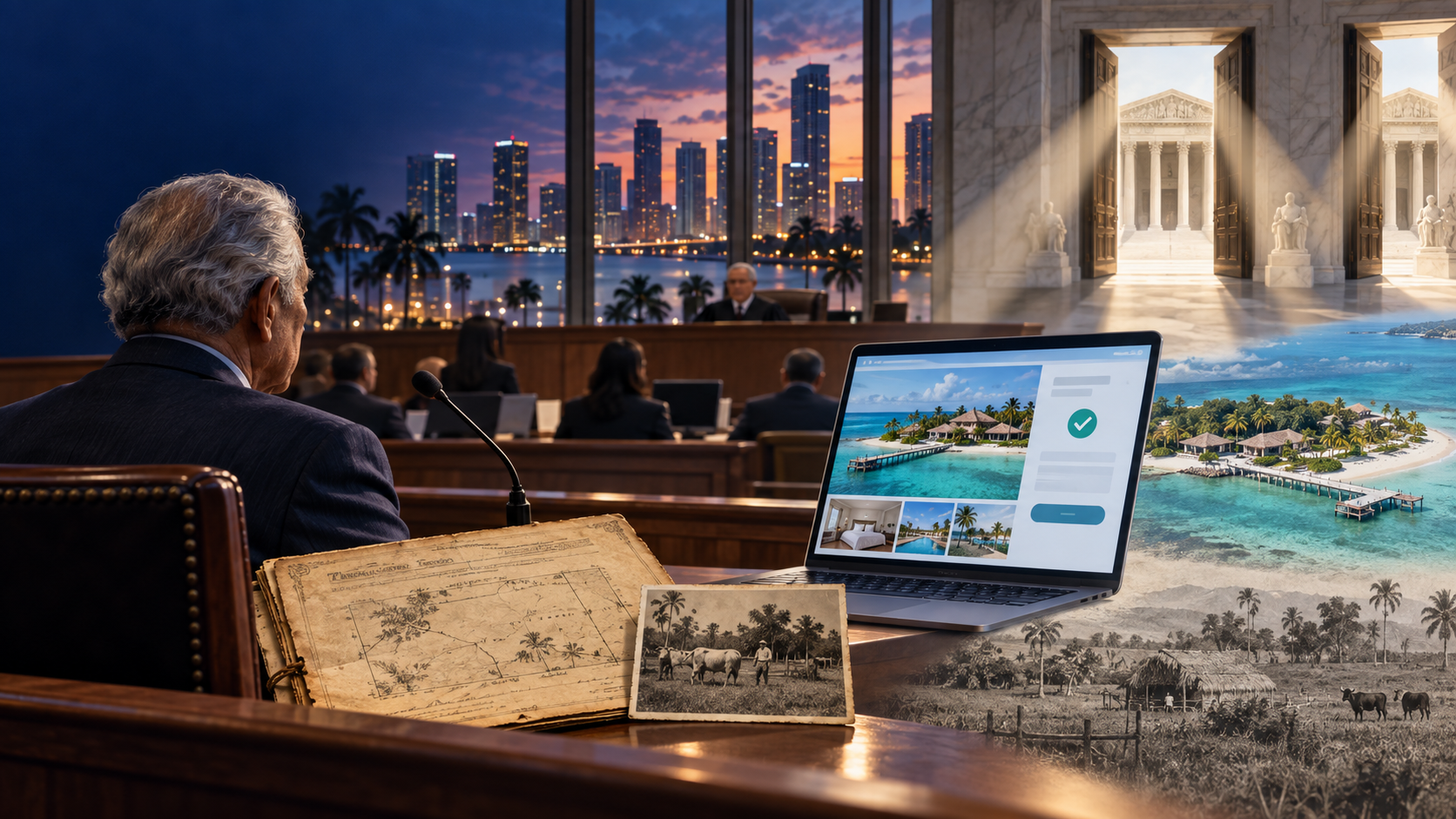
The New York Times reported that Mario Echevarria, now ninety-one, is seeking damages against Expedia Group for failing to obtain his permission when reserving rooms in hotels built on Cayo Coco, a cay off Cuba's north coast where his father ran a cattle and charcoal business before the property was confiscated in 1960. Asked at trial who had authorized the bookings, he testified that authorization came from "the dictatorship."
Expedia's position, as reported, is that the company believed it was acting lawfully. It entered Cuba in 2017, after the Obama administration issued rules permitting American hotel chains to operate there. The Times describes the case as one of a surge of claims by Cuban families over assets confiscated since 1959, and reports that dozens of such suits have been filed since the right to sue was restored in 2019.
Our take: the defendants are ordinary companies, and the defense is reliance
Two things about this case deserve attention from anyone assessing exposure.
The defendant profile. The public conversation about Helms-Burton tends to focus on the Cuban government and its state enterprises. The litigation does not. The defendants are American companies that made commercial decisions during a period of federal encouragement: cruise lines that docked in Havana, hotel operators, and now a travel booking platform that never touched Cuban soil at all. The alleged trafficking is the reservation, not the occupation.
The defense is reliance, and its strength is now the central question. Every one of these defendants entered Cuba under authorizations issued by the United States government during the 2016 to 2019 opening. Title III excludes uses of property "incident to lawful travel to Cuba," and the Supreme Court's May remand in the cruise line case put that exclusion squarely before the lower courts. How it is construed will do more to determine outcomes across this docket than either of the two decisions the Court has already issued.
The candid point is that reliance on a federal authorization is not obviously a defense to a private statutory claim. The authorization permitted the transaction under the sanctions regime. It did not purport to extinguish a private right of action Congress created in 1996 and left dormant. Defendants will argue the two cannot be squared. Plaintiffs will argue Congress wrote a specific exclusion and courts should not enlarge it. That is a genuinely open question, and a defendant who assumes the answer is favorable is making an expensive assumption.
Note also what a second trial against the same defendant in eighteen months tells you. These claims are not consolidating into a single global resolution. They are being tried family by family, property by property, which means the cost of defense is a function of the number of claimants rather than the number of properties.
What it means practically
If your company had commercial contact with Cuban property during or after the 2016 opening, the questions to answer now, before a demand letter arrives, are what property was involved, whether a certified claim exists against it, what federal authorization you relied on, and whether you can document that reliance contemporaneously. Certification matters because it drives treble damages, and documentation matters because the reliance defense is only as good as the record supporting it.
When to call a lawyer
Before responding to a Title III demand. These claims can carry enhanced damages, but not automatically. Under 22 U.S.C. 6082(a)(3), the enhanced measure applies where the claimant holds a claim certified by the Foreign Claims Settlement Commission, or where the claimant gave the statutory written notice at least 30 days before suit and the defendant continued trafficking after that period. Even then the statute trebles the value of the claim and adds the interest component rather than trebling the whole figure. Which route applies changes the exposure substantially, so establish it before pricing the demand.
Sources
Disclaimer
This post discusses publicly reported legal developments for general informational purposes. It is not legal advice, it does not create an attorney client relationship, and it does not reflect the firm's position in any pending matter. Outcomes depend on the specific facts and the governing law of the relevant jurisdiction.
UPDATE, September 10, 2026. This post was published while the trial described below was underway. The jury returned a verdict for Expedia on August 31, 2026. According to reporting on the verdict, the jury found that the claimants had not proved ownership of the confiscated land, and therefore never reached the defense that the bookings were incident to lawful travel authorized by the federal government. The significance of the outcome is that the case turned on proof of title rather than on whether booking hotel rooms constitutes trafficking. A claim certified by the Foreign Claims Settlement Commission is conclusive proof of ownership and amount by statute; an uncertified claimant must prove ownership of Cuban property as it stood in 1960. That evidentiary burden, rather than the merits of the trafficking theory, is what decided this case. The analysis below remains accurate as to the law; the reliance defense discussed in it is still undecided and is pending on remand in the cruise line litigation.