

Hirzel Dreyfuss & Dempsey, PLLC
NEWS AND INFORMATION
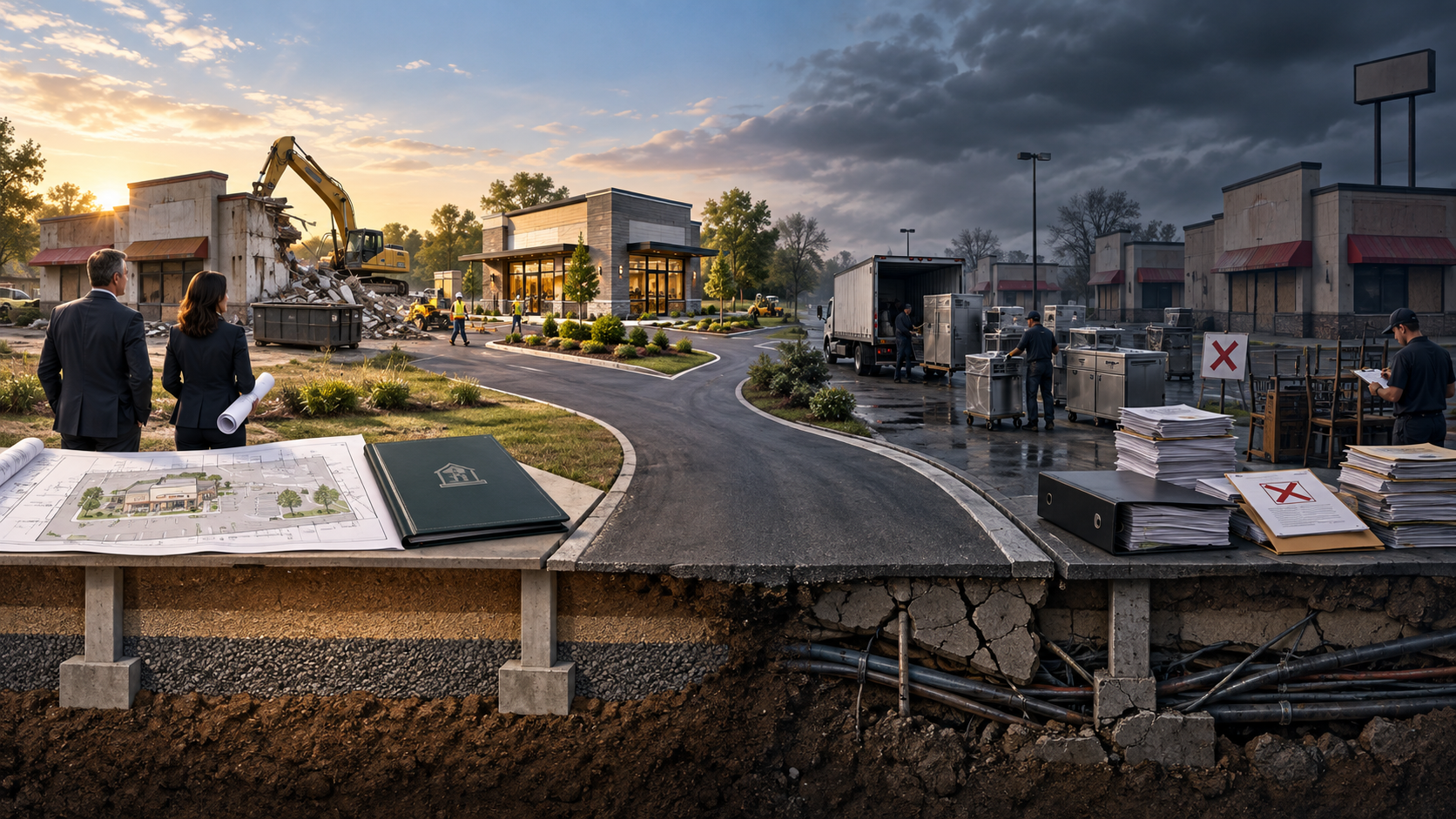
Two Franchisees, Two Ways to Close a Restaurant, and the Decisions That Separate Them
The short answer
One multi-brand franchisee closes underperforming units on its own schedule, rebuilds on land it owns, and grows revenue by more than a third. Another files Chapter 11 and puts forty-nine of its sixty-five restaurants up for sale through a liquidation firm. Both are closing restaurants. Only one of them still controls the outcome, and the difference traces back to decisions about real estate, leases and defaults made long before either closure.
The operator that closed by choice
Franchise Times reported on August 28, 2026 on a Kansas-based operator that runs fifty-two Burger King and forty Denny's restaurants across two entities, with revenue up 34.3 percent since 2023 to $135 million.
The described strategy is unsentimental. The chief executive put it this way: "We're growing by adding locations and we're growing by getting rid of losers." The chief financial officer described closing or declining to renew locations that are not performing while opening replacements that do better. In 2024 the company tore down and rebuilt an aging Burger King on a site it had acquired, and sales improved more than 25 percent. This year it closed a location when the lease expired and is rebuilding on separate space it owns.
The financial officer identified the structural reason this works: owning the real estate means "you're not getting hit with increased rents on the properties you own like you do with the other ones." The operator owns much of the real estate under its more than ninety stores.
The operator that ran out of choices
On April 2, 2026, a franchisee operating sixty-five Carl's Jr. restaurants in California, together with five affiliates, filed Chapter 11 in the United States Bankruptcy Court for the Central District of California. Forty-nine of the sixty-five have been put up for sale, marketed by a firm that specializes in liquidations. Reporting attributes the distress in part to California's $20 fast food minimum wage, per a statement by the company's chief executive in a court filing.
The detail that matters most is buried in the filing. The company is in default under its franchise agreements at a number of locations for failure to timely pay rent, royalties and other required charges. Those defaults could result in termination of the franchise agreements, which would end the ability to operate and generate revenue at all.
Reporting also quotes a bankruptcy analysis for the proposition that even where a debtor is not assigning a franchise agreement, assumption without franchisor consent is barred in the Ninth Circuit, which gives franchisors substantial leverage over whether a distressed franchisee continues under existing agreements.
Our take: the franchise agreement is the asset, and it is the one you can lose fastest
Read the two stories together and the same variable appears in both.
Real estate ownership is the difference between a decision and an emergency. The healthy operator closes a location when a lease expires and rebuilds on land it owns. It is not negotiating with a landlord in distress, and its occupancy cost does not reset at renewal. The distressed operator is in default on rent, which is what put its franchise agreements at risk. Two operators facing the same cost environment ended in different places largely because one controls its occupancy cost and the other does not.
A franchise default is faster and more dangerous than a lease default. A landlord that is not paid must generally evict, which takes time and produces a claim. A franchisor that is not paid can terminate, and termination ends the business rather than the tenancy. Once bankruptcy is filed, the franchisee's ability to keep the agreement is constrained in ways an ordinary contract is not. The Ninth Circuit position described in the reporting means the franchisor's consent may be required even to keep an agreement the franchisee is not trying to sell.
Closing units is not itself a distress signal, and closing them late is. The healthiest operator in these two stories closed more locations by choice than many struggling ones close under pressure. The failure mode is not the closure, it is subsidizing an underperforming location out of the cash flow of the good ones until there is no cushion left. The operating discipline and the balance sheet are the same subject.
We would add a candid caveat about the minimum wage explanation. A wage increase applies to every operator in the state, and many of them did not file. It is a real cost pressure and it is rarely the whole story. The default on rent and royalties is the more proximate cause of the loss of control, and it is the part a franchisee can actually manage.
What it means practically
If you are a franchisee: know which of your locations lose money and what each one costs to exit. Model lease expirations against unit economics so that closures happen at renewal rather than in default. Understand that missing rent and missing royalties are not the same kind of problem, because only one of them can terminate the business. If a franchise agreement default notice arrives, the cure period is the last point at which you control the outcome.
If you are a franchisor: the reporting shows both sides of the leverage. Consent rights are real and enforceable, and they are worth exercising deliberately rather than reflexively, because a terminated agreement produces a dark location and a rejection damages claim rather than an operating royalty stream.
If you are a landlord to a franchisee: the franchisor's consent rights can determine whether your tenant survives, and you may have no seat at that table.
When to call a lawyer
Before signing or renewing a lease at a marginal location, on the first missed royalty payment, and immediately on receiving a default or termination notice under a franchise agreement.
Sources
Disclaimer
This post discusses publicly reported legal developments for general informational purposes. It is not legal advice, it does not create an attorney client relationship, and it does not reflect the firm's position in any pending matter. Outcomes depend on the specific facts and the governing law of the relevant jurisdiction.

Two Florida Restaurant Franchisees, Two Chapter 11 Filings, One Pattern Worth Understanding
The short answer
Two large Florida restaurant franchisees filed Chapter 11 in the Southern District of Florida within seven months of each other. Sailormen Inc., a Miami based Popeyes franchisee with 136 locations, filed January 15, 2026. Quality Fresca I, a Palm Beach based Moe's Southwest Grill franchisee, filed August 4, 2026. Neither case is unusual on its facts. Both illustrate how quickly a franchisee's Chapter 11 converts from a reorganization into a sale, and what that means for the landlords, vendors and franchisors left behind.
Why it comes up
Franchisee bankruptcies rarely stay reorganizations. A franchise agreement is an executory contract, and a franchisee's ability to assume its own franchise agreement is constrained in ways that a typical debtor's contract rights are not. That structural fact pushes distressed franchisees toward a sale of the going concern rather than a stand alone plan, and it pushes creditors toward a compressed timeline.
What happened
Sailormen. Court filings reported by Franchise Times put liabilities at $342 million against $232 million in assets, with BMO Bank owed $112 million in unpaid principal plus $17 million in interest and fees. Sailormen attributed its position in part to a failed 2023 sale of sixteen Georgia restaurants. By June, an auction had produced buyers for 97 of the 136 locations, and 52 had drawn no bidder. Nation's Restaurant News reported the results: Pulse Restaurant Group took 50 locations for $2.69 million, RFI Ventures 23 for $2.5 million, Popeyes corporate 16 Miami area locations for $9.6 million, 61 Biscuits three West Palm Beach locations for $1.11 million, and SBH Foods five in Savannah for $650,000. The USA Today Network reported that a June 27 order extended the list of locations to be vacated to 22, with a June 30 deadline, and quoted the debtor's filing that the unsold stores "now constitute a burden on the Debtor's estate."
Quality Fresca. The Real Deal reported the petition listed liabilities between $10 million and $50 million, assets between $1 million and $10 million, and 200 to 999 creditors. Approximately $16 million is owed to secured lender GR Loanco 1, which holds liens on all assets. Revenue was $58.9 million last year and $26.4 million through mid June. Among the first day motions was a request to reject the leases at sixteen closing locations retroactive to the filing date, affecting centers owned by Brixmor, Regency Centers, Publix and Benderson. Fast Company published the full closing list, fourteen in Florida plus one each in Virginia and Georgia.
Our take: the auction is the case
Read the two dockets together and the same shape appears. A first day motion rejects the leases at the locations nobody will buy. An auction runs on a short timeline. The going concern locations transfer. The unsold locations become rejection damages claims, and the landlords who held those leases move from collecting rent to standing in line as general unsecured creditors.
Two observations that follow, neither of which is obvious from the headlines.
First, the franchisor is a bidder, not a bystander. Popeyes corporate paid $9.6 million for sixteen Miami area locations, which is more than three of the four other buyers paid combined for far more units. A franchisor that wants to protect a market will buy into it, and that changes the auction dynamics for everyone else.
Second, insider affiliated purchasers are common and are not automatically improper. Nation's Restaurant News reported that Pulse Restaurant Group, which acquired 50 locations, was established by Sailormen's chief executive. That structure invites scrutiny under the Bankruptcy Code's provisions governing sales to insiders, and creditors who intend to object need to be organized before the bid procedures order, not after the auction.
What it means practically
● If you are a landlord, the window to protect yourself is the first day motions, not the claims bar date. Rejection is frequently sought retroactive to the petition date, which affects the administrative rent you can recover.
● If you are a vendor, examine payments received in the ninety days before filing. Preference exposure in these cases is real and it arrives long after the case appears to be over.
● If you are a franchisee considering a filing, understand before you file that your franchise agreement may not be yours to keep.
● If you are a franchisor, decide early whether you intend to consent to an assumption and assignment, because that decision drives the entire sale process.
When to call a lawyer
The moment a franchisee in your system stops paying, or the moment you receive a bankruptcy notice naming a tenant, customer or franchisee. Nearly every meaningful right in these cases is exercised in the first thirty days.
Sources
● Franchise Times, 136-unit Popeyes franchisee files for bankruptcy (January 16, 2026)
● The Real Deal, Moe's Southwest Grill franchisee bankruptcy to close stores (August 6, 2026)
● Fast Company, Moe's Southwest Grill closing locations, full list (August 10, 2026)
Disclaimer
This post discusses publicly reported legal developments for general informational purposes. It is not legal advice, it does not create an attorney client relationship, and it does not reflect the firm's position in any pending matter. Outcomes depend on the specific facts and the governing law of the relevant jurisdiction.