
Hirzel Dreyfuss & Dempsey, PLLC
NEWS AND INFORMATION
A Title III Trial in Miami Shows What the Supreme Court's Two Rulings Actually Unlocked
The short answer
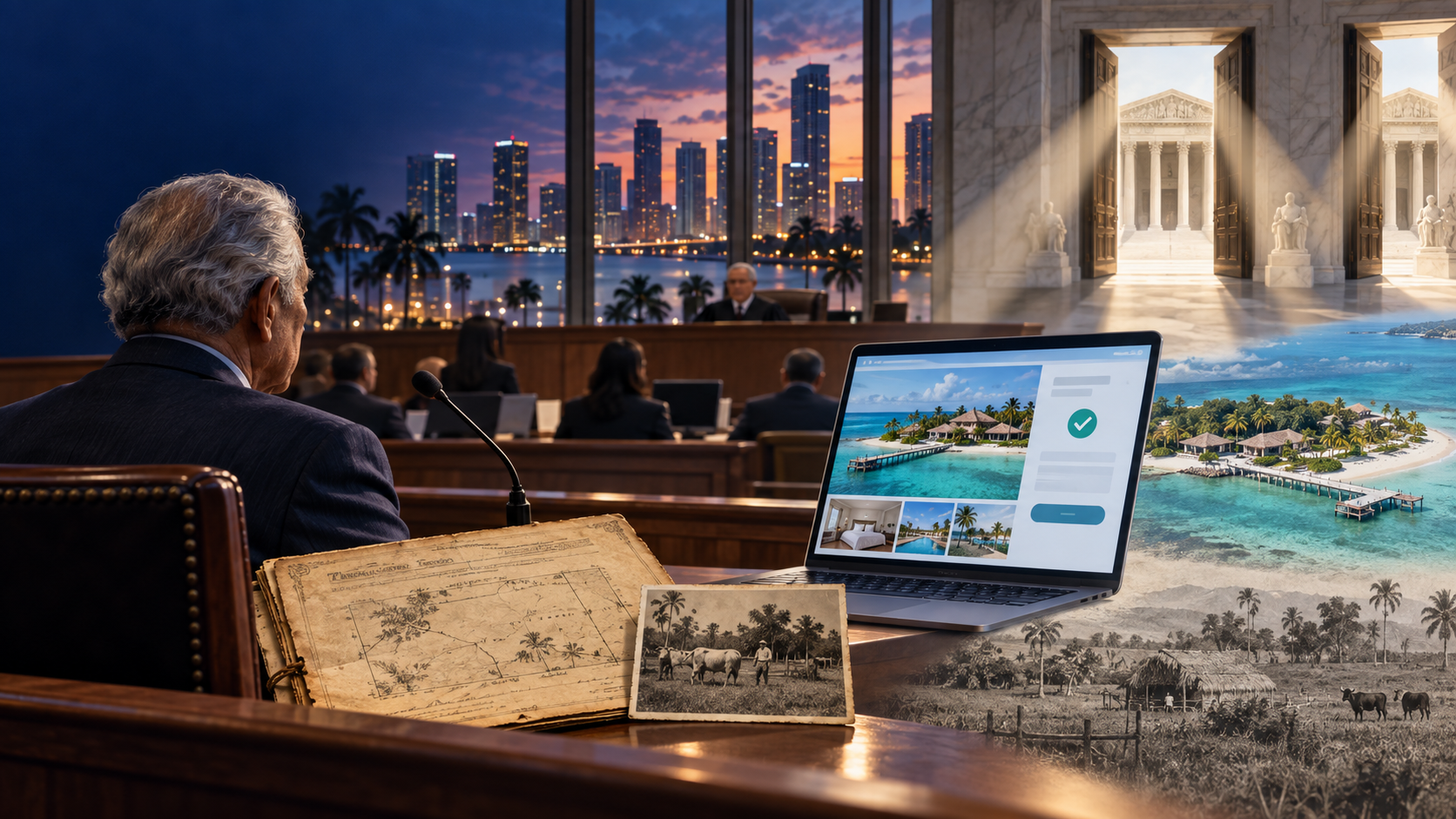
A Helms-Burton Title III case went to trial in Miami federal court in late August 2026 against a travel booking company, over hotel reservations on Cuban land confiscated from the plaintiff's family in 1960. It is the second such trial against that defendant in eighteen months. This is what the Supreme Court's May and June decisions look like on the ground.
What happened
The New York Times reported that Mario Echevarria, now ninety-one, is seeking damages against Expedia Group for failing to obtain his permission when reserving rooms in hotels built on Cayo Coco, a cay off Cuba's north coast where his father ran a cattle and charcoal business before the property was confiscated in 1960. Asked at trial who had authorized the bookings, he testified that authorization came from "the dictatorship."
Expedia's position, as reported, is that the company believed it was acting lawfully. It entered Cuba in 2017, after the Obama administration issued rules permitting American hotel chains to operate there. The Times describes the case as one of a surge of claims by Cuban families over assets confiscated since 1959, and reports that dozens of such suits have been filed since the right to sue was restored in 2019.
Our take: the defendants are ordinary companies, and the defense is reliance
Two things about this case deserve attention from anyone assessing exposure.
The defendant profile. The public conversation about Helms-Burton tends to focus on the Cuban government and its state enterprises. The litigation does not. The defendants are American companies that made commercial decisions during a period of federal encouragement: cruise lines that docked in Havana, hotel operators, and now a travel booking platform that never touched Cuban soil at all. The alleged trafficking is the reservation, not the occupation.
The defense is reliance, and its strength is now the central question. Every one of these defendants entered Cuba under authorizations issued by the United States government during the 2016 to 2019 opening. Title III excludes uses of property "incident to lawful travel to Cuba," and the Supreme Court's May remand in the cruise line case put that exclusion squarely before the lower courts. How it is construed will do more to determine outcomes across this docket than either of the two decisions the Court has already issued.
The candid point is that reliance on a federal authorization is not obviously a defense to a private statutory claim. The authorization permitted the transaction under the sanctions regime. It did not purport to extinguish a private right of action Congress created in 1996 and left dormant. Defendants will argue the two cannot be squared. Plaintiffs will argue Congress wrote a specific exclusion and courts should not enlarge it. That is a genuinely open question, and a defendant who assumes the answer is favorable is making an expensive assumption.
Note also what a second trial against the same defendant in eighteen months tells you. These claims are not consolidating into a single global resolution. They are being tried family by family, property by property, which means the cost of defense is a function of the number of claimants rather than the number of properties.
What it means practically
If your company had commercial contact with Cuban property during or after the 2016 opening, the questions to answer now, before a demand letter arrives, are what property was involved, whether a certified claim exists against it, what federal authorization you relied on, and whether you can document that reliance contemporaneously. Certification matters because it drives treble damages, and documentation matters because the reliance defense is only as good as the record supporting it.
When to call a lawyer
Before responding to a Title III demand. These claims can carry enhanced damages, but not automatically. Under 22 U.S.C. 6082(a)(3), the enhanced measure applies where the claimant holds a claim certified by the Foreign Claims Settlement Commission, or where the claimant gave the statutory written notice at least 30 days before suit and the defendant continued trafficking after that period. Even then the statute trebles the value of the claim and adds the interest component rather than trebling the whole figure. Which route applies changes the exposure substantially, so establish it before pricing the demand.
Sources
Disclaimer
This post discusses publicly reported legal developments for general informational purposes. It is not legal advice, it does not create an attorney client relationship, and it does not reflect the firm's position in any pending matter. Outcomes depend on the specific facts and the governing law of the relevant jurisdiction.
UPDATE, September 10, 2026. This post was published while the trial described below was underway. The jury returned a verdict for Expedia on August 31, 2026. According to reporting on the verdict, the jury found that the claimants had not proved ownership of the confiscated land, and therefore never reached the defense that the bookings were incident to lawful travel authorized by the federal government. The significance of the outcome is that the case turned on proof of title rather than on whether booking hotel rooms constitutes trafficking. A claim certified by the Foreign Claims Settlement Commission is conclusive proof of ownership and amount by statute; an uncertified claimant must prove ownership of Cuban property as it stood in 1960. That evidentiary burden, rather than the merits of the trafficking theory, is what decided this case. The analysis below remains accurate as to the law; the reliance defense discussed in it is still undecided and is pending on remand in the cruise line litigation.

The Question the Supreme Court Did Not Answer Is the One That Decides the Cruise Line Cases
The short answer
When the Supreme Court decided the Havana Docks case in May, it resolved what counts as confiscated property and left three defenses undecided. The most important is whether use of confiscated property incident to lawful travel to Cuba is excluded from liability. That question is now before the Eleventh Circuit on remand, and it, not the Supreme Court's holding, will determine whether roughly $439 million in judgments is ever collected.
Why it comes up
Between 2016 and 2019, American companies entered Cuba under federal authorizations issued during a deliberate opening of relations. Cruise lines docked in Havana. Hotel and booking platforms sold rooms. Those authorizations are the entire factual predicate for the largest Title III cases now pending, and Congress wrote an exclusion into the statute for uses of property incident to lawful travel to Cuba.
What the Supreme Court did and did not decide
The Court held, 8 to 1, that Title III reaches the confiscated property itself and not merely the claimant's interest in it, so the expiration of Havana Docks' 1905 concession in 2004 did not defeat liability. Justice Thomas wrote for the Court. Justice Sotomayor concurred, joined by Justice Kavanaugh, flagging the arithmetic of a certified loss of roughly $9 million producing recoveries measured in the hundreds of millions. Justice Kagan dissented alone.
Justice Thomas expressly reserved the lawful travel question, noting that the cruise lines had argued their use of the docks fell within the exception for uses of property incident to lawful travel, and that the district court had rejected that argument based on the general ban against travel to Cuba for tourist activities. The judgment was vacated and the case remanded to the Eleventh Circuit. The Court's judgment issued June 22, 2026, and the record was returned to the Southern District of Florida on August 5, 2026.
Our take: this is the heart of the case now
Nearly everything else in the cruise line litigation has been decided against the defendants. The principal unresolved question is one of statutory construction that has never been resolved by an appellate court, and the stakes could not be more lopsided: if the exclusion applies, the judgments disappear entirely.
The competing readings are both serious.
The claimants' reading is that Congress wrote a narrow exclusion for travel, that a cruise line's commercial use of a pier is not travel by the cruise line, and that reading the exclusion broadly would let any company launder trafficking through a licensed travel program.
The defendants' reading is that the United States government affirmatively authorized precisely this conduct, that the exclusion exists to protect people and companies operating under those authorizations, and that imposing treble damages for doing what federal regulators permitted is not a result Congress intended.
Our own view is that the defendants have the better of the equities and the harder textual argument. The exclusion is written in terms of uses of property incident to lawful travel, and a cruise line docking to disembark authorized travelers is a plausible fit. But the district court has already rejected it once, and the Eleventh Circuit has not been notably receptive to Title III defendants this year.
Two other defenses also survive for the remand: whether the concession was nonexclusive and limited to cargo services, and other defenses not reached below.
What it means practically
If your company operated in Cuba during the 2016 to 2019 opening, preserve now, in an organized form, every federal authorization you relied on, every legal opinion you obtained, and the contemporaneous record showing what you understood the authorization to permit. That record is the reliance defense, and it is worth nothing if it cannot be produced.
When to call a lawyer
Before responding to a Title III demand, and before assuming that a federal authorization resolves the question. It has not been resolved.
Sources
● Havana Docks Corp. v. Royal Caribbean Cruises, Ltd., No. 24-983, Supreme Court docket
● Havana Docks Corp. v. Royal Caribbean Cruises, Ltd., opinion via Justia
Disclaimer
This post discusses publicly reported legal developments for general informational purposes. It is not legal advice, it does not create an attorney client relationship, and it does not reflect the firm's position in any pending matter. Outcomes depend on the specific facts and the governing law of the relevant jurisdiction.
The Supreme Court Opened Two Doors on Helms-Burton Title III in Five Weeks
The short answer
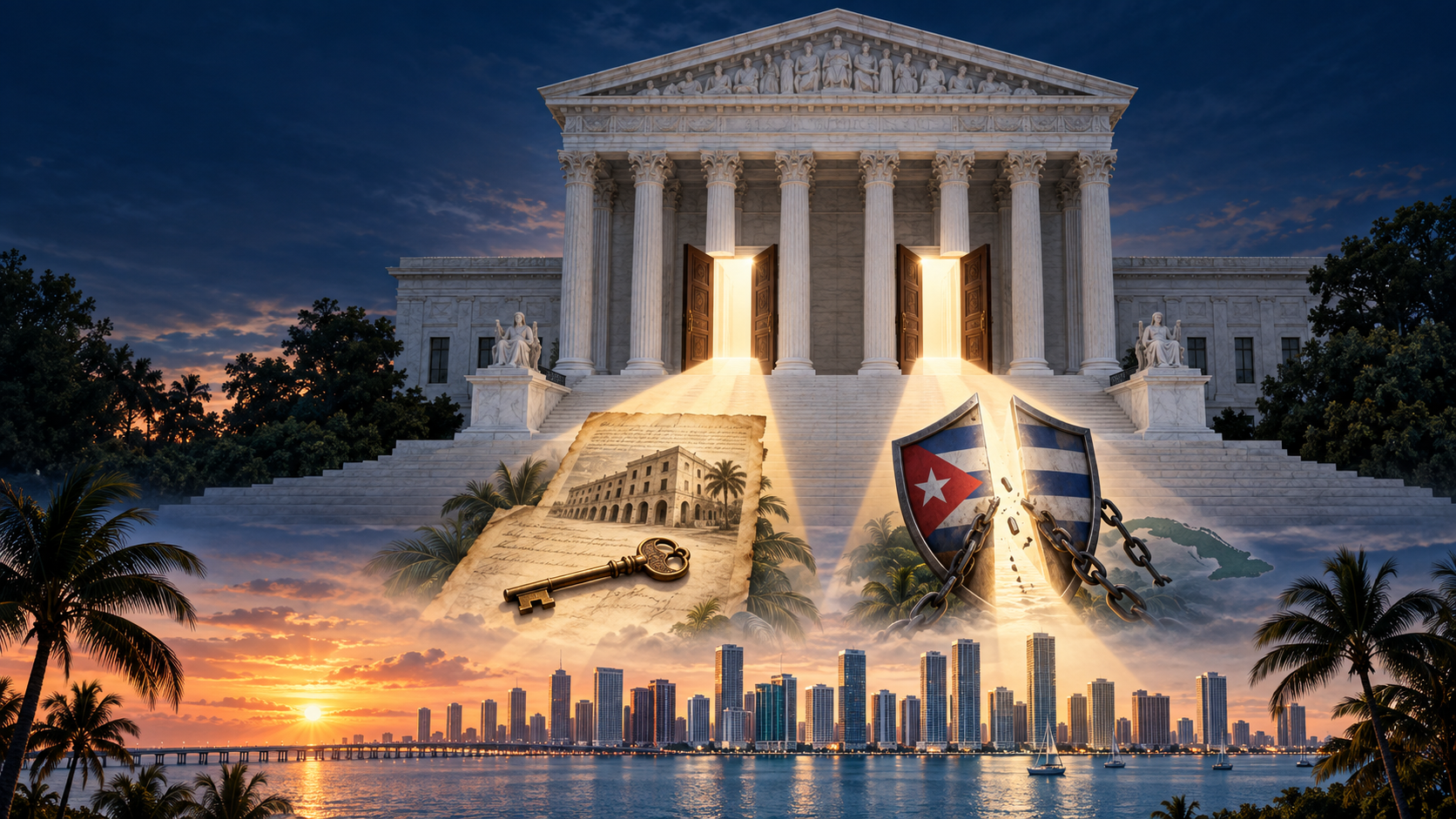
In May and June of 2026 the Supreme Court decided two cases under Title III of the Helms-Burton Act, and both went against the defendants. The first held that a claimant may sue over the confiscated property itself even though its own interest in that property had expired. The second held that Cuban state owned entities do not get foreign sovereign immunity in these cases. Together they remove the two principal obstacles that had been keeping Title III claims out of court, and South Florida is where those claims are filed.
Why it comes up
Title III of the Cuban Liberty and Democratic Solidarity Act of 1996 gives a United States national a damages claim against anyone who "traffics" in property confiscated by the Cuban government on or after January 1, 1959. The right to sue was suspended by every administration until 2019. Since the suspension was lifted, claims have accumulated, and until this year the defenses had largely been holding.
Havana Docks Corporation v. Royal Caribbean Cruises, Ltd., No. 24-983 (May 21, 2026)
Havana Docks held a ninety nine year concession, granted in 1905 and expiring in 2004, to operate the Havana port docks. Cuba expropriated the concession in 1960, and the Foreign Claims Settlement Commission certified the loss at approximately $9 million. After the suspension was lifted in 2019, Havana Docks sued four cruise lines over their use of the docks from 2016 to 2019. The district court entered judgment of roughly $110 million per defendant. The Eleventh Circuit reversed, reasoning that the concession had expired well before the alleged trafficking.
The Supreme Court reversed, 8 to 1, in an opinion by Justice Thomas. The holding is that the statute reaches the confiscated property itself and not merely the claimant's interest in it. In the majority's phrasing, confiscated property is "tainted," and one who uses it faces liability to the holder of the prior interest. Justice Sotomayor, joined by Justice Kavanaugh, concurred, flagging the arithmetic problem of a $9 million certified loss producing potentially unlimited recoveries. Justice Kagan dissented alone, on the ground that the docks "belonged to the Cuban Government, not Havana Docks, all along." The case was remanded, and the Transnational Litigation Blog reports that the remand reaches the statutory exclusion for uses "incident to lawful travel to Cuba," a defense the lower courts had not fully addressed and which could still dispose of the judgment.
Exxon Mobil Corp. v. Corporación Cimex, S.A., No. 24-699 (June 23, 2026)
Standard Oil's Cuban operations, later Exxon Mobil's, included a refinery, product terminals and 117 service stations, all seized in 1960. An American commission certified the loss at nearly $72 million in 1969. With interest and a treble damages request, the amount in controversy runs into the hundreds of millions.
The question was whether Helms-Burton abrogates the sovereign immunity of Cuban state owned entities, or whether a claimant must also satisfy an exception under the Foreign Sovereign Immunities Act. The Court held, 6 to 3, in an opinion by Justice Kavanaugh, that Helms-Burton authorizes suit directly. "Stacking an FSIA requirement on top of the Helms-Burton Act would thwart Congress's design," the majority wrote, adding that "Congress does not ordinarily enact self-defeating statutes." Justice Kagan dissented, joined by Justices Sotomayor and Jackson, on the ground that abrogation of sovereign immunity requires "unmistakable clarity" that the statute's text does not supply.
Our take: the doors are open, and the room behind them is not empty
These decisions do not create new claims. They remove defenses. The distinction matters because the claims already exist in volume, and the practical effect is to move a large inventory of dormant Title III matters into active litigation, most of it in the Southern District of Florida.
Three points we would emphasize, including one that cuts against the plaintiffs.
First, the remaining obstacles are not trivial. Commentators have noted that abrogating immunity from suit is not the same as abrogating immunity from execution, and that the FSIA's service provisions may not follow automatically. A claimant may win a judgment against a Cuban state entity and still have nothing to collect against.
Second, the exposure runs to commercial defendants, not just the Cuban government. The cruise line case is the model. The defendants there were ordinary American companies operating under what they believed were lawful federal authorizations at the time. The Cuban state entities are the headline, but the commercial defendants are the docket.
Third, the "incident to lawful travel" exclusion is the live defense. The Havana Docks remand puts it squarely in issue. Any company that entered Cuba during the 2016 to 2019 opening did so under federal authorizations that existed at the time, and whether that fact defeats liability is now the most consequential open question in this area.
Layered on top is a changed sanctions environment. Executive Order 14404, issued May 1, 2026, created a new Cuba sanctions program under the International Emergency Economic Powers Act, separate from and additional to the Cuban Assets Control Regulations, and reaching non Cuban persons and foreign financial institutions. On June 11, 2026, OFAC designated Unión Cuba Petróleo, the state oil and gas company, under that order. A company assessing Title III exposure is now assessing sanctions exposure at the same time, and the two analyses do not have the same answers.
What it means practically
If your company had any commercial contact with Cuban property between 2016 and 2019, or has one now, three questions are worth answering before a complaint arrives:
1. What property did you touch, and is there a certified claim against it? Certification matters, because it drives treble damages.
2. What federal authorization were you operating under, and can you document reliance on it?
3. Does your current activity touch a designated entity, directly or through infrastructure that entity controls?
When to call a lawyer
Before responding to a Title III demand letter, and before any transaction touching Cuban property or Cuban counterparties. These claims can carry enhanced damages under 22 U.S.C. 6082(a)(3), but only where the claim was certified by the Foreign Claims Settlement Commission or where the claimant gave the statutory written notice at least 30 days before suit and the defendant continued trafficking afterward. Which route applies changes the settlement calculus from the first day.
Sources
● SCOTUSblog, Court rules against cruise lines in Cuban confiscation case (May 21, 2026)
● SCOTUSblog, Court rules for Exxon Mobil in Cuban confiscation case (June 23, 2026)
● Transnational Litigation Blog, Cimex
● PBS NewsHour, Supreme Court OKs ExxonMobil lawsuit over Cuban property (June 23, 2026)
● CNN, Exxon can sue Cuba over property confiscated in 1960 (June 23, 2026)
● Courthouse News Service, Supreme Court greenlights suit against cruise giants
Disclaimer
This post discusses publicly reported legal developments for general informational purposes. It is not legal advice, it does not create an attorney client relationship, and it does not reflect the firm's position in any pending matter. Outcomes depend on the specific facts and the governing law of the relevant jurisdiction.