

Hirzel Dreyfuss & Dempsey, PLLC
NEWS AND INFORMATION

When the Franchisor Grades You on Price: McDonald's New Value Standard and the Limits of Franchisee Pricing Independence
The short answer
Effective January 1, 2026, McDonald's added value to the standards by which it assesses franchisees. The company says operators keep pricing independence. Operators say a standard that scores the outcome of your pricing decisions, and that feeds into whether you may expand or renew, is not independence. Both statements can be true at once, and the gap between them is where franchise law actually lives.
Why it comes up
Menu pricing is one of the few operational decisions a franchise agreement usually leaves to the franchisee. It is also the decision that most directly determines whether a unit makes money, because the franchisor's royalty and rent are typically calculated on gross sales while the franchisee absorbs the margin consequence of a discount.
That structure is not a scandal. It is the deal. But it means franchisor and franchisee have genuinely different interests in a discount, and a national value promotion is the point where those interests diverge most sharply.
What happened
In December 2025, McDonald's communicated a value provision added to its global franchising standards, applying in the United States and its largest international markets, effective January 1, 2026. Trade reporting describes the standard as assessing the outcomes of franchisees' pricing decisions in relation to delivering value to customers, weighing factors including use of company pricing tools, work with approved third-party pricing consultants, support for system promotions, and business performance, with local circumstances considered.
The significance is in what standards scores govern. According to that reporting, franchising standards scores bear on expansion eligibility and franchise agreement renewal.
In January 2026, the National Owners Association, an independent and self-funded association of McDonald's operators formed in 2018, approved a franchisee bill of rights consisting of fifteen standards it considers essential to fair franchising, including the right to set prices.
In February 2026, CNBC reported a Kalinowski Equity Research survey of twenty McDonald's operators finding unanimous opposition to the new standards, described as the first time in more than twenty years of that survey that every respondent answered a yes or no question identically. The same survey reported operators rating their relationship with corporate at 1.37 out of 5, down from 1.71 in October 2025.
McDonald's has said publicly that it has a responsibility to protect the strength and integrity of the brand and to ensure every owner-operator upholds the standards that make the system successful. That is a position with real content, not a deflection. A franchisor that cannot maintain consistency across a system has a brand problem, and brand problems are franchisee problems too.
Our take: this is a system standards question, not a pricing question
The franchise agreement is where this gets decided, and the relevant provision is usually not a pricing clause at all. It is the standards clause.
Most franchise agreements give the franchisor the unilateral right to modify the operating manual and system standards, and require the franchisee to comply with standards as modified. Item 17 of the Franchise Disclosure Document is required to disclose the modification provision, along with the renewal requirements and the definition of cause for termination. A franchisor that adds a criterion to its standards, and that ties standards performance to renewal and expansion eligibility, is generally exercising a right the agreement already gave it.
That is why "you still set your own prices" and "my pricing is being graded" are not actually in conflict. Nobody is setting the price for the operator. The operator is being evaluated on the result, under a standards regime the operator agreed to be evaluated under, with consequences attached at renewal.
What law constrains this? Less than most people assume.
The FTC Franchise Rule does not reach it. It is a pre-sale disclosure rule. It requires the franchisor to disclose that it may modify the manual and system standards, and to disclose the renewal conditions. It does not limit what the standards may contain or how they may change. A standards regime can be demanding, one-sided, and entirely lawful under the Franchise Rule, because there disclosure is compliance. Other federal law is not so narrow. An agreement or coercion on resale prices can raise antitrust questions, and since Leegin Creative Leather Products, Inc. v. PSKS, Inc., 551 U.S. 877 (2007), vertical minimum resale price restraints are analyzed under the rule of reason rather than falling outside federal law altogether. Whether anything is actionable depends on whether the facts show a unilateral standard or an agreement, and on coercion, market power and competitive effect.
State franchise relationship laws reach it only in a minority of states, and even there imperfectly. Those statutes generally govern termination and nonrenewal on a good cause standard. A franchisor declining to renew an operator with poor standards scores would have to defend that decision in those states. In Florida, there is no general franchise relationship statute at all, so the agreement governs entirely.
The implied covenant of good faith and fair dealing is the residual argument, and in Florida it cannot override an express contractual term. Where the agreement expressly grants the franchisor discretion to set and modify standards, the covenant constrains the manner of exercise, not the existence of the right.
The genuinely interesting point is that the FTC's 2024 Issue Spotlight on franchising, drawn from more than two thousand public comments, specifically documents franchisors controlling franchisee operations through mandatory operating hours and required price ranges, and separately documents franchisee fear of retaliation. The agency has identified the category. It has not regulated it. That gap, between an identified concern and an enforceable rule, is the current state of federal franchise law on this subject.
What it means practically
For a franchisee in any system, read the standards and modification provisions before you sign, not when a new standard arrives. The question is not whether the franchisor may impose the standard. It usually may. The question is what the standard is tied to, and whether there is any process, notice, or appeal before a score affects renewal.
Ask what a standards score actually controls. Expansion eligibility and renewal are the consequential ones. A score that affects nothing is a report card. A score that affects renewal is a term of the contract.
Document the economics. Where a franchisee's position is that a mandated or pressured discount is unsustainable at the unit level, that position is worth far more supported by unit-level data than asserted. That is true whether the forum is a franchisee association, a negotiation, or eventually a dispute.
For franchisors, the FTC's 2024 policy statement matters. The Commission has taken the position that contract terms prohibiting franchisees from reporting potential law violations to the government are unfair, unenforceable, and illegal. That statement was adopted on a three to two vote with two commissioners dissenting, one of whom now chairs the Commission, so its future is uncertain. But it is the agency's stated position and it sits alongside a franchise enforcement program that produced a seventeen million dollar redress judgment in March 2026.
When to call a lawyer
Before signing, when the standards and modification provisions are still readable as a negotiation. And when a standards change materially alters unit economics, early enough that the response is a strategy rather than a reaction.
Why this is not a do-it-yourself problem
The instinct on receiving a new standard is to argue about the standard. The productive question is structural and counterintuitive: what provision of the agreement authorizes it, what does compliance or non-compliance actually trigger, and is there any procedural protection attached. Those three answers determine whether there is anything to be done, and they are found in three different parts of a long document that do not cross-reference one another. An operator reading the announcement alone cannot tell whether the standard is an exercise of a granted right, which it usually is, or an overreach, which it occasionally is. And the moment at which the answer matters most, renewal, arrives on a fixed date years later, after the record has already been built.
Talk to us
HDD Law Firm represents franchisees and franchisors in franchise disputes and transactions in the Florida state courts, the Southern, Middle and Northern Districts of Florida, and the Eleventh Circuit. If a change to your system standards is affecting your unit economics or your renewal position, contact us to discuss your matter.
Sources
● McDonald's is making value part of its franchise standards, Restaurant Business (December 8, 2025)
● McDonald's updates franchising standards over value, Restaurant Dive (December 9, 2025)
● 16 C.F.R. 436.5, Contents of the disclosure document, including the Item 17 table (eCFR)
● FTC, Issue Spotlight: Risks to Small Business Success in Franchising
● FTC Secures Settlement Against Xponential Fitness for Franchise Rule Violations (March 18, 2026)
● Fla. Stat. 542.335, Valid restraints of trade or commerce
Disclaimer
This post discusses publicly reported legal developments for general informational purposes. It is not legal advice, it does not create an attorney client relationship, and it does not reflect the firm’s position in any pending matter. Outcomes depend on the specific facts and the governing law of the relevant jurisdiction.

The Franchise Agreement Terms That Actually Decide Your Outcome
The short answer
Item 17 of every Franchise Disclosure Document is a required table of 23 rows covering term, renewal, termination, transfer, non-competes, and dispute resolution. It is the most consequential page in the document. Rows (k) through (o) determine whether you can ever sell. Rows (u) through (w) determine where and how any fight happens, and often whether a fight is economically possible at all.
Why it comes up
Buyers evaluate franchises on the front end: the fee, the royalty, the build-out cost, the projected volume. Those are the numbers on the spreadsheet. But franchise disputes almost never turn on the royalty rate. They turn on the exit terms, and the exit terms are set out in a chart that reads like an index.
What Item 17 requires
Under 16 C.F.R. 436.5(q), the FDD must contain a table with a summary and a section reference for each of the following: length of the term; renewal or extension; requirements to renew; termination by franchisee; termination by franchisor without cause; termination by franchisor with cause; cause defined for curable defaults; cause defined for non-curable defaults; obligations on termination or non-renewal; assignment by the franchisor; transfer by the franchisee, defined; franchisor approval of transfer; conditions for approval; the franchisor's right of first refusal; the franchisor's option to purchase; death or disability; non-competition during the term; non-competition after termination; modification of the agreement; the integration or merger clause; arbitration or mediation; choice of forum; and choice of law.
Read that list once and the structure of franchise law becomes visible. The Rule requires the franchisor to tell you, before you sign, exactly which breaches get a second chance and which do not, and exactly what it takes to get out.
Our take: five terms carry most of the risk
Territory, and specifically its contingencies. Item 12 discloses whether you get an exclusive or protected area. The size of that area is the number buyers focus on. The contingencies are what matter. Does protection end if you miss performance benchmarks? What about the franchisor's own website and app orders placed by customers inside your area, third-party delivery platforms, ghost and virtual kitchens, alternative channels such as grocery or wholesale, and other brands owned by the same parent? Each of those is a channel through which revenue can be taken from your territory without a competing unit ever opening in it.
Renewal. The FTC's consumer guidance puts it plainly: franchise agreements may run as long as 20 years, and renewals are not automatic. The franchisor may decline to renew, or offer a renewal that does not have the same terms as your original contract, including a higher royalty or a reduced territory. Ask what could prevent renewal. Loss of the lease and failure to hit minimum performance levels are the usual answers.
There is a useful signal buried in the FTC's compliance guidance here. A franchisor need not issue a new FDD to a franchisee continuing at the same outlet unless the new relationship is on terms materially different from the present agreement. So if you are handed a fresh FDD at renewal, that may signal that the terms changed materially. It is not an admission. A franchisor may furnish the document voluntarily, out of caution, or because a state requires it. Compare the old agreement against the proposed one before drawing any conclusion.
Transfer. Row (k) requires the FDD to state how "transfer" is defined, precisely because the definitions vary. A well-drafted agreement treats a change of control of the franchisee entity as a transfer. That means a seller cannot avoid franchisor consent, the transfer fee, the right of first refusal, and the general release by selling stock instead of assets. Our post on selling or transferring a franchise covers this in full.
Post-term covenants. The FTC notes that after termination, contractual restrictions typically stop you from operating a competing business within specified distances, potentially for as long as three years. NASAA's position is that these should be narrowly drawn and limited to roughly the market the franchisee actually served, for roughly the time needed to replace the franchisee. Whether that position carries any weight depends entirely on the governing state law. In Florida, section 542.335 governs, and it is not a franchisee-friendly statute. Our post on franchisee rights in Florida covers it.
One asymmetry worth flagging to any client reading an arbitration clause: most franchise agreements carve intellectual property and restrictive-covenant enforcement out of arbitration. The franchisor wants a court and an injunction for those, and arbitration for everything else. Read the carve-out, not just the clause.
Dispute resolution. Four features price separately and negotiate separately.
Arbitration versus court, and the injunction carve-out just described. Forum selection, where a Florida franchisee arbitrating in the franchisor's home state can face a cost differential that exceeds the value of the claim outright. Jury waiver, which is often a standalone clause that survives even where arbitration does not apply. And fee-shifting, which is frequently one way in the franchisor's favor.
The baseline is that the Federal Arbitration Act strongly favors enforcement of arbitration clauses in commercial contracts, and vacatur grounds are narrow. The counterweight is state anti-waiver statutes, which in a minority of states can defeat out-of-state choice-of-law and forum clauses for in-state franchisees. Florida is not one of those states, which is a point Florida franchisees should understand before signing rather than after.
What it means practically
Read Item 17 before you read anything else in the FDD, then read the actual contract sections it cross-references. The table is a summary. The contract governs.
Price the dispute-resolution clause as a real cost. An arbitration clause with a distant forum, a one-way fee provision, and a jury waiver is not a procedural detail. It is a decision, made before any dispute exists, about whether disputes are worth pursuing.
Ask which of these the franchisor will move. Cure periods, guaranty scope, transfer mechanics, post-term radius, and mutual fee-shifting are the realistic asks. The royalty rate is not.
When to call a lawyer
Before signing, while Item 17 is still a negotiation rather than a description of what happened to you.
Why this is not a do-it-yourself problem
Item 17 is written in summary form and cross-references contract sections that are written in operative form, and the two do not always sit comfortably together. A summary that says consent to transfer "shall not be unreasonably withheld" sounds protective until you read the section it references and find a menu of conditions the franchisor may impose, each of which is reasonable by definition. Reading the table alone produces a materially wrong picture of the deal, and the mismatch is not visible without reading both against each other. This is also the one part of the agreement where a modest, well-targeted request can genuinely be granted, and knowing which requests those are is the whole of the skill.
Talk to us
HDD Law Firm handles franchise agreement review, negotiation, and litigation for franchisees and franchisors. If you want the exit terms of a franchise agreement explained before you sign, contact us to discuss your matter.
Sources
● 16 C.F.R. 436.5, Contents of the disclosure document, including the Item 17 table (eCFR)
● FTC, A Consumer's Guide to Buying a Franchise
● FTC, Franchise Rule Compliance Guide
● FTC, Issue Spotlight: Risks to Small Business Success in Franchising (2024)
● NASAA, Post-Term Non-Compete Provisions in Franchise Agreements Should Be Reasonable
● Fla. Stat. 542.335, Valid restraints of trade or commerce
● International Franchise Association, Basics Track: Franchise Relationship Laws
● American Bar Association, Franchise Agreement Provisions That Can Make or Break a Court Case
Disclaimer
This post discusses publicly reported legal developments for general informational purposes. It is not legal advice, it does not create an attorney client relationship, and it does not reflect the firm’s position in any pending matter. Outcomes depend on the specific facts and the governing law of the relevant jurisdiction.
How a Lawyer Helps When You Are Buying a Franchise
The short answer
A franchise purchase is a ten-year commitment to a contract you did not draft, cannot meaningfully rewrite, and will be held to precisely. The value a lawyer adds is not in changing the royalty rate. It is in telling you what the document actually obligates you to do, which of the salesperson's statements are enforceable, and which handful of terms are genuinely negotiable and worth spending your leverage on.
Why it comes up
Buying a franchise feels like buying a proven business. What you are actually buying is a license to use someone else's trademark and system, on their terms, for a defined period, with your capital at risk and their brand standards controlling how you operate.
The FTC's 2024 Issue Spotlight on franchising, which analyzed more than 2,000 public comments, recorded the pressure buyers describe. One commenter reported being told that hiring an attorney "would be throwing money down the drain." Another was told to sign quickly or be replaced by a different candidate. Those are not neutral sales techniques. They are directed at the one step most likely to surface a problem.
What the process should look like
Confirm you are actually getting an FDD. If you are buying an existing unit from the franchisee who owns it, without significant franchisor involvement, the FTC's compliance guidance takes the position that you are not a "prospective franchisee" and the franchisor may owe you no disclosure document at all. You will still be required to sign the franchisor's current franchise agreement. Make delivery of the current FDD a written condition of closing rather than assuming a right to it.
The same gap appears at the high end. Under 16 C.F.R. 436.8, no FDD is required where the initial investment reaches roughly $1.47 million with a signed acknowledgment, or where the buyer has been in business five years with a net worth of roughly $7.35 million. Sophisticated buyers get less disclosure, not more.
Read the FDD against the pitch. Write down, contemporaneously, every specific number you were given and who gave it to you. Then check whether it appears in Item 19. This takes twenty minutes and it is the difference between a provable claim and a swearing contest.
Call franchisees, including former ones. The FTC calls franchisee calls the most reliable way to verify a franchisor's claims, and suggests segmenting the calls: franchisees about a year in on actual versus estimated investment and time to open; franchisees five or more years in on time to profitability and whether the franchisor met its obligations; and former franchisees on why they left.
Read Item 21 with an accountant. The FTC poses the diagnostic question directly: does the franchisor make more of its income from royalties paid by successful existing franchisees, or from selling franchises to new prospects? The Issue Spotlight's SBA loan data shows how wide the spread between brands runs, with default rates at some systems in the high single digits and above while the franchise average sat near four percent.
Resolve the personal guaranty before you sign. The IFA's own list of key legal questions tells prospects to ask whether a personal guaranty is required and what obligations it covers. The questions that matter: does it reach only money, or also the non-compete and indemnity covenants; is it joint and several among owners; does it reach spouses; does it survive termination and extend to liquidated damages; and does it release when you sell. That last one surprises more sellers than any other term in the document.
Our take: negotiate the exit, not the entry
Most buyers who try to negotiate spend their leverage on the royalty rate and the initial fee. Those are the two terms a franchisor will almost never move, because moving them creates a precedent every other franchisee will demand, and because eight states prohibit discrimination among similarly situated franchisees, which makes one-off concessions genuinely costly to the franchisor.
Spend the leverage on the terms that decide what happens when things go wrong.
Cure periods. A ten-day monetary cure period and a thirty-day operational one are common. Lengthening them costs the franchisor almost nothing and can save the business.
Personal guaranty scope, caps, and release on transfer. A guaranty that releases when you sell is worth more than a point of royalty.
Territory contingencies. The size of the protected area matters less than the list of things that end the protection. Get in writing how the franchisor treats its own website and app orders sourced from your area, third-party delivery, ghost kitchens, alternative channels like grocery and wholesale, and sister brands owned by the same parent. The FTC Issue Spotlight records franchisee complaints about franchisors adding brand after brand into protected territory.
Fee-shifting. Franchise agreements frequently shift fees one way, in the franchisor's favor. Asking to make it mutual is a modest, cheap request that occasionally succeeds and changes the economics of every future dispute.
Post-term covenant radius and duration. The FTC notes post-termination restrictions can run as long as three years. NASAA's published position is that these covenants should be narrowly drawn and reasonable in scope, duration, and territory. That position is a useful thing to put in front of a franchisor's counsel.
One more point worth making, because it is commonly used against buyers. A franchisor cannot tell you that your requested change would restart the seven-day waiting period and therefore cannot be made. The FTC's rule expressly exempts changes initiated at the prospective franchisee's request. Negotiation is contemplated by the Rule itself, and 16 C.F.R. 436.9(h) says so, permitting a prospect to voluntarily waive specific contract terms during the course of sale negotiations.
What it means practically
Budget for the review. A franchise lawyer's review of an FDD and franchise agreement is a small fraction of the initial investment and a very small fraction of the ten-year cost of the contract.
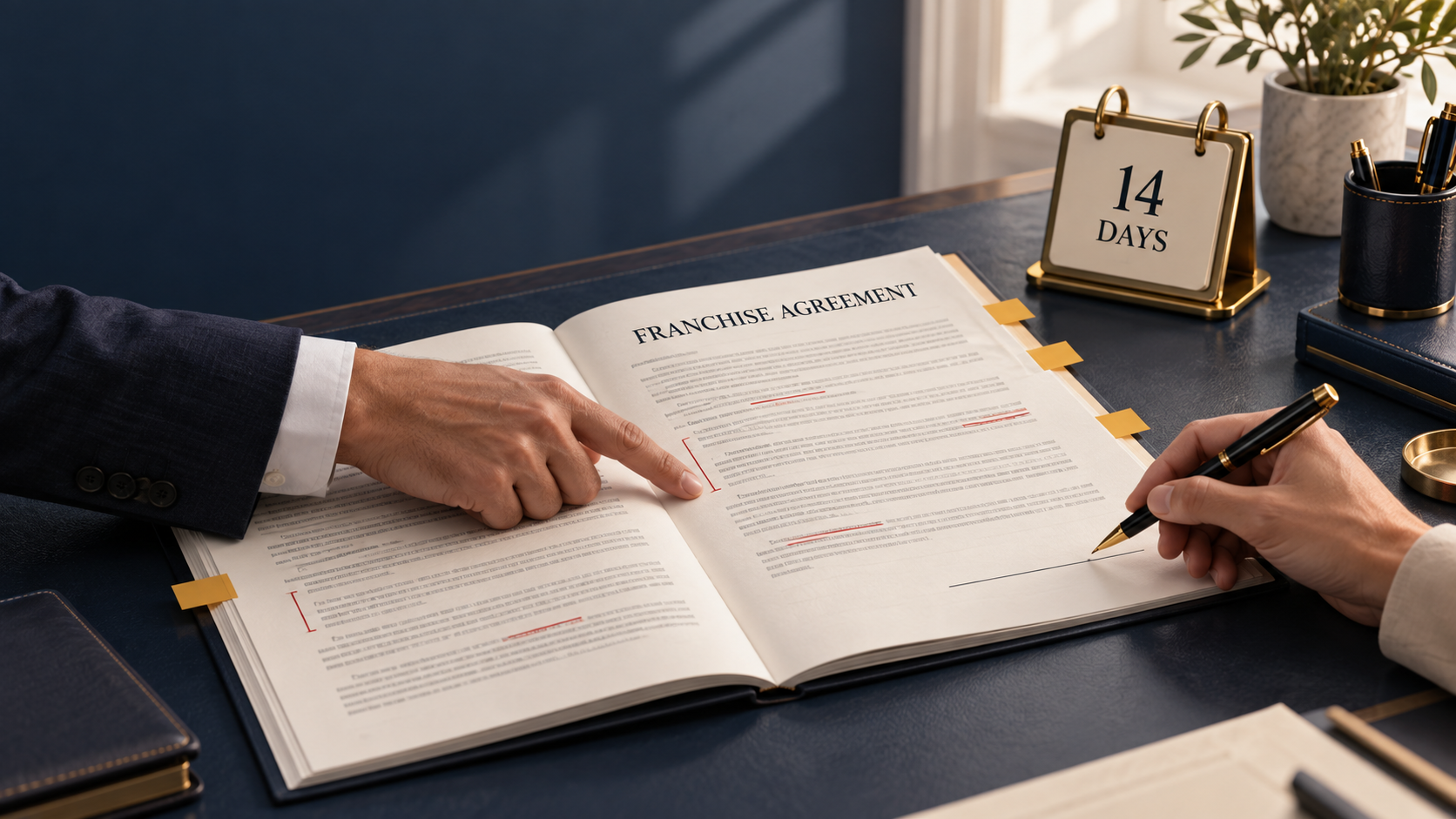
Do it inside the 14 days, not after. Once you sign, every term is settled and the conversation changes from negotiation to compliance.
If your lawyer reads a term they have never seen before and cannot recommend, the SBA's own guidance says to walk away unless the franchisor agrees to modifications your attorney accepts. That is not lawyer caution. That is the federal small-business agency's published advice.
When to call a lawyer
When the FDD arrives, and before you pay a deposit. A "fully refundable" deposit is frequently the payment that starts the clock.
Why this is not a do-it-yourself problem
The document is not hard to read. It is hard to read correctly, because the terms that matter interact across Items that never reference one another, and because the consequences are asymmetric. A franchisee who misreads a territory contingency finds out three years later when a sister brand opens two miles away. A franchisee who does not notice that the personal guaranty survives a sale finds out at closing, when it is far too late to negotiate. A lawyer who reads these regularly is pricing risk you have no basis to price, on a contract you will live under for a decade, and is doing it against a 14-day clock that runs whether or not anyone is reading. The review is also the only moment in the entire relationship when you have leverage, because it is the only moment when you can still walk.
Talk to us
HDD Law Firm represents franchisees and franchisors in franchise transactions and disputes in the Florida state courts, the Southern, Middle and Northern Districts of Florida, and the Eleventh Circuit. If you are considering a franchise purchase, contact us to discuss your matter before the disclosure period runs.
Sources
● 16 C.F.R. 436.8, Exemptions (eCFR)
● 16 C.F.R. 436.9, Additional prohibitions (eCFR)
● FTC, A Consumer's Guide to Buying a Franchise
● FTC, Issue Spotlight: Risks to Small Business Success in Franchising (2024)
● FTC, Franchise Rule Compliance Guide
● FTC, Amended Franchise Rule FAQs
● FTC, Franchise Fundamentals: Considering, calculating, and consulting
● NASAA, Post-Term Non-Compete Provisions in Franchise Agreements Should Be Reasonable
● International Franchise Association, Basics Track: Franchise Relationship Laws
Disclaimer
This post discusses publicly reported legal developments for general informational purposes. It is not legal advice, it does not create an attorney client relationship, and it does not reflect the firm’s position in any pending matter. Outcomes depend on the specific facts and the governing law of the relevant jurisdiction.
A Franchisee Bill of Rights Is Not a Legal Document. Here Is Why It Still Matters.
The short answer
In January 2026, an independent association of McDonald's operators approved a fifteen-point franchisee bill of rights, including the right to set prices. It creates no enforceable rights, because a franchisee association cannot amend anyone's franchise agreement. What it does is establish a documented, collective position at a moment when three separate forces, the FTC, several state legislatures, and the renewal cycle itself, are all newly attentive to franchisor control.
Why it comes up
Franchisees are structurally disorganized. Each one signs the same contract separately, at a different time, with no ability to bargain collectively and, in most systems, a contractual relationship that runs only vertically to the franchisor. Franchisor-recognized advisory councils exist in most large systems, but they are creatures of the franchisor.
Independent associations are the exception, and they exist precisely because the vertical structure leaves franchisees without a way to say anything together.
What happened
The National Owners Association was formed in October 2018, reported at the time as the first independent, self-funded franchisee association in McDonald's United States history. More than four hundred operators met in Tampa and voted to form it. By March 2023 it reported more than one thousand members, in a system with more than two thousand United States franchisees. It is distinct from the National Franchisee Leadership Alliance, which is the company-recognized elected operator body.
In January 2026, following McDonald's addition of a value criterion to its franchising standards, the association approved a list of fifteen standards it considers vital to fair franchising, including the right to set prices.
Our take: the document has no legal force, and three reasons it matters anyway
Start with the plain answer. A franchisee bill of rights is not a contract, a statute, or a rule. Nobody is bound by it. Franchise agreements are individually negotiated and individually signed, and most contain integration clauses that foreclose reliance on anything outside the four corners of the document. An association's declaration changes none of that.
Three things give it weight regardless.
One. There is a live federal record, and it is built from franchisee statements. The FTC's 2023 Request for Information on franchisor control over franchisees and workers drew, by the agency's own account, more than five thousand submissions, of which staff reviewed over two thousand publicly posted comments spanning more than one hundred and fifty brands. The resulting 2024 Issue Spotlight catalogued the leading complaint categories, including unilateral operating manual changes, fees and royalties, mandatory supply restrictions, renewal and non-negotiable contract terms, and fear of retaliation, and it documented franchisors controlling operations through mandatory operating hours and required price ranges.
A collective, documented franchisee position is an input into that process. The Franchise Rule review opened in February 2019 remains open. Whether it produces anything is genuinely uncertain, and the 2024 policy statement issued alongside the Spotlight passed on a three to two vote with two commissioners dissenting, one of whom now chairs the Commission. But the record is being built, and the record is made of exactly this kind of material.
Two. States are legislating, and one of the recurring provisions is the right to associate. Recent trade reporting describes franchise bills in several states, including provisions protecting franchisees' right to form associations, a ban on post-termination non-competes, and good cause plus notice requirements for termination and nonrenewal. That is the first meaningful state-level franchise legislative activity in years, and the right-to-associate provisions speak directly to the concern franchisee groups have voiced about retaliation for participating in owner-only meetings.
Three. And this is the one that actually operates today: it changes the evidentiary picture. A franchisor's standard response to a franchisee complaint is that it is an outlier. A documented position adopted by an association representing a substantial share of the system is harder to characterize that way. In a dispute over whether a standard was applied uniformly, whether a nonrenewal was pretextual, or whether a franchisor's discretion was exercised in good faith, contemporaneous evidence of a system-wide objection is not dispositive but it is not nothing.
The candid limit. None of this helps an individual franchisee facing an individual renewal decision next quarter. Association advocacy operates on a legislative and regulatory timescale. Contract deadlines do not. A franchisee whose renewal is at risk needs to read the renewal conditions in Item 17 and the corresponding contract sections, and to understand what standards scores actually control, which is the subject of the companion post to this one.
What it means practically
Participation in an independent association is protected in some states and under some agreements, but there is no general nationwide protection, so check the governing state law and the agreement. Some agreements contain non-disparagement and confidentiality provisions that a franchisor could read as reaching association activity. The FTC's 2024 policy statement takes the position that contract terms barring franchisees from reporting potential law violations to the government are unfair, unenforceable, and illegal. That addresses government reporting specifically, not association activity generally, and the distinction matters.
Do not treat a bill of rights as a defense. If a franchisor asserts a default, the answer is in the franchise agreement, not in a declaration of principles.
Franchisors should read this as information rather than as a threat. A documented list of fifteen items is a franchisee body telling a franchisor exactly what it cares about, in writing, in advance. Systems that treat that as intelligence tend to have fewer disputes than systems that treat it as insubordination.
When to call a lawyer
Before responding to a franchisor inquiry about association activity. Before a renewal cycle in which standards performance is in question. And before a franchisee group commits anything to writing that will be read later by a regulator, a court, or the franchisor.
Why this is not a do-it-yourself problem
Collective franchisee action sits on an awkward legal seam. The activity is generally lawful, and in several states is becoming expressly protected, but the franchise agreement usually contains confidentiality, non-disparagement, and cooperation provisions drafted before anyone contemplated an independent association, and the franchisor's reading of those provisions is not always the obvious one. There are also antitrust considerations when competitors in the same system discuss pricing, which is precisely the subject at issue here, and those considerations are real regardless of how sympathetic the underlying grievance is. Getting the participation right, and getting the documents right, is a different exercise than being right on the merits.
Talk to us
HDD Law Firm represents franchisees and franchisors in franchise disputes and transactions in the Florida state courts, the Southern, Middle and Northern Districts of Florida, and the Eleventh Circuit. If you are evaluating your position within a franchise system, contact us to discuss your matter.
Sources
● Nation's Restaurant News coverage of the franchisee bill of rights (January 28, 2026)
● McDonald's franchisees may take their complaints to the FTC, Restaurant Business (March 14, 2023)
● FTC, Issue Spotlight: Risks to Small Business Success in Franchising
● FTC, Policy Statement on Franchisors' Use of Contract Provisions
● FTC, Franchise Rule, 16 C.F.R. Parts 436 and 437
● From Maryland to Arizona, States Consider New Franchise Legislation, Franchise Times
Disclaimer
This post discusses publicly reported legal developments for general informational purposes. It is not legal advice, it does not create an attorney client relationship, and it does not reflect the firm’s position in any pending matter. Outcomes depend on the specific facts and the governing law of the relevant jurisdiction.
What a Franchise Disclosure Document Is, and Which Items to Read First
The short answer
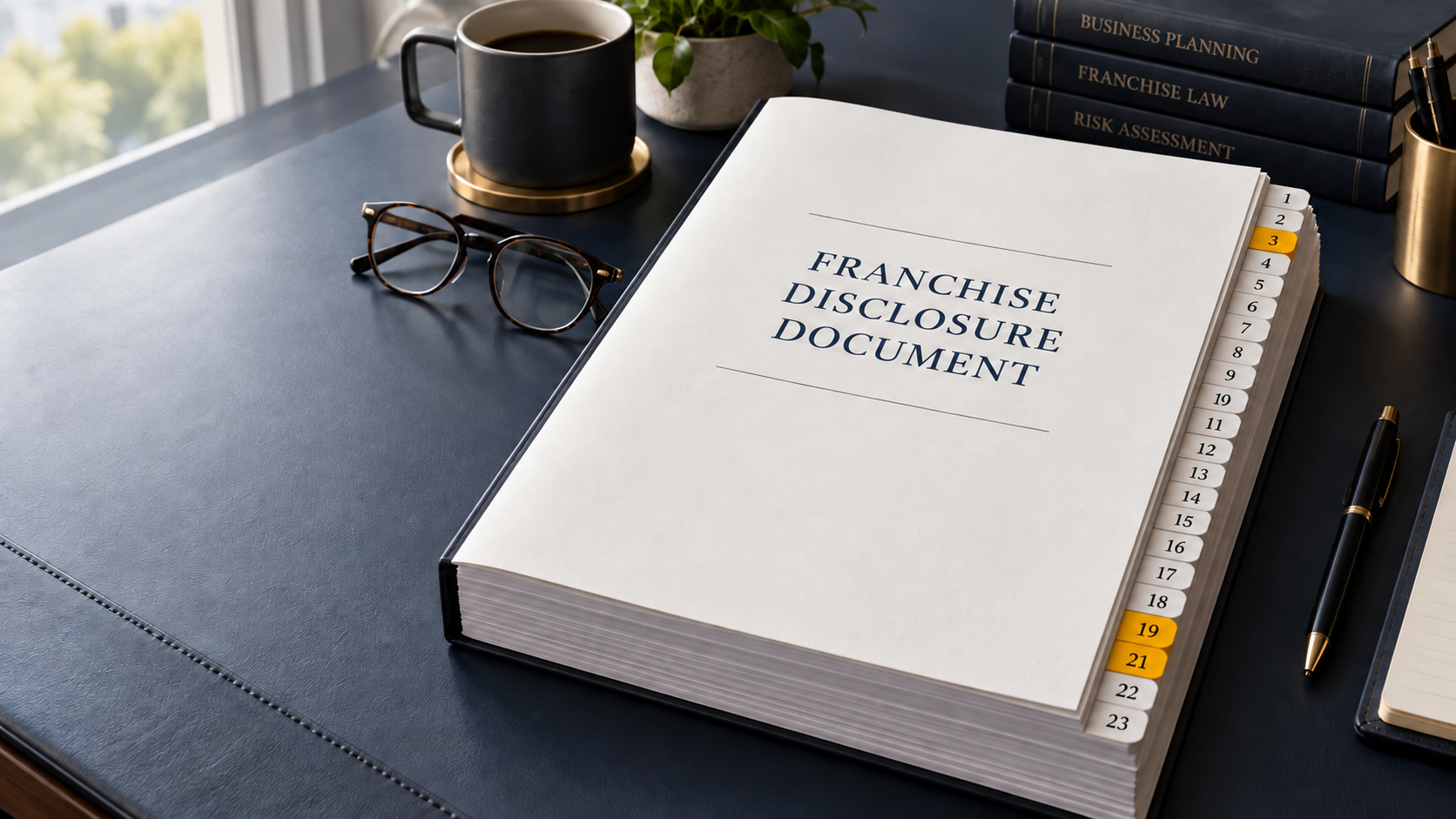
Federal law requires a franchisor to hand you a Franchise Disclosure Document, containing 23 numbered Items, at least 14 calendar days before you sign a binding agreement with, or make any payment to, the franchisor or one of its affiliates in connection with the sale. The FTC does not review or approve it. Some states do review it: a registration state such as California or New York examines the filing and issues comment letters on deficiencies. That review is a compliance check on the document, not an endorsement of the offering, and by statute an effective registration is not a finding that the document is true, complete or not misleading. It is a disclosure document, not a seal of approval. The three Items that tell you the most are the ones most buyers skip.
Why it comes up
The FDD arrives as a bound volume of two hundred pages or more, most of it exhibits. It is designed to be complied with, not read. The natural response is to skim the marketing-adjacent Items, sign the receipt at the back, and rely on what the salesperson said.
That is the mistake the entire disclosure regime exists to prevent, and it is the reason a franchise dispute three years later so often turns on a document the franchisee received and never opened.
What the rule requires
The FTC Franchise Rule, 16 C.F.R. Part 436, governs. Three mechanics matter.
A franchise is defined by function, not by label. Under 16 C.F.R. 436.1(h), three elements must be present: you obtain the right to operate under the franchisor's trademark, the franchisor exerts or may exert significant control over your method of operation or provides significant assistance with it, and you are required to make a payment. Calling you a "licensee," a "dealer," or a "distributor" does not avoid the Rule if those three elements exist. The FTC alleged exactly that workaround in its 2024 case against a coffee franchisor.
The 14-day clock is real, and it is calendar days. Under 16 C.F.R. 436.2(a), the franchisor must furnish the FDD at least 14 calendar days before you sign a binding agreement or make any payment, whichever comes first. If the document is sent by first-class mail, it must go out at least three calendar days before that date, so a mailed FDD effectively needs seventeen. Under 16 C.F.R. 436.9(e), the franchisor must also give you the FDD earlier on reasonable request, and cannot hold it back.
A separate 7-day clock applies to changes. Under 16 C.F.R. 436.2(b), if the franchisor unilaterally and materially changes the agreement, you get seven more calendar days with the revised version before signing. Important, and widely misunderstood in the franchisee's favor: changes you asked for do not restart the clock. The FTC's compliance guidance says so expressly. A franchisor cannot refuse your requested addendum on the ground that it would reset the timeline.
Our take: read Items 20, 21, 19 and 17, in that order
Most buyers read Item 7, the estimated initial investment, and stop. Item 7 is the franchisor's own estimate of what it costs to open. It tells you almost nothing about whether the system works.
Item 20 first. Item 20 requires outlet counts for the three most recent fiscal years, broken out by state, showing outlets opened, terminated, not renewed, reacquired by the franchisor, and ceased for other reasons. It also requires contact information for current franchisees, and, critically, a list of every franchisee whose outlet was terminated, cancelled, not renewed, or that otherwise ceased operating during the last fiscal year, plus anyone the franchisor has not heard from in ten weeks.
That last list is the single most valuable page in the document. Those are the people with no incentive to sell you anything. Call them. The FTC treats a stale or inaccurate former-franchisee list as a material violation, and it was one of the counts in the agency's 2026 case against a fitness franchisor that produced a $17 million judgment for franchisee redress.
Item 20 also carries a warning worth reading twice: some current and former franchisees may have signed provisions restricting their ability to speak openly about their experience. If a franchisee will not talk to you, that may be a contract term rather than an absence of problems.
Item 21 second. Item 21 requires audited financial statements: balance sheets for the two most recent fiscal years and statements of operations, equity, and cash flows for the three most recent. Read it to answer one question. Can this franchisor actually deliver, for the next ten years, everything Item 11 promises about training, field support, supply chain, technology, and advertising?
A going-concern qualification, negative equity, or revenue dominated by initial franchise fees rather than ongoing royalties all tell you something. A franchisor whose income comes from selling franchises rather than from the royalties of successful ones is in a different business than you think it is.
Item 19 third. Item 19 is where a franchisor’s financial performance representations must appear, and making the disclosure is entirely optional. Two narrow exceptions let a franchisor give you figures outside Item 19: the actual operating results of a specific outlet being offered for sale, given only to potential purchasers of that outlet, and a written supplemental representation about a particular location or variation where the franchisor has already made an Item 19 disclosure. See 16 C.F.R. 436.5(s)(4) and (5). Many franchisors make none. If Item 19 says the franchisor makes no representations about financial performance, and a salesperson has been telling you what units make, you have a problem that our post on earnings claims addresses in detail.
Item 17 fourth. Item 17 is a required table of the exit rules: term, renewal, how the franchisor can terminate, which defaults are curable and which are not, transfer rights, non-competes, and where and how disputes get resolved. It is the most consequential page in the document and it is formatted as a chart, which is why people skim it.
What it means practically
Three habits change outcomes.
Read Item 20's former-franchisee list and actually make the calls. Ask what the unit did in revenue, what it cost to run, why they left, and what they wish they had known.
Compare what you were told to what Items 19 and 20 say. Where they diverge, write down the divergence, with dates and names, before you sign. That contemporaneous record is worth far more than a recollection reconstructed two years later.
Use the 14 days. The clock exists to give you time for a lawyer and an accountant to read the document. The 14 days are not yours to waive. Section 436.2(a) makes it an unfair or deceptive act for the franchisor to fail to furnish the document at least 14 calendar days before you sign or pay, so a franchisor who puts the agreement in front of you on day three is the one violating the Rule. Do not agree to compress the period.
When to call a lawyer
When the FDD arrives, not after you have signed the receipt at the back.
Why this is not a do-it-yourself problem
The FDD is a compliance artifact written by franchisor's counsel to satisfy a federal rule. It is accurate, and it is organized to be defensible rather than to be understood. The information that would change your decision is real and it is in there, distributed across Items 3, 4, 8, 12, 17, 19, 20 and 21, none of which cross-reference each other. A lawyer who reads these regularly knows which combinations matter: an Item 12 territory that shrinks in Item 17, an Item 8 supply restriction that quietly transfers margin through rebates disclosed elsewhere, an Item 20 turnover pattern that contradicts an Item 19 average. Those are not hidden. They are simply not visible unless you know to look for the pairing. And the review has a deadline, because the 14-day clock runs whether or not anyone is reading.
Talk to us
HDD Law Firm represents franchisees and franchisors in franchise disputes and transactions in the Florida state courts, the Southern, Middle and Northern Districts of Florida, and the Eleventh Circuit. If you have received an FDD and want it reviewed before the clock runs, contact us to discuss your matter.
Sources
● 16 C.F.R. Part 436, Disclosure Requirements and Prohibitions Concerning Franchising (eCFR)
● 16 C.F.R. 436.2, Obligation to furnish documents (eCFR)
● 16 C.F.R. 436.5, Contents of the disclosure document (eCFR)
● FTC, Franchise Rule Compliance Guide
● FTC, Amended Franchise Rule FAQs
● FTC, A Consumer's Guide to Buying a Franchise
● FTC, Franchise Fundamentals: Taking a deep dive into the FDD
● FTC Secures Settlement Against Xponential Fitness for Franchise Rule Violations (March 18, 2026)
● FTC Takes Action Against Qargo Coffee for Franchise Rule Violations (October 16, 2024)
Disclaimer
This post discusses publicly reported legal developments for general informational purposes. It is not legal advice, it does not create an attorney client relationship, and it does not reflect the firm’s position in any pending matter. Outcomes depend on the specific facts and the governing law of the relevant jurisdiction.
Two Threshold Questions in Every Helms-Burton Case: Who Can Sue, and How Long Do They Have
The short answer
Two appellate decisions in 2025 set the boundaries of the Title III claimant pool. The Eleventh Circuit held that a claimant must be a United States national when suit is filed, not when the property was taken, which substantially enlarges who can sue. The Second Circuit held that the statute's two-year deadline is a statute of repose that the presidential suspensions did not toll, which substantially shortens what can be sued over.
Who can sue
In López Regueiro v. American Airlines, decided July 30, 2025, the Eleventh Circuit rejected the argument that the property owner had to be a United States national at the time of the confiscation. The statute speaks of any United States national, and once such a national acquires an interest in confiscated property the right to sue attaches regardless of when citizenship was obtained.
The practical effect is large. Cuban-born exiles who were naturalized after 1959, and their United States citizen descendants, are within the statute. That is most of the community with a claim.
The counterweight is the acquisition bar. The statute denies a right of action to anyone who acquired the claim on or after March 12, 1996. An inheritance from a family member who held the claim before that date is generally fine. A purchased or assigned claim generally is not.
How long they have
In Moreira v. Société Générale, decided January 7, 2025, the Second Circuit held that the two-year deadline is a statute of repose rather than a limitations period, and that the suspensions of Title III between 1996 and 2019 did not toll it. The statute says an action may not be brought more than two years after the trafficking giving rise to the action has ceased to occur, and the court held that language admits no exceptions.
The consequence is that trafficking which stopped more than two years before filing is not actionable, no matter how strong the claim otherwise is, and no matter that the claimant was legally forbidden to sue during much of that period.
Our take: the two rules interact, and the interaction is the advice
Taken together these decisions describe a claim that is broadly available to the right people and narrowly available in time.
That combination produces a specific and uncomfortable result. A family with an unimpeachable claim to property that a company used from 2016 to 2019 and then stopped using may have no remedy at all, because the trafficking ceased. A family with a weaker claim to property someone is using today has a live case. The strength of the underlying claim and the availability of the remedy are close to independent of each other.
Two practical consequences follow.
For claimants: the question to answer first is not whether the family owned the property. It is whether anyone is trafficking in it now, or stopped doing so within the last two years. That question is cheap to answer and it disposes of a great many potential cases before any money is spent on title research.
For defendants: the date trafficking ceased is a dispositive fact and it should be established and documented. A company that exited Cuba should be able to prove precisely when.
We note that the repose holding comes from the Second Circuit and is not binding in the Eleventh. We are aware of no Eleventh Circuit decision squarely adopting it. That is a real opening for a claimant, and it should be argued rather than conceded.
When to call a lawyer
Before assuming a claim is stale, and before assuming it is timely. The analysis turns on when the conduct stopped, which is frequently a disputed fact.
Sources
● Transnational Litigation Blog, Helms-Burton's statute of repose (February 13, 2025)
Disclaimer
This post discusses publicly reported legal developments for general informational purposes. It is not legal advice, it does not create an attorney client relationship, and it does not reflect the firm's position in any pending matter. Outcomes depend on the specific facts and the governing law of the relevant jurisdiction.
Clean Juice Sues Franchisees for Allegedly Violating Contracts
Clean Juice Sues Franchisees for Allegedly Violating Contracts
Jan 5, 2024 Updated Jan 15, 2024
Amid arbitration filings from several franchisees, Clean Juice is suing owners in Charleston, South Carolina, and Philadelphia for allegedly violating contracts and using trade secrets to operate a competing business, CraveWell Cafe.
The juice bar franchisor filed the complaint December 22 in the U.S. District Court for the Western District of North Carolina against Debra and Morgan Manchester, Richard Kline and Roy Crain.
The complaint lists Crain as the owner of three Clean Juice stores, and the Manchesters also own three. According to the complaint, the franchisees reportedly closed their stores “years before expiration” of their contracts, stopped paying royalties and used Clean Juice’s trade secrets to operate a competing juice brand in their existing stores.
Clean Juice took measures to keep its trade secrets private, such as with confidentiality agreements for franchisees, the complaint says. Clean Juice, based in Charlotte, North Carolina, had 132 stores open by the end of 2022. Landon and Kat Eckles founded the company in 2014. Systemwide sales hit $64.5 million in 2022.
Crain owned three Clean Juice bars in the Charleston area through three separate franchise agreements, two of which were signed January 5, 2017, and the other on December 23, 2017. Each agreement had a 10-year term.
Clean Juice reports one of Crain’s stores closed April 28, 2023, and the other two stopped paying royalties and other required fees October 25 and stores ceased operations November 21 and reportedly re-opened as CraveWell Cafés November 28.
Clean Juice sued franchisees in South Carolina and Pennsylvania in December, stating the owners violated their franchise agreements and unlawfully used the company's trade secrets to run a competing brand.
According to the complaint, CraveWell Café is “nearly identical” to Clean Juice.
The Manchesters owned three Philadelphia area stores, per a multi-unit development agreement effective June 1, 2018, with 10-year terms for each store.
The Manchesters shut down their juice bars September 23. Clean Juice alleges they opened a competing juice bar called CraveWell Café in the three former Clean Juice locations. CraveWell’s website lists five open locations in Pennsylvania and South Carolina. The brand sells fresh and bottled juices, wellness shots, sandwiches, salads and other health-focused options.
Clean Juice terminated the Pennsylvania franchise agreements October 17 and South Carolina agreements December 6 via letter.
Attorney Leon Hirzel represents the defendants in this case, plus a group of more than 50 franchisees who filed an arbitration suit against the company in September that alleges Clean Juice deceived franchisees by selling a faulty business model. The suit follows franchisee bankruptcies, evictions and profit losses. Franchisees say a switch from fresh juice to bottled juices caused sales to dwindle.
“Clean Juice's recent lawsuit is a transparent attempt to distract from their own unethical practices,” Hirzel said in a statement to Franchise Times January 3. He called the claim that the franchisees violated trade secrets false.
“It must be understood that there is nothing inherently distinctive, unique, or secret about Clean Juice’s franchise business system,” he continued. “Hinting at these practices as proprietary is akin to claiming exclusivity over the combination of strawberries and bananas in a smoothie. Furthermore, suggesting a unique method for such widely recognized practices is as misplaced as implying one holds a distinct method for squeezing oranges. The information that Clean Juice alludes to as ‘proprietary’ is not only available widely in the public domain but is as fundamental to the juice cafe business as blenders are to smoothies. To assert ownership over such universally practiced methods is, at best, audacious.”
Clean Juice did not respond to a request for comment.
Clean Juice franchisees cannot operate a competing business during operation or within two years. The franchise agreement notes doing so would lead to termination, according to the lawsuit.
If agreements are terminated for any reason, owners need to return all Clean Juice information, stop using Clean Juice’s system methods and for two years they cannot operate or associate with a competing business at the former store, within 10 miles of that store or within 10 miles of any Clean Juice store, according to the complaint.
Franchisees whose agreements are terminated early due to breach of contract must pay “the average monthly royalties payable to us for the twelve months preceding the date of termination, multiplies by the less of 24 or the number of months remaining in the term at the time of termination,” according to the complaint. None of the franchise owners have followed post-termination requirements, Clean Juice alleges.
The lawsuit also lists defendant Richard Kline, an apparent “longtime” employee of the Charleston franchisees. Kline reportedly worked as a Clean Juice franchisee trainer. The complaint alleges Kline based CraveWell off the Clean Juice franchise system and “induced” the franchisees to violate their agreements so “Kline could manage the CraveWell Café venture.”
The lawsuit states Clean Juice has suffered “irreparable harm” following the alleged violations.
Clean Juice is asking for a preliminary and permanent injunction to require the defendants to comply with post-termination agreements and stop using the company’s trade secrets, as well as damages “in an amount to be determined at trial,” according to the suit.
“Cravewell’s business takes nothing from Clean Juice. CraveWell Café is not an Organic Juice bar, CraveWell Café uses a completely different menu, different supply chain, different products, different vendors, different recipes, and different equipment,” Hirzel wrote. “Moreover, Clean Juice's selective persecution of Mr. Crain, Mr. Kline, and the Manchesters, while ignoring other former Clean Juice franchisees who have also rebranded, blatantly exposes their duplicitous standards.”
This article has been edited to change the lead sentence to reflect that several arbitration suits have been filed. Dozens more franchisees are represented by Leon Hirzel.
Hirzel Dreyfuss & Dempsey Representing the Bay Of Pigs Veterans Association in Trademark Dispute
The law firm of Hirzel Dreyfuss & Dempsey is presently representing the “Bay Of Pigs Veterans Association, 2506 Brigade, Inc.” in trademark litigation pending before the United States District Court for the Southern District of Florida. “Bay Of Pigs Veterans Association, 2506 Brigade, Inc.” was formed in 1963 by the veterans of Assault Brigade 2506. Trained and supported by the Central Intelligence Agency and United States Military, the mission of the Assault Brigade 2506 was to conquer the beach and overthrow the communist dictatorship of Fidel Castro on April 17, 1961. Some 1,200 members of Assault Brigade 2506 were captured and served almost two years as prisoners of war; more than 100 were killed. Our firm is fighting to prevent the misuse of Assault Brigade 2506’s name and image in a way that is confusing to the public at large.
Story: Little Havana's Bay of Pigs Museum Sues Hialeah Gardens Copycat for Ripping Off Its Name
More than 30 years ago, the Bay of Pigs Veterans Association raised $86,000 to open a museum commemorating their failed, CIA-backed invasion of Cuba. Since then, the renovated house in Little Havana has hosted celebrities and presidents all the way up to Donald Trump, who stopped by the Brigade 2506 Museum and Library before the 2016 election and thanked the vets for their endorsement.
But in recent years, association members sparred over whether to move the famed museum to a new building in Hialeah Gardens, which would be maintained by the city and funded in part by a state grant. The dispute was apparently never resolved. Instead, Little Havana has the Brigade 2506 Museum and Library, and Hialeah Gardens has the Assault Brigade 2506 Museum.
Now the battle of the Bay of Pigs museums is heading to court. The Bay of Pigs Veterans Association last week filed a federal lawsuit against Hialeah Gardens. The association claims the city ripped off its trademarked name, "Brigade 2506," and seal. The complaint accuses the municipality of trying to mislead the public and capitalize on the "Brigade 2506" name.
"There's only one Brigade 2506 Museum," says attorney Leon Hirzel, who represents the veterans association. "And it's in Little Havana, and it's been there over 30 years."
Attorneys for Hialeah Gardens have not yet formally responded to the lawsuit, and city officials didn't immediately return New Times' call seeking comment. The museum, which houses one of the B-26 bombers used during training of the Cuban exiles, was scheduled to open this summer at 13501 NW 107th Ave., next to a new community garden.
The dispute over its location traces back at least four years. The now-elderly members of the brigade disagreed over how to preserve the museum so that it would continue after their deaths. Some leaders said the move to Hialeah Gardens would solve the problem, but other members wanted to protect the facility that has housed the museum in Little Havana, the spiritual center of the exile community, for more than three decades.
In 2014, author and Bay of Pigs veteran Frank de Varona led an effort to declare the Little Havana home a historic monument. He and other members worried the move to Hialeah Gardens would mean the original location would ultimately close or be sold, according to the Miami Herald, and thought the designation would open up ways to preserve the building.
The group members didn't object to the new location, but they worried it would not be as popular as the original and would be subject to the whims of Hialeah Gardens council members.
In the end, de Varona withdrew the application he had submitted to Miami's historic preservation office.
Two hundred association members gathered at the Hialeah Gardens location in 2016 to announce the new museum. But this year, the association's president, Johnny López, told the Herald that the new museum was created by "a small number of members of our association" and that it has "no relation or affiliation with our organization."
Hirzel says the similarly named Hialeah Gardens museum has caused confusion in the public. The issue can be easily resolved, he says, by renaming the new facility: Hialeah Gardens Freedom Fighters Museum or Bay of Pigs Cuban Freedom Fighters Museum, for instance.
From the Miami New Times (by Brittany Shammas). Read Original Article Here.
HB352 Seeks to Save The American Dream For Franchisee Small Business Owners
Florida needs similar legal protections for Franchisees…
“The Bush family spent nearly three decades building a successful small business in rural Elmore County. Twenty-six years ago, Darrel Bush’s parents purchased a Huddle House franchise and began the grueling task of opening a new restaurant. The restaurant grew into a success and, as they became ready, the next generation of the Bush family joined the business. Two generations of a single family were living the American Dream until the Huddle House corporation decided they wanted the profits that the Bush’s were making for themselves – cut out the small business owners that built the Huddle House name in Wetumpka.
Once the corporation had their eyes set on the Bush’s business, they used corporate bullying to drive the Bush’s out of business so that the corporation could build a company-owned Huddle House just a mile down the road. Alabama law had no protections for the Bush family and they lost the dream they had devoted their lives to achieving.
Unfortunately, the Bush family is not alone. Time after time, Alabama’s small business owners find themselves at the mercy of large out of state corporations due to our state’s weak franchisee protection laws.
Under current statute, the out of state franchisors hold all of the cards while Alabama small business owners are largely powerless to defend themselves. It is not uncommon for these franchisors to come back year after year and demand changes to franchise contracts. If the franchisees balk at agreeing to the changes, their businesses are threatened. They are often forced to purchase products at far above the fair market value, forced to make investments of their profits into systems and programs that benefit the corporation, not their small business. If a location gets too successful, they are at risk of being shut down so that a corporate owned store can open up down the street and usurp the profits for the corporation. Often, franchise owners are told that they can’t leave their businesses to their children.
Many Alabama franchisees lives in a constant state of fear.”
Read More at https://yellowhammernews.com/hb352-seeks-to-save-the-american-dream-for-alabama-small-business-owners/
Never Buy a Franchise Without Researching These Available Sources of Information
Finding the right franchise opportunity involves research and effort. Additionally, prospective franchisees should consult with a franchise attorney to protect their interests and to avoid the prospect of signing franchise agreements that may be drafted against the interests of the franchisee. Hirzel Dreyfuss & Dempsey can protect franchisees during the initial franchise acquisition process and can also help if problems emerge later in the franchisor-franchisee relationship.
The following excerpt is from Mark Siebert’s book The Franchisee Handbook: Everything You Need to Know About Buying a Franchise.
While the internet is an extremely valuable resource in your hunt for potential franchises, let’s discuss some of your other options for information gathering.
Franchise brokers
Another resource that can help guide you through the process of buying a franchise is a franchise broker. Brokers, who often call themselves “franchise consultants,” can be a valuable tool in helping you assess your options.
Unlike a franchise salesperson, a broker isn’t limited to a single franchise concept and may represent a hundred or more franchisors. In the best networks, the broker is trained to help a prospective franchisee narrow their choices to a handful of opportunities for which they are well-suited.
Ultimately, brokers are a great resource that can provide genuine value, but they aren’t the completely unbiased buyer’s advocates some would have you believe. So while brokers are a resource you should certainly consider, ultimately you should make certain they’ve steered you in the right direction.
Trade and Industry Shows
Another great place to get information on franchises you might want to consider is at franchise trade shows and, if you’re looking in a specific field, industry shows. Franchise shows in particular will give you an opportunity to speak with several hundred franchisors from a variety of industries in just a couple of days.
These shows have other advantages as well. Generally speaking, they offer seminars on all aspects of franchising, giving you a chance to learn before you buy. These seminars feature topics like industry trends, understanding contract provisions, veterans’ franchise programs, financing, and overall success as a franchisee and are often worth attending.
Keep in mind that these shows may not provide a representative sample of the franchise marketplace. The exhibitors tend to skew slightly toward younger franchises and ones with lower investment levels.
International Franchise Association
The website of the International Franchise Association contains a wealth of information on franchising. In addition to allowing you to search select franchisors, it provides information on industry suppliers in areas such as finance, insurance, veterans’ programs, minority programs, and the franchise buying process.
Read more at https://www.entrepreneur.com/article/323372