
Hirzel Dreyfuss & Dempsey, PLLC
NEWS AND INFORMATION

You Can Now Sue the Cuban Government. Collecting Is a Different Problem.
The short answer
In June the Supreme Court held that the Helms-Burton Act itself strips Cuban state entities of sovereign immunity, so a claimant need not also satisfy an exception under the Foreign Sovereign Immunities Act. Claimants have already begun using it, including the holder of the largest certified claim against Cuba. But immunity from suit and immunity from execution are different doctrines, and the second one was not disturbed.
What the Court held
In Exxon Mobil Corp. v. Corporación Cimex, S.A., decided June 23, 2026, the Court held 6 to 3, in an opinion by Justice Kavanaugh, that the Act abrogates the sovereign immunity of Cuban agencies and instrumentalities directly. Stacking a Foreign Sovereign Immunities Act requirement on top, the majority reasoned, "would thwart Congress's design," because the embargo would make those exceptions nearly impossible to satisfy, and "Congress does not ordinarily enact self-defeating statutes." Justice Kagan dissented, joined by Justices Sotomayor and Jackson, on the ground that abrogating sovereign immunity requires unmistakable clarity that the statute's text does not supply.
Standard Oil's Cuban assets, later Exxon's, included a refinery, product terminals and 117 service stations, all seized in 1960. An American commission certified the loss at nearly $72 million in 1969.
What has happened since
The case is active again before Judge Amit Mehta in the District of Columbia. The court of appeals recalled its earlier mandate in July and issued a new one on August 28, 2026. Judge Mehta ordered a joint status report and held a status conference on September 9, 2026.
Separately, the holder of the largest certified claim against Cuba filed suit in Washington in late July 2026, seeking roughly $267.6 million plus sixty years of interest at six percent, over the confiscated electric utility.
Our take: the judgment is the easy part
Commentators have identified two obstacles that the decision did not address, and both are serious.
Personal jurisdiction. The Foreign Sovereign Immunities Act contains a mechanism by which proper service establishes personal jurisdiction. If Helms-Burton abrogates immunity without routing through that statute, it is not obvious what supplies personal jurisdiction over a Cuban entity, or how service is accomplished. No court has answered this.
Execution. Sovereign immunity from execution is governed by a separate framework, and the decision did not touch it. Property of a Cuban instrumentality remains largely protected from attachment. A claimant may obtain a judgment and find nothing to levy against.
There is a serious argument that a judgment has value even when it cannot be collected. It is a public adjudication that the confiscation was wrongful, it can be leveraged in any future normalization negotiation, and for families who lost everything it is a record. That is a real reason to litigate. It is not the same as a recovery, and any lawyer who describes it as one is doing the client a disservice.
Layered on top is a sanctions problem. Treasury designated the Cuban state oil company in June 2026, and it is a party in this very case. A blocked counterparty complicates any settlement, because the mechanics of paying or receiving value from a designated entity require their own authorization.
What it means practically
If you hold a certified claim, this decision materially changed what is possible, and the timing question is now live given the two-year limitations period discussed in our post on the threshold questions in every Helms-Burton case. If you are a foreign company operating in Cuba's energy, mining, financial services or security sectors, you should expect to be named alongside Cuban state entities, and you should assume the sanctions and litigation analyses will run together.
When to call a lawyer
Before filing, so the collection analysis is done first rather than last.
Sources
● Exxon Mobil Corp. v. Corporación Cimex, S.A., No. 24-699, Supreme Court slip opinion
● Transnational Litigation Blog, Cimex (June 30, 2026)
● U.S.-Cuba Trade and Economic Council, reporting on the Cuban Electric filing (July 31, 2026)
Disclaimer
This post discusses publicly reported legal developments for general informational purposes. It is not legal advice, it does not create an attorney client relationship, and it does not reflect the firm's position in any pending matter. Outcomes depend on the specific facts and the governing law of the relevant jurisdiction.
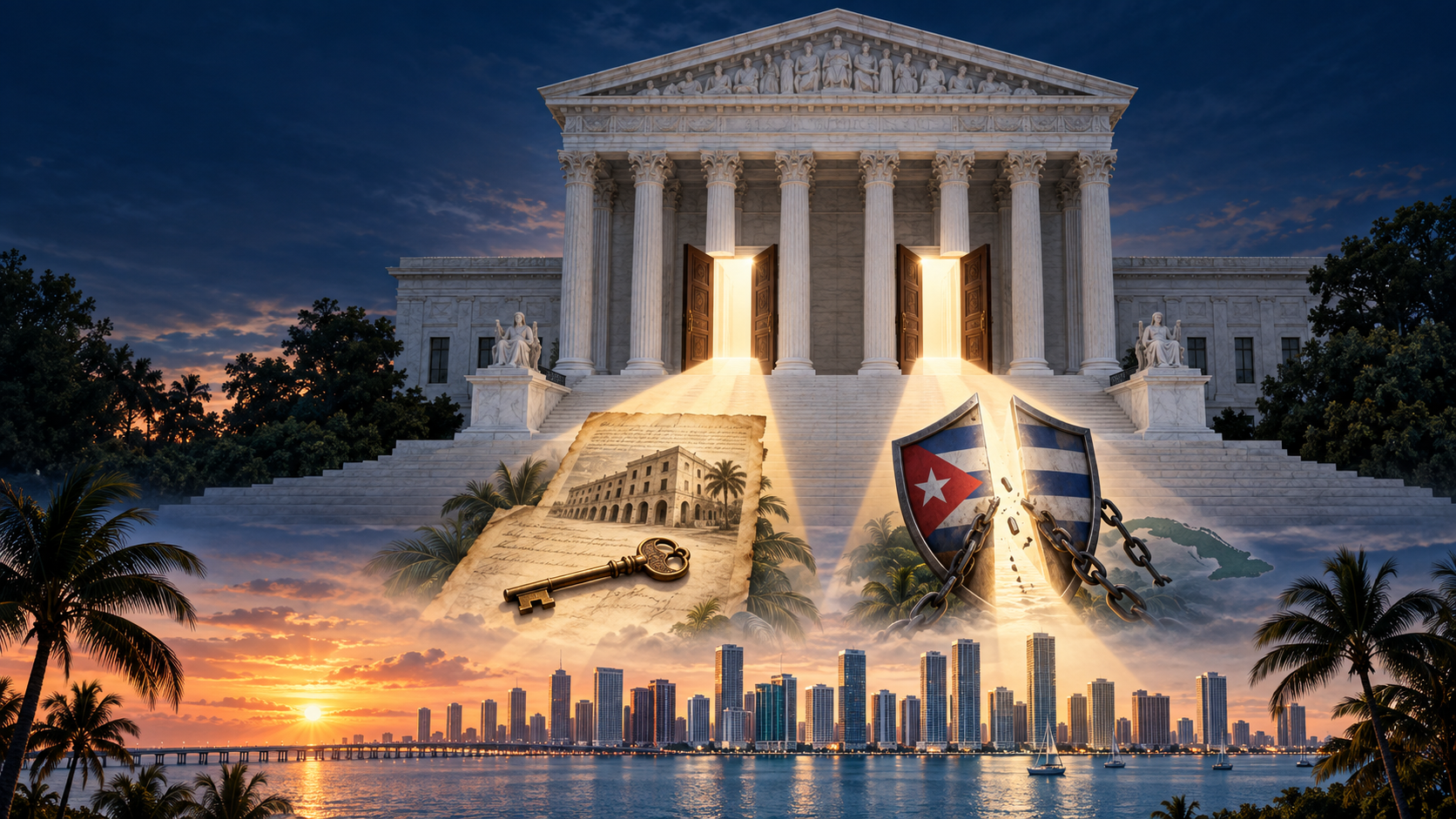
The Supreme Court Opened Two Doors on Helms-Burton Title III in Five Weeks
The short answer
In May and June of 2026 the Supreme Court decided two cases under Title III of the Helms-Burton Act, and both went against the defendants. The first held that a claimant may sue over the confiscated property itself even though its own interest in that property had expired. The second held that Cuban state owned entities do not get foreign sovereign immunity in these cases. Together they remove the two principal obstacles that had been keeping Title III claims out of court, and South Florida is where those claims are filed.
Why it comes up
Title III of the Cuban Liberty and Democratic Solidarity Act of 1996 gives a United States national a damages claim against anyone who "traffics" in property confiscated by the Cuban government on or after January 1, 1959. The right to sue was suspended by every administration until 2019. Since the suspension was lifted, claims have accumulated, and until this year the defenses had largely been holding.
Havana Docks Corporation v. Royal Caribbean Cruises, Ltd., No. 24-983 (May 21, 2026)
Havana Docks held a ninety nine year concession, granted in 1905 and expiring in 2004, to operate the Havana port docks. Cuba expropriated the concession in 1960, and the Foreign Claims Settlement Commission certified the loss at approximately $9 million. After the suspension was lifted in 2019, Havana Docks sued four cruise lines over their use of the docks from 2016 to 2019. The district court entered judgment of roughly $110 million per defendant. The Eleventh Circuit reversed, reasoning that the concession had expired well before the alleged trafficking.
The Supreme Court reversed, 8 to 1, in an opinion by Justice Thomas. The holding is that the statute reaches the confiscated property itself and not merely the claimant's interest in it. In the majority's phrasing, confiscated property is "tainted," and one who uses it faces liability to the holder of the prior interest. Justice Sotomayor, joined by Justice Kavanaugh, concurred, flagging the arithmetic problem of a $9 million certified loss producing potentially unlimited recoveries. Justice Kagan dissented alone, on the ground that the docks "belonged to the Cuban Government, not Havana Docks, all along." The case was remanded, and the Transnational Litigation Blog reports that the remand reaches the statutory exclusion for uses "incident to lawful travel to Cuba," a defense the lower courts had not fully addressed and which could still dispose of the judgment.
Exxon Mobil Corp. v. Corporación Cimex, S.A., No. 24-699 (June 23, 2026)
Standard Oil's Cuban operations, later Exxon Mobil's, included a refinery, product terminals and 117 service stations, all seized in 1960. An American commission certified the loss at nearly $72 million in 1969. With interest and a treble damages request, the amount in controversy runs into the hundreds of millions.
The question was whether Helms-Burton abrogates the sovereign immunity of Cuban state owned entities, or whether a claimant must also satisfy an exception under the Foreign Sovereign Immunities Act. The Court held, 6 to 3, in an opinion by Justice Kavanaugh, that Helms-Burton authorizes suit directly. "Stacking an FSIA requirement on top of the Helms-Burton Act would thwart Congress's design," the majority wrote, adding that "Congress does not ordinarily enact self-defeating statutes." Justice Kagan dissented, joined by Justices Sotomayor and Jackson, on the ground that abrogation of sovereign immunity requires "unmistakable clarity" that the statute's text does not supply.
Our take: the doors are open, and the room behind them is not empty
These decisions do not create new claims. They remove defenses. The distinction matters because the claims already exist in volume, and the practical effect is to move a large inventory of dormant Title III matters into active litigation, most of it in the Southern District of Florida.
Three points we would emphasize, including one that cuts against the plaintiffs.
First, the remaining obstacles are not trivial. Commentators have noted that abrogating immunity from suit is not the same as abrogating immunity from execution, and that the FSIA's service provisions may not follow automatically. A claimant may win a judgment against a Cuban state entity and still have nothing to collect against.
Second, the exposure runs to commercial defendants, not just the Cuban government. The cruise line case is the model. The defendants there were ordinary American companies operating under what they believed were lawful federal authorizations at the time. The Cuban state entities are the headline, but the commercial defendants are the docket.
Third, the "incident to lawful travel" exclusion is the live defense. The Havana Docks remand puts it squarely in issue. Any company that entered Cuba during the 2016 to 2019 opening did so under federal authorizations that existed at the time, and whether that fact defeats liability is now the most consequential open question in this area.
Layered on top is a changed sanctions environment. Executive Order 14404, issued May 1, 2026, created a new Cuba sanctions program under the International Emergency Economic Powers Act, separate from and additional to the Cuban Assets Control Regulations, and reaching non Cuban persons and foreign financial institutions. On June 11, 2026, OFAC designated Unión Cuba Petróleo, the state oil and gas company, under that order. A company assessing Title III exposure is now assessing sanctions exposure at the same time, and the two analyses do not have the same answers.
What it means practically
If your company had any commercial contact with Cuban property between 2016 and 2019, or has one now, three questions are worth answering before a complaint arrives:
1. What property did you touch, and is there a certified claim against it? Certification matters, because it drives treble damages.
2. What federal authorization were you operating under, and can you document reliance on it?
3. Does your current activity touch a designated entity, directly or through infrastructure that entity controls?
When to call a lawyer
Before responding to a Title III demand letter, and before any transaction touching Cuban property or Cuban counterparties. These claims can carry enhanced damages under 22 U.S.C. 6082(a)(3), but only where the claim was certified by the Foreign Claims Settlement Commission or where the claimant gave the statutory written notice at least 30 days before suit and the defendant continued trafficking afterward. Which route applies changes the settlement calculus from the first day.
Sources
● SCOTUSblog, Court rules against cruise lines in Cuban confiscation case (May 21, 2026)
● SCOTUSblog, Court rules for Exxon Mobil in Cuban confiscation case (June 23, 2026)
● Transnational Litigation Blog, Cimex
● PBS NewsHour, Supreme Court OKs ExxonMobil lawsuit over Cuban property (June 23, 2026)
● CNN, Exxon can sue Cuba over property confiscated in 1960 (June 23, 2026)
● Courthouse News Service, Supreme Court greenlights suit against cruise giants
Disclaimer
This post discusses publicly reported legal developments for general informational purposes. It is not legal advice, it does not create an attorney client relationship, and it does not reflect the firm's position in any pending matter. Outcomes depend on the specific facts and the governing law of the relevant jurisdiction.