
Hirzel Dreyfuss & Dempsey, PLLC
NEWS AND INFORMATION

The Florida Supreme Court Just Invalidated a Large Number of Outstanding Settlement Proposals
The short answer
On July 2, 2026, the Florida Supreme Court held that a joint proposal for settlement must apportion the amount among the parties, and eliminated the exception some courts had recognized for proposals addressing a single unified claim. Any outstanding unapportioned joint proposal is now unlikely to support a fee award, and this is worth checking against every open file this week.
Why it comes up
The proposal for settlement is the principal fee-shifting device in Florida civil litigation, and it is how most cases get valued. Rule 1.442 requires that a proposal made by or to multiple parties state the amount and terms attributable to each party. Some courts had excused apportionment where the claim was unified and indivisible.
What the court held
The case arose from a residential renovation dispute. The owners sued a design company that had left the job; the company counterclaimed. Before trial the owners served a joint, unapportioned proposal of $10,000. The Fourth District held the proposal valid under the unified claim exception.
The Florida Supreme Court quashed that decision and approved the contrary decision of the Second District, holding that the rule requires apportionment in every joint proposal, whether or not the claim is unified.
Our take: this is a housekeeping emergency, not an academic development
Fee-shifting rules are technical and it is tempting to treat a decision like this as a detail. It is not. A proposal for settlement is often the single most valuable piece of paper in a case, because the prospect of fee exposure is what moves a defendant. A proposal that turns out to be invalid does not merely fail to shift fees. It removes the leverage the case was being litigated on, usually at the moment the case is being valued for settlement or trial.
The joint proposals that are now invalid are common in this firm's practice areas: spouses jointly asserting a construction defect claim, an association together with individual unit owners, affiliated developer entities, a contractor and its surety, business partners suing jointly.
The fix is simple where the proposal can still be reissued: state a dollar amount for each offeror and each offeree. The problem is the proposals already served, where the acceptance period has run and the case is heading to trial on the assumption that fee exposure attaches. Those need to be identified now, and in some cases served again.
What it means practically
Audit every open file for outstanding proposals for settlement involving more than one party on either side. Where the proposal is unapportioned, assume it will not support a fee award and decide whether a new, properly apportioned proposal should be served. Where the deadline has passed, the case may need to be revalued.
When to call a lawyer
Now, if you have a pending case with an outstanding joint proposal. This is a deadline-sensitive problem.
Sources
● Trace Elements, Inc. v. Mackensen, No. SC2024-1274 (Fla. July 2, 2026), via Justia
Disclaimer
This post discusses publicly reported legal developments for general informational purposes. It is not legal advice, it does not create an attorney client relationship, and it does not reflect the firm's position in any pending matter. Outcomes depend on the specific facts and the governing law of the relevant jurisdiction.

Your Employees Want the Service Charge Reclassified as a Tip. Doing It Creates a Wage and Hour Problem.
The short answer
Final Treasury and Internal Revenue Service regulations implementing the deduction for tip income published April 13, 2026 and took effect June 12, 2026. They define which payments qualify, and they exclude automatic gratuities and service charges. Hospitality employers across South Florida are being asked by staff to reclassify service charges as tips so the money qualifies. Doing that does not make it a tip for tax purposes, and it can create a wage and hour problem that did not exist before.
What the regulations do
The final regulations establish a list of occupations that customarily and regularly received tips on or before December 31, 2024, and require that a qualified tip be voluntary, determined by the payor, and not subject to negotiation. They cover card and electronic tips, address tip pools and the participation of managers and supervisors, and exclude tips arising from specified service businesses. The deduction is capped at twenty-five thousand dollars with a phase-out based on income.
Most importantly for an operator: automatic gratuities and service charges are excluded.
Our take: the tax question and the wage question are different questions with different answers
The distinction the regulations draw is the same one wage and hour law has drawn for decades, and that is not a coincidence.
A tip is money the customer decides to give, in an amount the customer chooses. A service charge is money the house imposes. Under wage and hour law, that difference determines whether the money belongs to the employee, whether it can be counted toward the minimum wage through a tip credit, who may share in it, and how overtime is calculated. Service charges are generally the employer's revenue, which the employer may distribute, and amounts distributed are wages that must be included in the regular rate for overtime.
So an employer that responds to staff pressure by relabeling a mandatory service charge as a tip is making three changes at once, only one of which was intended:
● It does not achieve the tax result. The regulations look at the substance. A charge the house imposes is not voluntary and not payor-determined, whatever it is called on the check.
● It may create a tip credit problem. If the employer takes a tip credit, the composition of the tip pool and who participates in it are regulated. Adding house-imposed money to that pool, or adding participants, can invalidate the credit and expose the employer to the difference for every hour worked.
● It may create an overtime problem. Service charge distributions are wages that belong in the regular rate. Recharacterizing them as tips removes them from that calculation, and if the recharacterization is wrong, the overtime was underpaid.
There is a further trap worth naming. The Department of Labor's public fact sheet on tipped employees still recites the twenty percent and thirty continuous minute limits from a rule that was vacated in litigation, with no mention of the vacatur. An employer relying on that fact sheet for tip credit compliance is relying on a document that does not reflect current law.
We should be clear about scope. This is a tax development, not a wage and hour rulemaking, and we found no Department of Labor tip credit rulemaking in the past year. The reason it belongs on an employment page is that the tax change is driving employers to make wage and hour decisions.
What it means practically
If staff have asked about reclassifying service charges, the answer is that the label does not control and the change carries risk in a different body of law. If you want employees to capture the deduction, the route is to make the payment a genuine tip, which means making it voluntary and customer-determined, and that is a pricing and operations decision, not a payroll relabeling.
When to call a lawyer
Before changing how any charge appears on a guest check or in payroll, and before revising a tip pool.
Why this is not a do-it-yourself problem
Here the client is being asked by their own employees to make a change that sounds like payroll administration and is actually a decision under two statutes at once. Whether a payment is a tip or a service charge determines who owns it, whether a tip credit survives, and how overtime is calculated, and the label on the check does not control any of it. This is also an area where the government's own published guidance is out of date, which means the compliance answer cannot be looked up.
Talk to us
This firm defends employers in wage and hour litigation, including Fair Labor Standards Act collective actions, and advises on the pay practices that generate them. Before you change how a charge appears on a guest check or in payroll, discuss your matter with our attorneys.
Sources
● Internal Revenue Bulletin 2026-18, containing T.D. 10044
● Department of Labor Fact Sheet 15A, tipped employees under the FLSA
Disclaimer
This post discusses publicly reported legal developments for general informational purposes. It is not legal advice, it does not create an attorney client relationship, and it does not reflect the firm's position in any pending matter. Outcomes depend on the specific facts and the governing law of the relevant jurisdiction.
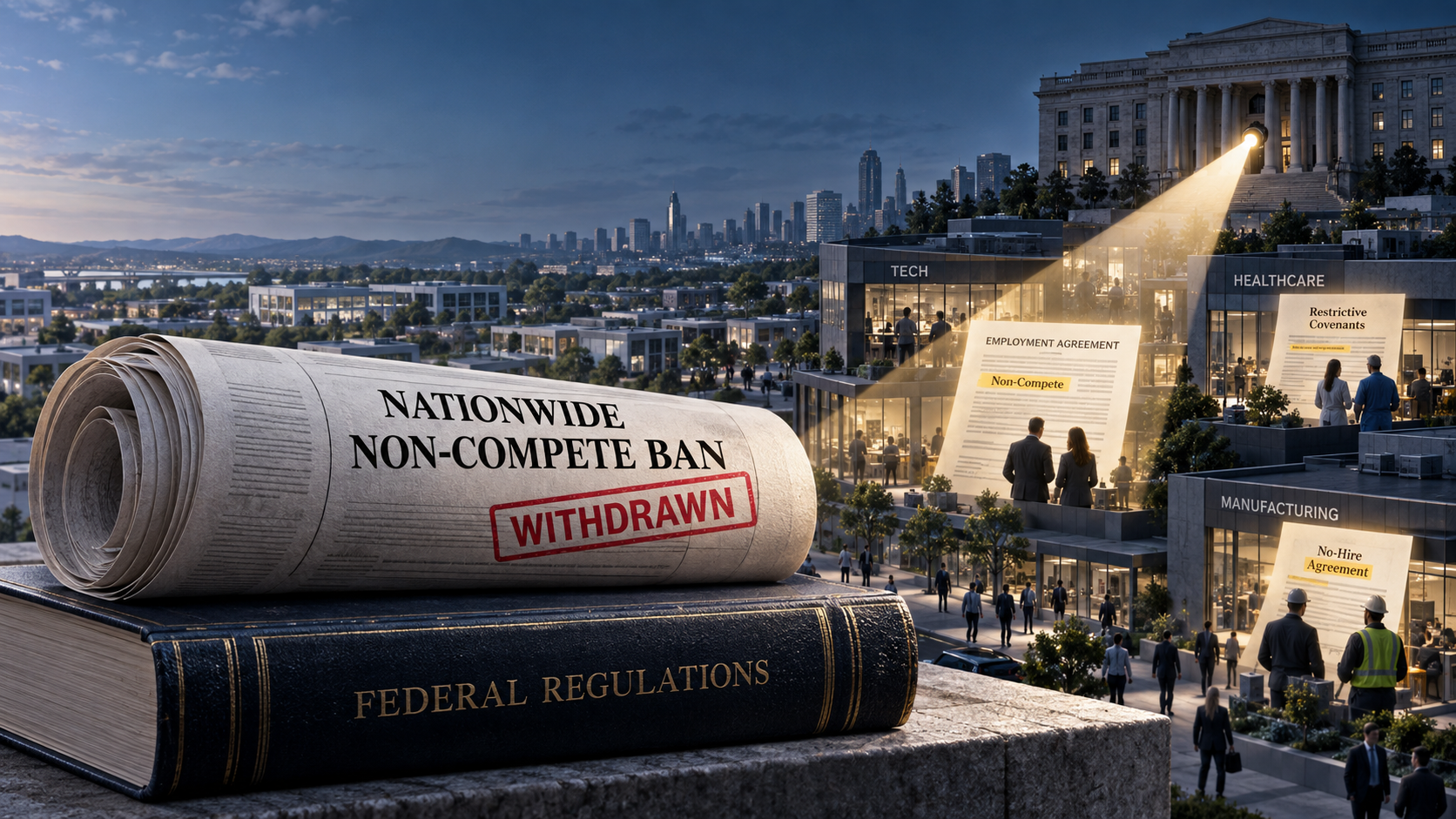
The Federal Non-Compete Ban Is Dead. The Agency That Wrote It Is Still Coming After Non-Competes.
The short answer
The Federal Trade Commission abandoned its defense of the 2024 rule that would have banned nearly all non-competes nationwide, and formally removed the rule from the Code of Federal Regulations effective February 12, 2026. It then began enforcing against non-competes case by case, including consent orders reaching more than eighteen thousand employees at a single company. The existential threat to restrictive covenant programs is gone. A narrower and better-aimed threat replaced it.
What happened, in order
September 4, 2025. The Commission issued a request for information on employer non-compete agreements, with comments due November 3.
September 5, 2025. The Commission voted three to one to dismiss its appeals and accede to vacatur of the rule. The vacatur rested on a holding that the Commission had exceeded its statutory authority.
September 10, 2025. The Chairman issued warning letters to several large healthcare employers and staffing firms, urging review of non-competes covering nurses and physicians.
November 2025. A final consent order against a pet cremation company required it to stop enforcing non-competes covering roughly eighteen hundred employees.
February 12, 2026. The Federal Register document removing the rule from the Code of Federal Regulations published and took effect.
February and June 2026. Consent orders against a building services company over no-hire agreements, and against a pest control company, the latter ending non-compete enforcement against more than eighteen thousand employees.
Our take: the exposure moved from everyone to a specific kind of employer
The instinct after a rule is vacated is to conclude the subject is closed. That instinct is wrong here, and the difference between the rule and what replaced it is the whole point.
The rule was categorical. It would have voided nearly every non-compete for nearly every worker. Its defeat means a Florida employer can build a restrictive covenant program without hedging against a federal ban, including under Florida's own statutory framework and the newer garden leave provisions.
The enforcement is targeted. Look at what the Commission actually charged: blanket covenants applied to rank and file service workers across an entire national workforce, and no-hire agreements between companies. Those are the fact patterns, and they are common in exactly the industries South Florida is full of, including healthcare staffing, building services, pest control and hospitality.
Two points that clients consistently get wrong.
A covenant can be enforceable under Florida law and still be a federal problem. Florida's statute asks whether there is a legitimate business interest and whether the restriction is reasonable in time and area. The Commission's theory is a competition theory under its own statute. Passing the first test does not answer the second.
No-hire and no-poach agreements between companies are within the scope. Many employers do not think of an agreement with a vendor or a competitor not to hire each other's people as a non-compete at all. The consent orders treat that conduct as within reach.
The practical direction is narrow tailoring and role differentiation. A covenant that binds an executive with access to strategy and customer relationships is defensible. The same covenant applied to every hourly employee in a national workforce is the thing the Commission has been buying consent orders about.
We would be candid that this enforcement posture depends on the composition of the Commission and could change. That is an argument for tailoring covenants to what you actually need to protect, which is good practice regardless of who is enforcing.
When to call a lawyer
Before rolling out a covenant across a workforce, before entering any agreement with another company about hiring, and on receipt of any inquiry from the Commission.
Why this is not a do-it-yourself problem
A restrictive covenant program now has to satisfy two different bodies of law with different tests, and passing one does not answer the other. Tailoring covenants by role, drafting them to a legitimate business interest, and keeping employer-to-employer hiring agreements out of the enforcement theory are drafting judgments that require knowing both frameworks. The employers named in the consent orders were not outliers; they were using standard forms across standard workforces.
Talk to us
HDD Law Firm drafts and litigates non-compete and other restrictive covenant agreements, and represents both employers and executives in those disputes. If you are rolling out covenants across a workforce, or you are an executive bound by one, discuss your matter with our attorneys.
Sources
● FTC, Commission files to accede to vacatur of the Non-Compete Clause Rule (September 5, 2025)
● Federal Register, removal of the Non-Compete Rule from the CFR (February 12, 2026)
● FTC non-compete enforcement page
● FTC, final order prohibiting non-compete enforcement, Gateway Services (November 2025)
Disclaimer
This post discusses publicly reported legal developments for general informational purposes. It is not legal advice, it does not create an attorney client relationship, and it does not reflect the firm's position in any pending matter. Outcomes depend on the specific facts and the governing law of the relevant jurisdiction.

Two Defamation Cases Against Netflix Show Why "We Never Said That" Is Not a Defense
The short answer
Within ten weeks, a South Carolina judge refused to dismiss a defamation claim over a true-crime documentary, and a federal court in California received a motion to strike a defamation claim by the creator of a reality series over a documentary about her own show. Neither case is about a false statement of fact. Both are about editing. That is the point worth understanding, because the same theory reaches ordinary businesses far more often than it reaches celebrities.
Why it comes up
Most people assume defamation requires someone to say something false. The more common claim in practice is defamation by implication: every individual statement is accurate, but the arrangement, juxtaposition and omission create a false impression. A profile that reports a company's true revenue decline, then cuts to an unrelated fraud investigation, may state nothing false and still convey something false.
That theory is why a business sues over a news segment, a trade publication article, a competitor's comparison chart, or a former employee's post. It is also the hardest defamation theory to defend, because the defendant cannot simply point at each sentence and say it was true.
The Murdaugh ruling
On August 27, 2026, a South Carolina judge denied motions to dismiss a defamation suit brought by Buster Murdaugh, the son of Alex Murdaugh, over a Netflix documentary that the plaintiff says connected him to the 2015 death of Stephen Smith, a Hampton County teenager. Smith's death was originally ruled a hit and run and later reclassified as a homicide. Murdaugh has never been named as a suspect.
The defendants argued the First Amendment protected reporting on the true fact that theories and speculation existed, and that the documentary posed questions and invited viewers to draw their own conclusions.
Judge Heath P. Taylor rejected that framing at the pleading stage. He wrote that the plaintiff alleges the defendants "selectively crafted and interposed interviews from law enforcement, community members and media personnel with those law enforcement reports to create the defamatory implication that Plaintiff is responsible for Stephen Smith's death." He found that the "creative liberties" taken in the production "present the information in a manner that can be reasonably interpreted by a viewer as answering the questions posed, mainly the speculation of Plaintiff's involvement in the death of Stephen Smith."
All motions to dismiss were denied and the case proceeds.
The Tyra Banks complaint
On June 13, 2026, Tyra Banks sued Netflix, the directors of its docuseries about America's Next Top Model, and the production company in the United States District Court for the Central District of California. She pleads defamation by implication, false light, breach of contract and false endorsement.
The core allegation is proportion. She sat for a three and a half hour interview; roughly sixteen minutes appeared. She alleges her comments were "stripped of context and reassembled to support a false and defamatory narrative unrelated to what she actually expressed." The specific example she cites is a sequence in which she is asked whether she remembers a contestant's account of a sexual assault, answers "um," and the screen cuts to black, which she says implies she could not remember it.
Netflix moved to strike and dismiss. Its motion argues the complaint is "about ordinary editorial decisions," that the documentary in fact shows her saying "I do remember her story," and that "a documentary expressly showing Banks remembering does not imply that she forgot." The motion also argues she signed an agreement granting the right to edit her footage, acknowledging she had "no right to review or approve" the finished documentary, and releasing claims including defamation and false light.
Our take: the release is the whole case, and most people sign one without reading it
Set the celebrity names aside and two lessons remain, both of which apply to any business owner or executive who is ever asked to comment on camera or on the record.
First, the editing is the claim. In both matters the publisher's position is that it reported accurately and made editorial choices. In both, the plaintiff's position is that the choices themselves conveyed a falsehood. The South Carolina court held that theory sufficient to survive dismissal. That is a meaningful signal: a defendant cannot reliably win at the pleading stage by parsing each statement in isolation, because the claim is about the whole.
Second, and more practically, the participation agreement decides most of these cases before they start. Netflix's lead argument is not that the documentary was accurate. It is that the plaintiff signed away the claim. That is a contract defense, and it is usually a good one. The standard participant release grants editing rights, disclaims any right of review or approval, and releases defamation and false light claims by name. Anyone who signs one and later dislikes the result is litigating against their own signature.
We should be candid about the tension between these two points. The Murdaugh defendants apparently had no release from the plaintiff, because he did not participate. The Banks defendants did. That difference may matter more than any doctrinal question about implication, and it is the reason the two cases could come out differently on similar theories.
There is also a fault question neither of these sources addresses. A public figure must prove actual malice, meaning knowledge of falsity or reckless disregard for the truth. A private figure ordinarily need not. Public figure status is a legal question decided on the facts, and general prominence does not by itself make someone an all-purpose or limited-purpose public figure as to a particular controversy. If either plaintiff is held to be one, actual malice becomes a serious obstacle, and that is a point the reporting does not reach.
What it means practically
Before you participate in any documentary, podcast, news feature or trade press profile: read the release. Ask whether you have any right of review, whether the release names defamation and false light, and whether it covers the entity as well as the individual. If the answer is that you have no approval right and have released those claims, understand that you are accepting whatever portrayal results.
If you have been portrayed unfairly and did not sign anything: the claim is about the whole piece, not one sentence. Preserve the publication, note the sequence and the omissions, and move quickly. Florida's limitations period for defamation is short, and a retraction demand under Florida's pre-suit statute may be a prerequisite to certain damages.
If you publish: the exposure is in the juxtaposition and the cut, not in the individual sentences your fact-checker verified.
When to call a lawyer
Before signing a participation agreement, and immediately after a damaging publication rather than after watching to see whether it blows over.
Sources
● WCBD News 2, Judge allows Buster Murdaugh's defamation lawsuit against Netflix to proceed
● The New York Times, Tyra Banks sues Netflix for defamation over Top Model docuseries (June 14, 2026)
● The Hollywood Reporter, Netflix files to dismiss Tyra Banks' ANTM defamation lawsuit
Disclaimer
This post discusses publicly reported legal developments for general informational purposes. It is not legal advice, it does not create an attorney client relationship, and it does not reflect the firm's position in any pending matter. Outcomes depend on the specific facts and the governing law of the relevant jurisdiction.

The Supreme Court Opened Two Doors on Helms-Burton Title III in Five Weeks
The short answer
In May and June of 2026 the Supreme Court decided two cases under Title III of the Helms-Burton Act, and both went against the defendants. The first held that a claimant may sue over the confiscated property itself even though its own interest in that property had expired. The second held that Cuban state owned entities do not get foreign sovereign immunity in these cases. Together they remove the two principal obstacles that had been keeping Title III claims out of court, and South Florida is where those claims are filed.
Why it comes up
Title III of the Cuban Liberty and Democratic Solidarity Act of 1996 gives a United States national a damages claim against anyone who "traffics" in property confiscated by the Cuban government on or after January 1, 1959. The right to sue was suspended by every administration until 2019. Since the suspension was lifted, claims have accumulated, and until this year the defenses had largely been holding.
Havana Docks Corporation v. Royal Caribbean Cruises, Ltd., No. 24-983 (May 21, 2026)
Havana Docks held a ninety nine year concession, granted in 1905 and expiring in 2004, to operate the Havana port docks. Cuba expropriated the concession in 1960, and the Foreign Claims Settlement Commission certified the loss at approximately $9 million. After the suspension was lifted in 2019, Havana Docks sued four cruise lines over their use of the docks from 2016 to 2019. The district court entered judgment of roughly $110 million per defendant. The Eleventh Circuit reversed, reasoning that the concession had expired well before the alleged trafficking.
The Supreme Court reversed, 8 to 1, in an opinion by Justice Thomas. The holding is that the statute reaches the confiscated property itself and not merely the claimant's interest in it. In the majority's phrasing, confiscated property is "tainted," and one who uses it faces liability to the holder of the prior interest. Justice Sotomayor, joined by Justice Kavanaugh, concurred, flagging the arithmetic problem of a $9 million certified loss producing potentially unlimited recoveries. Justice Kagan dissented alone, on the ground that the docks "belonged to the Cuban Government, not Havana Docks, all along." The case was remanded, and the Transnational Litigation Blog reports that the remand reaches the statutory exclusion for uses "incident to lawful travel to Cuba," a defense the lower courts had not fully addressed and which could still dispose of the judgment.
Exxon Mobil Corp. v. Corporación Cimex, S.A., No. 24-699 (June 23, 2026)
Standard Oil's Cuban operations, later Exxon Mobil's, included a refinery, product terminals and 117 service stations, all seized in 1960. An American commission certified the loss at nearly $72 million in 1969. With interest and a treble damages request, the amount in controversy runs into the hundreds of millions.
The question was whether Helms-Burton abrogates the sovereign immunity of Cuban state owned entities, or whether a claimant must also satisfy an exception under the Foreign Sovereign Immunities Act. The Court held, 6 to 3, in an opinion by Justice Kavanaugh, that Helms-Burton authorizes suit directly. "Stacking an FSIA requirement on top of the Helms-Burton Act would thwart Congress's design," the majority wrote, adding that "Congress does not ordinarily enact self-defeating statutes." Justice Kagan dissented, joined by Justices Sotomayor and Jackson, on the ground that abrogation of sovereign immunity requires "unmistakable clarity" that the statute's text does not supply.
Our take: the doors are open, and the room behind them is not empty
These decisions do not create new claims. They remove defenses. The distinction matters because the claims already exist in volume, and the practical effect is to move a large inventory of dormant Title III matters into active litigation, most of it in the Southern District of Florida.
Three points we would emphasize, including one that cuts against the plaintiffs.
First, the remaining obstacles are not trivial. Commentators have noted that abrogating immunity from suit is not the same as abrogating immunity from execution, and that the FSIA's service provisions may not follow automatically. A claimant may win a judgment against a Cuban state entity and still have nothing to collect against.
Second, the exposure runs to commercial defendants, not just the Cuban government. The cruise line case is the model. The defendants there were ordinary American companies operating under what they believed were lawful federal authorizations at the time. The Cuban state entities are the headline, but the commercial defendants are the docket.
Third, the "incident to lawful travel" exclusion is the live defense. The Havana Docks remand puts it squarely in issue. Any company that entered Cuba during the 2016 to 2019 opening did so under federal authorizations that existed at the time, and whether that fact defeats liability is now the most consequential open question in this area.
Layered on top is a changed sanctions environment. Executive Order 14404, issued May 1, 2026, created a new Cuba sanctions program under the International Emergency Economic Powers Act, separate from and additional to the Cuban Assets Control Regulations, and reaching non Cuban persons and foreign financial institutions. On June 11, 2026, OFAC designated Unión Cuba Petróleo, the state oil and gas company, under that order. A company assessing Title III exposure is now assessing sanctions exposure at the same time, and the two analyses do not have the same answers.
What it means practically
If your company had any commercial contact with Cuban property between 2016 and 2019, or has one now, three questions are worth answering before a complaint arrives:
1. What property did you touch, and is there a certified claim against it? Certification matters, because it drives treble damages.
2. What federal authorization were you operating under, and can you document reliance on it?
3. Does your current activity touch a designated entity, directly or through infrastructure that entity controls?
When to call a lawyer
Before responding to a Title III demand letter, and before any transaction touching Cuban property or Cuban counterparties. These claims can carry enhanced damages under 22 U.S.C. 6082(a)(3), but only where the claim was certified by the Foreign Claims Settlement Commission or where the claimant gave the statutory written notice at least 30 days before suit and the defendant continued trafficking afterward. Which route applies changes the settlement calculus from the first day.
Sources
● SCOTUSblog, Court rules against cruise lines in Cuban confiscation case (May 21, 2026)
● SCOTUSblog, Court rules for Exxon Mobil in Cuban confiscation case (June 23, 2026)
● Transnational Litigation Blog, Cimex
● PBS NewsHour, Supreme Court OKs ExxonMobil lawsuit over Cuban property (June 23, 2026)
● CNN, Exxon can sue Cuba over property confiscated in 1960 (June 23, 2026)
● Courthouse News Service, Supreme Court greenlights suit against cruise giants
Disclaimer
This post discusses publicly reported legal developments for general informational purposes. It is not legal advice, it does not create an attorney client relationship, and it does not reflect the firm's position in any pending matter. Outcomes depend on the specific facts and the governing law of the relevant jurisdiction.

The Florida Statute That Reaches Creditors the Federal Debt Collection Act Does Not
The short answer
A class action filed in the Northern District of Florida in May 2026 alleges that a credit card bank kept collecting from a consumer after being told he was represented by counsel. The interesting legal question is not whether that is prohibited. It is which statute prohibits it. Under Eleventh Circuit law, a bank collecting debts it owns is generally not a "debt collector" and is generally outside the federal Fair Debt Collection Practices Act. Florida's statute has no such limit. It reaches any person collecting a consumer debt, and that difference is the entire case.
Why it matters to Florida businesses
Any business that extends credit to consumers and then collects on it, in its own name, is subject to the Florida Consumer Collection Practices Act. Many of those businesses have compliance programs built around the federal statute, which does not apply to them, and no program at all for the state statute, which does.
That is an avoidable exposure, and it is the reason this post exists.
What was filed
Pitts v. Merrick Bank, No. 5:26-cv-00138, was filed in the United States District Court for the Northern District of Florida on May 27, 2026, before District Judge M. Casey Rodgers and Magistrate Judge Michael J. Frank.
According to reporting on the filing, the plaintiff notified the original creditor in May 2025 that he was represented by an attorney and that all future communications should go to counsel; that the notice of representation was disclosed during the sale of the debt; that the bank nonetheless retained a collection agency to contact him directly; and that a collection letter dated December 27, 2025 failed to disclose that the debt was disputed. The reporting describes claims under both the federal act and the Florida act, brought on behalf of a putative class, seeking declaratory and injunctive relief, statutory and actual damages, and fees.
These are allegations in a complaint. Nothing has been adjudicated.
What the two statutes actually say
The federal provision. 15 U.S.C. 1692c(a)(2) provides that, without the consumer's prior consent given directly to the debt collector or a court's express permission, a debt collector may not communicate with a consumer in connection with the collection of any debt if the debt collector knows the consumer is represented by an attorney with respect to such debt and has knowledge of, or can readily ascertain, such attorney's name and address, unless the attorney fails to respond within a reasonable period of time to a communication from the debt collector or unless the attorney consents to direct communication.
The Florida provision. Fla. Stat. 559.72(18) provides that, in collecting consumer debts, a person may not communicate with a debtor if the person knows that the debtor is represented by an attorney with respect to such debt and has knowledge of, or can readily ascertain, such attorney's name and address, unless the debtor's attorney fails to respond within 30 days to a communication from the person, unless the debtor's attorney consents to a direct communication with the debtor, or unless the debtor initiates the communication.
Read the two openings again. The federal provision governs a debt collector. The Florida provision governs a person.
Our take: the coverage gap is the whole story
Who is a "debt collector" federally. Under 15 U.S.C. 1692a(6), the term means a person whose principal purpose is the collection of debts, or who regularly collects debts owed or due another. It excludes, among others, officers and employees of a creditor collecting in the creditor's name, and persons collecting debts they originated.
The Eleventh Circuit addressed the purchased-debt scenario squarely in Davidson v. Capital One Bank (USA), N.A., 797 F.3d 1309 (11th Cir. 2015). Capital One had purchased defaulted credit card accounts from another bank. The court held that a bank does not qualify as a debt collector where it does not regularly collect debts owed or due another and where debt collection is not the principal purpose of its business, even where the debt was in default when the bank acquired it. The inquiry, the court said, is not whether the bank collects on debts originally owed to another and now owed to it, but whether it collects on debts owed to another at the time of collection.
The practical consequence for a case like the one filed in May is significant. If the bank owns the accounts it is collecting, the federal claim against the bank is on difficult ground. The retained collection agency is a different matter entirely, since an agency collecting a debt owed to someone else is squarely within the definition.
Florida closes the gap. Section 559.72 opens with "In collecting consumer debts, a person may not." There is no definitional gate, and no exclusion for creditors collecting their own debts. Section 559.77(1) authorizes a civil action against "a person violating the provisions of s. 559.72," and 559.77(2) makes "any person" who fails to comply liable.
The Eleventh Circuit applied the statute to a first-party creditor in Medley v. DISH Network, LLC, 958 F.3d 1063 (11th Cir. 2020), where DISH was collecting its own account. And a federal court in Florida allowed an FCCPA claim against an original credit card issuer on facts close to those alleged here in Kelliher v. Target National Bank, 826 F. Supp. 2d 1324 (M.D. Fla. 2011), where the consumer had notified the bank of representation and the bank both continued sending statements and retained a third-party agency. The court credited the theory that the creditor used the agency as the medium through which to send collection communications, noting that the statute defines "communicate" to include conveying information about a debt indirectly through any medium.
Two more differences worth knowing. Florida fixes the attorney non-response window at 30 days, where the federal statute says only "a reasonable period of time." And Florida adds a safe harbor the federal statute lacks: the prohibition does not apply where the debtor initiates the communication.
The defense side is not empty. Medley is also the leading authority on what a plaintiff must prove. The Eleventh Circuit held that even where the direct contact and the notice of representation are established, the statute requires actual knowledge, not constructive knowledge, and that the knowledge must be specific to the debt being collected. The court remanded for the district court to consider whether DISH actually knew the consumer was represented as to the debt at issue, and whether the bona fide error defense applied.
That defense, at Fla. Stat. 559.77(3), provides that a person may not be held liable if the person shows by a preponderance of the evidence that the violation was not intentional and resulted from a bona fide error. The Florida text differs from its federal counterpart in a way that has been litigated, and a business relying on it should not assume the federal case law transfers.
What it means practically
For a business collecting its own consumer accounts in Florida: build the notice-of-representation process around Florida's statute, not the federal one. That means a defined intake path for attorney representation notices, a flag that travels with the account, and, critically, a mechanism that carries the flag to any agency or purchaser the account is placed with or sold to. The theory in Kelliher is that a creditor can communicate indirectly through an agency. An account file that omits the representation flag is where that theory is born.
Understand the remedies. Fla. Stat. 559.77(2) provides actual damages plus additional statutory damages not exceeding $1,000, together with court costs and reasonable attorney's fees. In a class action, statutory damages run up to $1,000 per named plaintiff plus an aggregate award for the remaining class members capped at the lesser of $500,000 or one percent of the defendant's net worth. Punitive damages and injunctive relief are available. The limitations period is two years from the violation. And the statute contains a reverse fee provision: a plaintiff whose suit fails to raise a justiciable issue of law or fact is liable for the defendant's costs and fees.
Note that registration exemption is not substantive exemption. Original creditors are among the categories not required to register as consumer collection agencies under Fla. Stat. 559.553. That exemption is from the registration requirement only. It does not exempt anyone from Section 559.72.
When to call a lawyer
Before a collection program starts, when the process is a design question. And immediately on receiving a claim, because the two-year limitations period and the bona fide error defense both turn on records that need to be preserved at once.
Why this is not a do-it-yourself problem
The trap here is that the well-known statute is the wrong one. A business that reads the federal act, correctly concludes it is not a debt collector, and stops, has just built a compliance program around a statute that does not apply to it while ignoring the one that does. The Florida act reaches further, carries fees and class exposure, and has a knowledge element that turns entirely on internal recordkeeping that nobody designs until after the first claim. The defense, when it comes, is a factual one about what the company actually knew and what its procedures actually were, which means the case is largely won or lost by the document retention and account-flagging decisions made years before anyone sued.
Talk to us
HDD Law Firm represents businesses in commercial disputes and litigation in the Florida state courts, the Southern, Middle and Northern Districts of Florida, and the Eleventh Circuit. If your business extends and collects consumer credit in Florida, contact us to discuss your matter.
Sources
● Pitts v. Merrick Bank, No. 5:26-cv-00138 (N.D. Fla., filed May 27, 2026), docket (CourtListener)
● 15 U.S.C. 1692c, Communication in connection with debt collection
● 15 U.S.C. 1692a, Definitions
● Fla. Stat. 559.72, Prohibited practices generally
● Fla. Stat. 559.77, Civil remedies
● Fla. Stat. 559.553, Registration of consumer collection agencies required
● Davidson v. Capital One Bank (USA), N.A., 797 F.3d 1309 (11th Cir. 2015) (CourtListener)
● Medley v. DISH Network, LLC, 958 F.3d 1063 (11th Cir. 2020) (CourtListener)
● Kelliher v. Target National Bank, 826 F. Supp. 2d 1324 (M.D. Fla. 2011) (CourtListener)
● 12 C.F.R. 1006.6, Communications in connection with debt collection (eCFR)
Disclaimer
This post discusses publicly reported legal developments for general informational purposes. It is not legal advice, it does not create an attorney client relationship, and it does not reflect the firm’s position in any pending matter. Outcomes depend on the specific facts and the governing law of the relevant jurisdiction.

Your Arbitration Agreement May Not Cover Your Drivers, Even If They Never Leave Florida
The short answer
On May 28, 2026, a unanimous Supreme Court held that a worker who moves goods only within one state can still fall within the Federal Arbitration Act's transportation worker exemption, and therefore cannot be compelled to arbitrate under that statute. For any Florida employer whose workers move goods on a final or intermediate leg of an interstate journey, this is the most consequential arbitration decision in years.
What the Court held
In Flowers Foods, Inc. v. Brock, No. 24-935, Justice Gorsuch wrote for a unanimous Court that a worker who transports goods on an intrastate leg of an interstate journey can qualify for the exemption without crossing state lines or interacting with vehicles that do. What matters is whether the worker plays a direct and necessary role in moving goods across state lines, not whether the worker personally crosses a border.
Our take: check the goods, not the job title
The exemption has always been read to cover interstate transportation workers. What employers assumed, reasonably, was that a driver who never left the state was not one. That assumption is now wrong.
The workers this reaches are more numerous than the phrase "transportation worker" suggests: route drivers and distributors, last-mile delivery, port and airport drayage, warehouse-to-store transfer, and bakery and beverage distributors. In South Florida, where goods arrive by ship and air and are then moved locally, that is a large category.
The consequence is not merely that one arbitration agreement fails. If the exemption applies, the Federal Arbitration Act does not supply the enforcement mechanism at all, which means the agreement and any class action waiver in it may be unenforceable under federal law, and a collective action the employer thought was foreclosed is live.
The mitigation is available and most agreements do not have it. The Federal Arbitration Act is not the only arbitration statute. The Florida Arbitration Code is an independent basis for enforcement, and the exemption is a feature of the federal statute rather than a general prohibition on arbitrating these disputes. An agreement that expressly invokes Florida law as an alternative basis, with a severability clause, is in a materially better position than one that recites only the federal act. Many form agreements recite only the federal act.
We should be candid that this is not a complete answer. Whether state arbitration law can be used to enforce an agreement the federal statute exempts is itself contested, and the argument has not been definitively resolved. But an agreement that preserves the argument is better than one that does not.
What it means practically
Employers should identify which categories of workers plausibly move goods in interstate commerce, review the arbitration agreements covering them, and add an express state-law fallback with severability. This is a drafting fix, and it is cheap compared to defending a collective action that the agreement was supposed to prevent.
For an executive or a worker, the exemption is narrower than it sounds. It turns on the goods and the role, not on the label in the employment agreement.
When to call a lawyer
Before your next arbitration agreement is rolled out, and immediately on being served with a collective action by workers you assumed were bound to arbitrate.
Sources
● Flowers Foods, Inc. v. Brock, No. 24-935 (U.S. May 28, 2026), Supreme Court slip opinion
Disclaimer
This post discusses publicly reported legal developments for general informational purposes. It is not legal advice, it does not create an attorney client relationship, and it does not reflect the firm's position in any pending matter. Outcomes depend on the specific facts and the governing law of the relevant jurisdiction.

A Franchisee Says the Franchisor's Mandatory AI Cost It $100 Million. The Claim Is About Contract, Not Technology.
The short answer
A Pizza Hut franchisee operating approximately 111 restaurants filed suit on May 6, 2026, in the Texas Business Court, alleging that a delivery management platform the franchisor required it to adopt destroyed its delivery performance and more than $100 million in business value. The legal theory is ordinary breach of the franchise agreement. The fact pattern is not, and it is going to recur.
Why it comes up
Franchise agreements routinely give the franchisor authority to specify required systems and technology. That authority was uncontroversial when it meant a point of sale terminal. It is considerably less so when it means an algorithmic system that reorders how the franchisee's business actually runs, and when the franchisee bears the entire economic consequence of a decision it did not make.
What is alleged
Chaac Pizza Northeast operates roughly 111 Pizza Hut restaurants across New York, New Jersey, Maryland, Washington D.C. and Pennsylvania. As reported by Business Insider, the complaint alleges that before the rollout more than ninety percent of its deliveries arrived within thirty minutes, with double digit sales growth and guest satisfaction above system averages.
The franchisee alleges that the Dragontail platform gave DoorDash drivers real time visibility into kitchen workflows and order timing, including when pizzas would come out of the oven. Drivers responded, according to the complaint, by waiting "up to fifteen (15) minutes" to batch additional orders rather than departing with a completed one. The complaint is also reported to allege that drivers could see tip amounts and whether an order was cash, making them selective about which deliveries to accept. In the New York City market, year over year sales growth is alleged to have moved from positive 10.19 percent to negative 9.78 percent.
The pleaded theory, as reported, is that the franchisor breached the franchise agreement by mandating continued use of the software while failing to exercise "reasonable business judgment" or to modify the system to accommodate the franchisee's reliance on third party delivery drivers. A Pizza Hut spokesperson said the company was reviewing the claims and would respond "through the appropriate legal channels."
Our take: this is a mandated systems case, and the AI is incidental
Strip out the word artificial intelligence and what remains is a claim that has existed in franchise law for decades. A franchisor exercised a contractual right to require a system. The system did not work for this franchisee's operating model. The franchisee absorbed the loss. The question is whether the franchisor's exercise of that reserved discretion was subject to any standard at all.
That question, not the technology, is where the case will be decided. Most franchise agreements grant technology mandates in broad, unqualified language. Franchisees will argue that the implied covenant of good faith and fair dealing constrains how that discretion is exercised. Franchisors will argue that an express, unqualified grant of discretion cannot be narrowed by an implied covenant. Courts have gone both ways on that proposition, and the answer is heavily dependent on the governing law the agreement selects.
The genuinely novel element is the causal chain. The system did not fail. It worked as designed, and the harm came from how a third party, the delivery driver, responded to the information the system disclosed to him. Proving that chain requires system wide data, and a franchisee alleging it will need comparative performance evidence across the system that only the franchisor possesses. Expect the real fight to be about discovery.
We should be candid about the weaknesses. Correlation between the rollout and the sales decline is not causation, and 2024 through 2026 was a difficult period for the brand generally. Business Insider reported that Yum! Brands has been exploring strategic options for Pizza Hut after consecutive quarters of declining same store sales, and announced plans to close 250 U.S. locations in the first half of the year. The franchisor will point at that record, and it is a serious defense.
What it means practically
For franchisees, before a mandated technology rollout: document baseline performance, put objections in writing at the time and not in hindsight, and preserve the operating data. A performance claim two years later is only as good as the contemporaneous record.
For franchisors: an unqualified mandate right is not the same as an unqualified mandate. Pilot the system, document that you evaluated operating models that differ from the norm, and respond in writing when a franchisee reports degradation. The reported allegation that the franchisor "refused requests for support" and "ignored worsening delivery metrics" is the allegation that turns a contract dispute into a damages case.
When to call a lawyer
Before you sign an amendment adopting a new required system, and at the first documented sign that a mandated system is degrading your operations. Not after a year of losses.
Sources
● Business Insider, Pizza Hut faces lawsuit from franchisee over AI system (May 2026)
● PMQ Pizza Magazine, Disgruntled franchisee slaps Pizza Hut with $100 million lawsuit (May 21, 2026)
● L'Express Franchise, Pizza Hut franchisee sues for $100 million (May 28, 2026)
Related coverage: this dispute sits inside a broader pattern of franchise-system control litigation, including how franchisors’ earnings claims are regulated and how territorial protections are tested in court.
Disclaimer
This post discusses publicly reported legal developments for general informational purposes. It is not legal advice, it does not create an attorney client relationship, and it does not reflect the firm's position in any pending matter. Outcomes depend on the specific facts and the governing law of the relevant jurisdiction.

When a Franchisor's Earnings Claims Cross the Line
The short answer
A franchisor may tell you what its units earn in exactly one place: Item 19 of the Franchise Disclosure Document. Making the disclosure is optional, and many franchisors make none. If a salesperson, a broker, a webinar, or a spreadsheet gave you numbers that are not in Item 19, that is a violation of federal law, and it is a violation whether or not the numbers were accurate.
Why it comes up
Nobody buys a franchise without forming a view of what it will earn. If Item 19 is blank, that view came from somewhere. It came from a conversation, a pro forma emailed during diligence, a figure mentioned at discovery day, or a bank loan projection someone helped prepare.
Franchisors know this, which is why their FDDs say no one is authorized to make such representations. Whether that disclaimer protects them is the whole question.
What the rule requires
Under 16 C.F.R. 436.9(c), it is an unfair or deceptive act to disseminate any financial performance representation unless the franchisor has a reasonable basis and written substantiation for it at the time it is made, and the representation is included in Item 19. Three independent conditions. Subject to the two narrow exceptions noted below, a representation can be perfectly accurate and still unlawful because it is not in Item 19.
Section 436.9(a) separately prohibits making any claim or representation, orally, visually, or in writing, that contradicts information required to be disclosed. Note "orally" and "visually." That reaches sales conversations, slide decks, and webinars.
Section 436.9(d) requires the franchisor to make written substantiation available to prospects on reasonable request, and to the FTC.
If a franchisor does make an Item 19 disclosure, it must state whether the figures are historical performance or a forecast; for historical data, disclose the date range, the number of outlets included, the total number of outlets, the number and percentage that actually attained or surpassed the stated results, and the material characteristics of the measured outlets that may differ from the outlet being offered to you. That last requirement is what exposes cherry-picking. A franchisor may lawfully report only its top quartile, but it must tell you that is what it did, how many units are in the group, and how many hit the number.
If it makes none, Item 19 must contain prescribed language stating that the franchisor does not make representations about future financial performance or past performance of its outlets, does not authorize its employees or representatives to make such representations orally or in writing, and that if you receive any other financial performance information or projections of your future income, you should report it to the franchisor's management, the FTC, and the appropriate state regulator.
Read that last sentence again. The FDD itself tells you what to do if someone gives you numbers outside Item 19.
The prohibitions run to the "franchise seller," not only the franchisor, and the FTC's guidance treats a broker under contract with the franchisor and compensated on sales as within that definition. A broker's oral projection is squarely covered.
How to read an Item 19 number, against Items 20 and 21
An Item 19 figure in isolation is close to meaningless, because the disclosure reports revenue far more often than profit, and because the outlets behind it may look nothing like yours. Three questions make it readable.
Ask what the number measures. Average unit volume is gross sales. It says nothing about food cost, labor, rent, royalty, advertising contribution, debt service, or what the owner takes home. A system can report a strong average unit volume and still have unprofitable units.
Ask which outlets are in it. The Rule requires disclosure of the subset. Read it. A figure drawn from mature company-operated locations in dense markets tells a prospective owner-operator of a new suburban unit very little.
Ask how many hit the number. The Rule requires the percentage that attained or surpassed the stated result. If forty percent of the reported group hit an average, the average is being carried by the top of the distribution.
Then read Item 20. It gives outlet counts by state for three years, including terminations, non-renewals, reacquisitions and closures. A system reporting healthy averages while churning units is telling you two different things, and the turnover table is the more reliable one. Item 20 also carries the contact list for franchisees who left the system in the last fiscal year. Those are the people with no incentive to sell you anything.
And read Item 21. Audited financial statements. The FTC poses the diagnostic question directly: does the franchisor make more of its income from royalties paid by successful existing franchisees, or from selling franchises to new prospects?
What an unlawful earnings claim looks like
The FTC's own enforcement complaints supply the taxonomy. In its case against a burger franchisor, the agency pleaded a stand-alone count for dissemination of financial performance representations not included in the FDD, alleging that the defendants made verbal representations about the financial performance of existing locations and prospective franchisees' likely performance, including estimates for weekly or monthly sales figures and break-even points, and that they not only failed to include those in Item 19 but contradicted them by stating in the FDD that no such representations had been made.
That pattern, oral numbers plus a "no representations" Item 19, is the classic fact pattern. The others look like this: spreadsheets, pro formas, or loan projection templates handed over outside the FDD; "you'll make X in year one" or "most of our owners clear six figures"; and claims on the franchisor's website, on franchise broker portals, in webinars, on discovery day slides, or on social media.
In FTC v. Minuteman Press, 53 F. Supp. 2d 248 (E.D.N.Y. 1998), a franchisor's sales force told prospects specific expected monthly gross sales and profit figures while the offering circular disclaimed earnings claims. The court found gross sales claims made without contemporaneous substantiating documentation, and reasoned from the common-sense net impression prospects received rather than from the written disclaimer.
Our take: you cannot sue under the Franchise Rule, and that changes everything
There is no private right of action to enforce the FTC Franchise Rule. Courts have said so consistently, and the FTC said so itself in the Federal Register when it adopted the amended rule. A franchisee cannot walk into court with a Rule violation as a cause of action.
What the Rule supplies is the standard. The claim travels through other vehicles.
State franchise investment statutes, in the registration states, create private remedies for untrue statements of material fact and material omissions in connection with the offer or sale of a franchise.
State deceptive trade practices statutes. In Florida, FDUTPA is the vehicle, and courts have litigated 16 C.F.R. 436.9 through it. Florida's own section 817.416 separately makes it unlawful to intentionally misrepresent the prospects or chances for success of a franchise, with a remedy of all moneys invested plus costs and, at the court's discretion, fees. For a Florida franchisee, that statute is frequently the strongest claim available, and our post on franchisee rights in Florida covers it.
Common-law fraud and negligent misrepresentation, where the fight is usually about reliance.
The disclaimer, integration clause, and questionnaire are the battleground. The franchisor's standard package is an Item 19 disclaiming representations, an integration clause, an express non-reliance representation, and a pre-closing compliance questionnaire in which the buyer certifies that nobody said anything about sales, costs, income, or profits. The purpose is to convert a later fraud claim into an unreasonable-reliance loser.
Courts split on whether it works, and the split runs along state lines more than along facts. In Hetrick v. Ideal Image Development Corp., 758 F. Supp. 2d 1220 (M.D. Fla. 2010), franchisees had signed a compliance questionnaire certifying that no agent made revenue statements, and the disclosure document said the franchisor did not authorize salespersons to furnish information concerning actual or potential sales, costs, income, or profits. A jury nonetheless found the franchisees were not precluded from relying on the statements despite their certifications, and the court granted summary judgment against the franchisor's affirmative defense premised on the questionnaire.
In Teng Moua v. Jani-King of Minnesota, Inc., 810 F. Supp. 2d 882 (D. Minn. 2011), the court reached the opposite result, holding it unreasonable as a matter of law to rely on a representation completely contradicted by the terms of a written agreement, and giving effect to an acknowledgment form on which a plaintiff had written "none" in answer to whether any representations about sales, income, or profit levels had been made.
Some states have removed the question from the courts. California voids as contrary to public policy any provision disclaiming representations made to a prospective franchisee or disclaiming reliance on them. Washington and New York require addendum language providing that no questionnaire or acknowledgment signed at the commencement of the relationship waives claims under state franchise law, including fraud in the inducement, or disclaims reliance on statements by the franchisor.
Florida has no such statute, which is why the Florida answer depends on a fact-bound reliance analysis rather than on a legislative rule. Hetrick is a Florida decision and it is a good outcome for franchisees, but it is a district court decision resolving a specific record, not a rule.
One note on federal law's limit here. Section 436.9(h) prohibits requiring a prospect to waive reliance on any representation made in the disclosure document. By its terms that protects reliance on the FDD. It does not, on its face, reach a questionnaire aimed at oral statements made outside the FDD. That textual gap is exactly what the California, Washington, and New York provisions close, and exactly what Florida leaves open.
What it means practically
Write it down before you sign. Every specific number, who gave it, when, and in what form. Keep the emails and the attachments. A contemporaneous record is the difference between a claim and a recollection.
Ask for the substantiation. If a franchisor makes an Item 19 claim, section 436.9(d) requires it to make written substantiation available on reasonable request. Making that request, in writing, is free and highly informative.
If you were given numbers that are not in Item 19, say so in writing before you sign the compliance questionnaire, rather than certifying that nothing was said. That single step preserves more than any argument made afterward.
And note what the FDD itself tells you to do: report earnings information received outside Item 19 to the franchisor's management, the FTC, and the state regulator. The same prescribed legend carries one carve-out worth knowing: if you are purchasing an existing outlet, the franchisor may give you the actual records of that outlet. Section 436.5(s)(4) and (5) set out that exception and a second one for a written supplemental representation about a particular location or variation. The FTC's 2024 policy statement makes clear that contract terms prohibiting franchisees from reporting potential law violations to the government are unfair, unenforceable, and illegal.
When to call a lawyer
Before you sign the compliance questionnaire, if numbers were given to you that are not in Item 19. Afterward, promptly, because limitations periods run from events that are easy to misdate.
Why this is not a do-it-yourself problem
The violation is easy to identify and hard to convert into a recovery. There is no federal claim, so the case has to be built under a state statute or a common-law theory, each with different elements, different damages measures, and, in Florida, different fee exposure, one of which runs both ways. Layered on top is a signed questionnaire certifying that the very conversation you are describing never happened, and whether that certification defeats you is a state-specific question that courts have answered both ways on similar facts. The single most valuable thing anyone can do about an improper earnings claim happens before signing, which is why this is a post about diligence rather than about litigation.
Talk to us
HDD Law Firm represents franchisees and franchisors in disputes involving disclosure, misrepresentation, and the sale of franchises, in the Florida state courts, the Southern, Middle and Northern Districts of Florida, and the Eleventh Circuit. If you were given earnings figures that do not appear in Item 19, contact us to discuss your matter.
Sources
● 16 C.F.R. 436.9, Additional prohibitions (eCFR)
● 16 C.F.R. 436.5, Contents of the disclosure document, including Item 19 (eCFR)
● FTC, Franchise Rule Compliance Guide
● FTC, Amended Franchise Rule FAQs
● FTC, Issue Spotlight: Risks to Small Business Success in Franchising (2024)
● FTC, Policy Statement on Franchisors' Use of Contract Provisions (July 2024)
● United States v. Burgerim Group USA, Inc., Complaint (C.D. Cal. 2022)
● FTC v. Minuteman Press, 53 F. Supp. 2d 248 (E.D.N.Y. 1998) (CourtListener)
● Hetrick v. Ideal Image Development Corp., 758 F. Supp. 2d 1220 (M.D. Fla. 2010) (CourtListener)
● Teng Moua v. Jani-King of Minnesota, Inc., 810 F. Supp. 2d 882 (D. Minn. 2011) (CourtListener)
● A Love of Food I, LLC v. Maoz Vegetarian USA, Inc., 70 F. Supp. 3d 376 (D.D.C. 2014) (CourtListener)
● Fla. Stat. 817.416, Franchises and distributorships; misrepresentations
● California DFPI, What's New in 2023 for Franchisors (AB 676)
● FTC, A Consumer’s Guide to Buying a Franchise
Disclaimer
This post discusses publicly reported legal developments for general informational purposes. It is not legal advice, it does not create an attorney client relationship, and it does not reflect the firm’s position in any pending matter. Outcomes depend on the specific facts and the governing law of the relevant jurisdiction.
Related coverage: earnings-claims disputes sit inside a broader pattern of franchise-system control litigation, including how mandated technology systems shift risk to franchisees and how territorial protections are tested in court.

Your Territory Was Drafted for One Brand. What Happens When the Franchisor Opens Two?
The short answer
One of the largest operators in a national restaurant system sued its franchisor in March 2026, alleging that the franchisor authorized co-branded restaurants combining two of its brands inside the operator's protected development territories. It is the clearest test yet of a question every legacy franchise agreement left unanswered: whether a hybrid unit is the brand your territory protects, or a different brand entirely.
Why it comes up
Territorial protection is the franchisee's core bargain. The development agreement says the franchisor will not open, or authorize another franchisee to open, a unit of the brand within a defined area. That language was drafted when a restaurant was one restaurant.
Franchisors under pressure to grow have turned to dual branding, putting two concepts under one roof. From the franchisor's side that is a new format. From the franchisee's side it is a competing location with the protected brand's sign on it.
What is alleged
The operator entities, affiliated with a large multi-brand restaurant company, filed suit on March 19, 2026, in the United States District Court for the District of Kansas, and amended the complaint on April 17. The defendants are the franchisor and its parent.
Plaintiffs allege the franchisor "secretly plotted over the last two years" to authorize dual-branded units inside their exclusive Dallas and Houston development territories, pointing to a location that opened in February and additional locations planned in three counties. They seek a declaration that the development agreements remain valid, an injunction against further openings and against termination, and damages.
The franchisor's reported position is that the development agreements were already terminated for failure to open and for improper closures, and it has separately objected to the operator's acquisition of another restaurant chain as a breach of a competitive activity provision.
Our take: the counter-theory is the tell
The encroachment question is genuinely open, and the answer will turn on the specific words of the specific agreement rather than on any general principle. If the protected right is defined by reference to a named brand, a unit bearing that brand's name is within it regardless of what else is under the roof. If the protection is defined by reference to a standard unit format or a defined restaurant type, the franchisor has a real argument that a hybrid is neither.
What is more instructive for a franchisee reading this is the shape of the franchisor's response. The reported defense is not primarily that dual branding is permitted. It is that the development agreements were terminated for the franchisee's own breaches, and that the franchisee independently breached a competitive activity restriction by acquiring another chain.
That is the standard pattern when a large operator pushes back on a franchisor, and franchisees should plan for it. A system that wants to defeat an encroachment claim will look for every default in the file: unmet development schedules, closures taken without consent, transfers, competing investments, late reports. Most large operators have some of these, because most development schedules are aspirational and most operators own other things.
Two practical consequences.
Before asserting an encroachment claim, audit your own compliance. The franchisor will. A development schedule that was quietly missed three years ago becomes the centerpiece of the franchisor's answer.
Read the competitive activity clause before you buy anything. A multi-unit operator acquiring a second concept may be creating the defense to its own future claim.
For franchisors, the drafting lesson is prospective and simple: define the protected right in terms broad enough to cover formats that do not exist yet, or expect to litigate whether they are covered.
When to call a lawyer
Before a franchisor opens anything inside your territory, and before you acquire an interest in a competing concept.
Why this is not a do-it-yourself problem
Encroachment claims are won and lost on the specific words of a specific territorial provision, read against a system's actual development history. That analysis requires reading the development agreement, the franchise agreements, the amendments and the correspondence together, and it requires anticipating the defaults the franchisor will assert in response. A franchisee who raises the claim without that preparation hands the franchisor the opening move. A franchisor drafting a new form needs the same analysis run forward, against formats that do not exist yet.
Talk to us
This firm represents franchisees and franchisors in territorial, encroachment, termination and development agreement disputes across the country. If a franchisor is opening inside your protected area, or you are evaluating a new format against your existing agreements, contact us to request a free consultation.
Sources
● Restaurant Dive, Applebee's dual-branding exclusivity lawsuit
● Restaurant Business, Applebee's sued by franchisee over co-branded restaurants
Related coverage: this dispute sits inside a broader pattern of franchise-system control litigation, including how mandated technology systems shift risk to franchisees and how franchisors’ earnings claims are regulated.
Disclaimer
This post discusses publicly reported legal developments for general informational purposes. It is not legal advice, it does not create an attorney client relationship, and it does not reflect the firm's position in any pending matter. Outcomes depend on the specific facts and the governing law of the relevant jurisdiction.