
Hirzel Dreyfuss & Dempsey, PLLC
NEWS AND INFORMATION

Bidding on a Competitor's Trademark Is Not Infringement. What You Put in the Ad Still Is.
The short answer
On August 4, 2026, the Eleventh Circuit held that buying a competitor's trademark as a search keyword cannot by itself support an infringement claim, because consumers never see the purchase. It affirmed a disgorgement award of more than $12.1 million on the visible uses, reversed a false advertising verdict that had never been pleaded, and vacated the actual damages award. All three holdings are useful, and the reason for each is worth understanding.
Why it comes up
Competitive keyword advertising is standard practice and it generates a steady stream of demand letters. Businesses receive them, panic, and either stop a lawful practice or keep doing something genuinely unlawful because the letter did not distinguish between the two.
What the court held
The case arose from a dispute over the mark "Battery Tender," tried in the Middle District of Florida.
On keyword bidding. Purchasing a competitor's mark as an invisible ad keyword is not infringement standing alone. The consumer never sees the purchase, only the resulting advertisement. Visible use of the mark in the resulting listings and advertisements was infringing.
On genericness. The mark was not generic. Registration created a presumption of validity, and the record showed descriptiveness plus secondary meaning.
On disgorgement. The court affirmed $12,135,943.70 on a finding of willfulness, resting heavily on the defendant's internal communications acknowledging that it could not use the mark in its messaging.
On false advertising. The verdict was reversed because the theory was never pleaded and the defendant never consented to try it.
On actual damages. The award of roughly $1.3 million was vacated because the lump sum could not be separated from theories that had now failed.
Our take: the money came from the emails
The disgorgement figure is the part that will get attention, and the reason for it is the part worth acting on. Willfulness was established by the defendant's own internal communications. The company knew it could not use the mark and used it anyway, and it wrote that down.
That is how nearly every large trademark award happens. Liability is usually a close question. Willfulness usually turns on a document. It is not a precondition to disgorging the infringer's profits: in Romag Fasteners, Inc. v. Fossil, Inc., 590 U.S. 212 (2020), the Supreme Court held that a plaintiff need not show willful infringement to obtain a profits award under 15 U.S.C. 1117(a) for a section 1125(a) violation. The defendant's mental state remains a highly important equitable consideration, and in practice it is decided by what is in the emails. Any business running a competitive advertising program should assume that its internal discussion of a competitor's mark will be read to a jury.
Two other lessons are less dramatic and more likely to matter to an ordinary case.
Plead your theories separately. A false advertising claim under a different subsection of the statute is a different claim from infringement. Trying it by implication and winning is not the same as pleading it, and the Eleventh Circuit will not save it.
Do not put your damages theories in one bucket. A single lump sum that depends on four theories dies if one of them fails. Ask for separate findings.
What it means practically
For a brand owner: keyword bidding by a competitor is not, by itself, a case in this circuit. Look at what the resulting ad says. That is where the exposure is.
For an advertiser: your keyword program is probably defensible. Your ad copy and your marketplace listings may not be, and your internal emails about the competitor are the highest-risk documents in the file.
When to call a lawyer
On receipt of a keyword advertising demand letter, before changing a lawful program or continuing an unlawful one, and before any internal discussion of a competitor's brand is committed to writing.
Sources
● Deltona Transformer Corp. v. The NOCO Co., No. 24-13590 (11th Cir. Aug. 4, 2026), via Justia
Disclaimer
This post discusses publicly reported legal developments for general informational purposes. It is not legal advice, it does not create an attorney client relationship, and it does not reflect the firm's position in any pending matter. Outcomes depend on the specific facts and the governing law of the relevant jurisdiction.

You Can Now Sue the Cuban Government. Collecting Is a Different Problem.
The short answer
In June the Supreme Court held that the Helms-Burton Act itself strips Cuban state entities of sovereign immunity, so a claimant need not also satisfy an exception under the Foreign Sovereign Immunities Act. Claimants have already begun using it, including the holder of the largest certified claim against Cuba. But immunity from suit and immunity from execution are different doctrines, and the second one was not disturbed.
What the Court held
In Exxon Mobil Corp. v. Corporación Cimex, S.A., decided June 23, 2026, the Court held 6 to 3, in an opinion by Justice Kavanaugh, that the Act abrogates the sovereign immunity of Cuban agencies and instrumentalities directly. Stacking a Foreign Sovereign Immunities Act requirement on top, the majority reasoned, "would thwart Congress's design," because the embargo would make those exceptions nearly impossible to satisfy, and "Congress does not ordinarily enact self-defeating statutes." Justice Kagan dissented, joined by Justices Sotomayor and Jackson, on the ground that abrogating sovereign immunity requires unmistakable clarity that the statute's text does not supply.
Standard Oil's Cuban assets, later Exxon's, included a refinery, product terminals and 117 service stations, all seized in 1960. An American commission certified the loss at nearly $72 million in 1969.
What has happened since
The case is active again before Judge Amit Mehta in the District of Columbia. The court of appeals recalled its earlier mandate in July and issued a new one on August 28, 2026. Judge Mehta ordered a joint status report and held a status conference on September 9, 2026.
Separately, the holder of the largest certified claim against Cuba filed suit in Washington in late July 2026, seeking roughly $267.6 million plus sixty years of interest at six percent, over the confiscated electric utility.
Our take: the judgment is the easy part
Commentators have identified two obstacles that the decision did not address, and both are serious.
Personal jurisdiction. The Foreign Sovereign Immunities Act contains a mechanism by which proper service establishes personal jurisdiction. If Helms-Burton abrogates immunity without routing through that statute, it is not obvious what supplies personal jurisdiction over a Cuban entity, or how service is accomplished. No court has answered this.
Execution. Sovereign immunity from execution is governed by a separate framework, and the decision did not touch it. Property of a Cuban instrumentality remains largely protected from attachment. A claimant may obtain a judgment and find nothing to levy against.
There is a serious argument that a judgment has value even when it cannot be collected. It is a public adjudication that the confiscation was wrongful, it can be leveraged in any future normalization negotiation, and for families who lost everything it is a record. That is a real reason to litigate. It is not the same as a recovery, and any lawyer who describes it as one is doing the client a disservice.
Layered on top is a sanctions problem. Treasury designated the Cuban state oil company in June 2026, and it is a party in this very case. A blocked counterparty complicates any settlement, because the mechanics of paying or receiving value from a designated entity require their own authorization.
What it means practically
If you hold a certified claim, this decision materially changed what is possible, and the timing question is now live given the two-year limitations period discussed in our post on the threshold questions in every Helms-Burton case. If you are a foreign company operating in Cuba's energy, mining, financial services or security sectors, you should expect to be named alongside Cuban state entities, and you should assume the sanctions and litigation analyses will run together.
When to call a lawyer
Before filing, so the collection analysis is done first rather than last.
Sources
● Exxon Mobil Corp. v. Corporación Cimex, S.A., No. 24-699, Supreme Court slip opinion
● Transnational Litigation Blog, Cimex (June 30, 2026)
● U.S.-Cuba Trade and Economic Council, reporting on the Cuban Electric filing (July 31, 2026)
Disclaimer
This post discusses publicly reported legal developments for general informational purposes. It is not legal advice, it does not create an attorney client relationship, and it does not reflect the firm's position in any pending matter. Outcomes depend on the specific facts and the governing law of the relevant jurisdiction.

Cuba Exposure Is Now Two Problems at Once, and They Do Not Have the Same Answer
The short answer
In the space of six months the United States built an entirely new Cuba sanctions program on top of the decades-old embargo, designated the state military conglomerate, the state oil company and a publicly traded foreign hotel investor, and authorized tariffs against any country that sells oil to Cuba. For a company with Cuba exposure, the sanctions analysis and the Helms-Burton analysis now have to be run together, and a transaction can be lawful under one and catastrophic under the other.
What changed, in order
January 29, 2026. Executive Order 14380 declared a national emergency and authorized additional duties on imports from any country that directly or indirectly supplies oil to Cuba. Commerce identifies the countries, State recommends the rate.
May 1, 2026. Executive Order 14404 created a new Cuba sanctions program under the International Emergency Economic Powers Act, separate from and additional to the Cuban Assets Control Regulations, authorizing blocking sanctions on foreign persons operating in identified sectors of the Cuban economy including energy, defense, metals and mining, financial services and security.
May 7, 2026. Treasury designated the Cuban military conglomerate GAESA under the new order, tagged the Sherritt joint venture Moa Nickel, and issued Cuba General License 1 so that transactions already authorized or exempt under the older regulations do not become prohibited by the new order. Six guidance items confirmed that the two authorities function in parallel and that being blocked under one does not automatically block a person under the other.
June 11, 2026. Treasury designated the state oil and gas company.
July 23, 2026. Eleven further designations, including a Guernsey-domiciled, publicly traded Cuba hotel and real estate investor, with general licenses authorizing wind-down and securities transactions in that company.
Our take: the two analyses point in opposite directions
Here is the trap, and it is not hypothetical.
The traditional embargo regime is built around authorizations. A company asks whether a transaction is licensed, and if it is, it proceeds. That instinct is correct as far as sanctions go, and it is exactly backwards for Helms-Burton. A federal authorization to do business in Cuba is not an authorization to traffic in confiscated property. Whether it is even a defense is the open question on the Havana Docks remand. Meanwhile the designations are landing on precisely the entities that hold confiscated property, because the Cuban state took that property and put it into these enterprises.
So a company evaluating a Cuban hotel, port, refinery or telecom asset now has to answer two questions that do not have the same answer:
● Is the counterparty blocked, or owned or controlled by a blocked person, and is the transaction authorized?
● Was this property confiscated from a United States national, and does using it constitute trafficking?
A yes to the first question does not resolve the second. The designation of the hotel investor is the clearest illustration: a foreign investor in Cuban hotel real estate is now simultaneously an SDN counterparty and a plausible Title III defendant, and the two exposures have different triggers, different defenses and different remedies.
The doctrinal shift underneath is that sector participation alone now justifies blocking sanctions, which creates a template for future designations across transportation, finance, telecommunications, logistics and mining.
What it means practically
Any company with Cuba contact should be running a combined screen: who owns the counterparty, whether the property has a certified claim against it, what authorization the activity rests on, and whether that authorization is documented contemporaneously. Companies that have run only the sanctions screen have answered half the question.
When to call a lawyer
Before any transaction touching Cuban property or Cuban counterparties, and on receipt of a demand letter, because the two analyses need to be run together and neither one alone is a defense to the other.
Sources
● Executive Order 14380, Federal Register (February 3, 2026)
● OFAC recent actions, May 7, 2026
● OFAC frequently asked questions added May 7, 2026
● OFAC recent actions, July 23, 2026
Disclaimer
This post discusses publicly reported legal developments for general informational purposes. It is not legal advice, it does not create an attorney client relationship, and it does not reflect the firm's position in any pending matter. Outcomes depend on the specific facts and the governing law of the relevant jurisdiction.
The American Franchise Act Clears Committee, and the Vote Tells You More Than the Bill Does
The short answer
A bill that would fix the federal joint employer standard for franchising cleared the House Committee on Education and Workforce on July 23, 2026, by a vote of 18 to 15. It now goes to the House floor. Franchisors should not change anything yet, because a bill out of committee is not law, and because the vote itself suggests the durable fix the industry wants may not arrive on this pass.
Why it comes up
The joint employer question is the single largest unresolved liability exposure in franchising. It asks when a franchisor becomes legally responsible for the employment decisions of an independent franchisee, and therefore exposed to that franchisee's wage and hour claims, discrimination claims and union obligations. According to Franchise Times, the standard has changed four times in thirteen years, moving with each change in presidential administration. The 2023 rule was struck down in federal court, and the National Labor Relations Board reaffirmed the 2020 standard in February 2024.
That instability is the actual problem. A franchisor cannot build a brand standards program around a test that changes every few years.
What the bill does
The American Franchise Act, H.R. 5267, would codify a control-based test. As reported, a franchisor would be a joint employer only if it "possesses and exercises substantial, direct and immediate control" over essential terms of employment, which the bill identifies as wages, benefits, hours, hiring, discipline, supervision and direction.
Two amendments offered by ranking member Bobby Scott failed, each by 15 to 18. One would have preserved the Board's ability to consider indirect control. The other would have given franchisees a right of action against franchisors. Representatives James Moylan and Virginia Foxx spoke in support of the bill. Representative Scott said it would "radically rewrite" the law and "severely curtail workers' ability to enforce their rights." The International Franchise Association, the American Association of Franchisees and Dealers, and the Coalition of Franchisee Associations support the bill.
Our take: read the vote, not the co-sponsor list
The bill was introduced in September 2025 by Representative Kevin Hern with six Republican and seven Democratic sponsors, and it now carries 142 co-sponsors. That is a genuinely bipartisan face. But the committee vote was straight party line, and both minority amendments failed on the same party line split.
That gap matters, and it is the part of this story worth a franchisor's attention. A statute enacted on a party line vote is a statute that a future Congress can repeal on a party line vote. The industry's complaint is not that the current standard is wrong. The complaint is that the standard keeps moving. A narrowly partisan enactment addresses the first problem and leaves the second one intact.
What it means practically
Nothing about a franchisor's operating posture should change on the strength of a committee vote. The operative standard today remains the Board's 2020 standard, and the practical protections remain the ones a franchisor builds itself:
● Reserve authority over brand standards, which protect the trademark and the customer experience. Recipes, approved vendors, hours of operation and system specifications are ordinarily defensible.
● Leave hiring, scheduling, supervision, discipline and compensation with the franchisee, in the franchise agreement and, more importantly, in actual practice. Courts look at what a franchisor does, not only at what the agreement says it may do.
● Audit the gap between the two. The exposure in most systems is not in the agreement. It is in the field consultant who tells a franchisee to fire someone.
When to call a lawyer
Before a system-wide rollout of any program that touches franchisee personnel practices, and immediately upon service of any charge or complaint naming both the franchisor and a franchisee as joint employers. The pleading stage is where the joint employer question is usually won or lost.
Sources
Disclaimer
This post discusses publicly reported legal developments for general informational purposes. It is not legal advice, it does not create an attorney client relationship, and it does not reflect the firm's position in any pending matter. Outcomes depend on the specific facts and the governing law of the relevant jurisdiction.

Florida Said Collection Emails Are Fine After 9 p.m. Federal Law Did Not.
The short answer
A 2025 Florida law added one sentence to the state's debt collection statute, exempting email from the prohibition on communicating with a debtor between 9 p.m. and 8 a.m. That is a real change and it eliminates a real category of state-law claims. It does not make after-hours collection emails lawful. For any business that is a debt collector under federal law, the Consumer Financial Protection Bureau's Regulation F still treats an email sent at 11 p.m. as sent at an inconvenient time, and federal law is a floor that state law cannot lower.
Why it comes up
Collection communication has moved to email and text, and the statutes were written for telephone calls. Courts then had to decide when an email "communicates" with someone: when it is sent, or when it is read. Those two answers produce completely different compliance regimes, because a collector controls when it sends and does not control when anyone reads.
Florida's legislature answered the question by removing email from the timing rule entirely. The federal regulator had already answered it the other way.
What Florida did
CS/CS/SB 232 (2025), titled Debt Collection, was sponsored by Senator Ana Maria Rodriguez with committee substitutes from Banking and Insurance and from Commerce and Tourism. The House companion, CS/CS/HB 147, was sponsored by Representative Peggy Gossett-Seidman and was laid on the table in favor of the Senate bill. The Senate passed it 36 to 0 on April 16, 2025 and the House 116 to 0 on April 29, 2025. It was approved by the Governor on May 16, 2025 as Chapter 2025-23, Laws of Florida, and it took effect upon becoming law, which is to say May 16, 2025.
One point of care. The committee analyses of earlier versions state a July 1, 2025 effective date. The enrolled bill changed it. The operative date is May 16, 2025.
What the amendment actually did was add a single sentence to Fla. Stat. 559.72(17). The subsection now reads, in relevant part, that in collecting consumer debts a person may not communicate with the debtor between the hours of 9 p.m. and 8 a.m. in the debtor's time zone without the prior consent of the debtor, and that "This subsection does not apply to an e-mail communication that is sent to an e-mail address and that otherwise complies with this section."
The time-zone presumptions in paragraphs (a) and (b), which are written entirely around telephone calls, are unchanged.
The drafting history is worth one line, because it shows the choice that was made. Earlier versions of the bill would have narrowed the prohibition to telephone calls. The enrolled version abandoned that and instead left the general prohibition on communication intact while carving out a defined class of email. What passed is an email-specific exception, not a telephone-only rule.
Our take: three things this does not do
One. It does not exempt text messages. The carve-out reaches only an email communication "sent to an e-mail address." A text message is not sent to an email address. The general prohibition on communicating with the debtor between 9 p.m. and 8 a.m. continues to cover SMS. Nothing in Chapter 2025-23 changes that, and a business that reads the amendment as a general electronic-communications exemption has misread it.
The statute does not define "e-mail address," which leaves at least one genuine open question: an email sent to a carrier gateway address that arrives on the recipient's phone as a text is literally sent to an email address. No Florida court appears to have construed the new sentence.
Two. It does not exempt the email from the rest of the statute. The carve-out applies only to an email "that otherwise complies with this section." Every other prohibition in Section 559.72 still applies to that email. If it is harassing in frequency, abusive in language, asserts a right the sender knows does not exist, simulates legal process, or goes to a debtor known to be represented by counsel, it remains actionable. The 9 p.m. clock is simply no longer an independent hook.
Three, and this is the one that costs money. It does not displace federal law.
The FDCPA's timing rule at 15 U.S.C. 1692c(a)(1) is not a fixed window. It prohibits a debt collector from communicating at any unusual time or place, or a time or place known or which should be known to be inconvenient to the consumer, and provides that in the absence of knowledge to the contrary the collector shall assume that the convenient time is after 8 a.m. and before 9 p.m. local time at the consumer's location. The hours are a presumption about inconvenience, not the rule itself. A collector with actual knowledge that a different time is inconvenient violates the section even at midday.
Regulation F carries that forward and is medium-neutral. 12 C.F.R. 1006.6(b)(1)(i) prohibits communicating at any unusual time, or at a time the debt collector knows or should know is inconvenient, and provides that in the absence of knowledge to the contrary a time before 8:00 a.m. and after 9:00 p.m. local time at the consumer's location is inconvenient. It applies to emails and texts, not only calls.
And the Bureau's Official Interpretations answer the question Florida's legislature answered the other way. Comment 6(b)(1)(i)-1 provides that an electronic communication occurs when the debt collector sends it, not when the consumer receives or views it.
Preemption runs one direction only. 15 U.S.C. 1692n provides that the federal act does not annul, alter, or affect state debt collection laws except to the extent those laws are inconsistent, and then only to the extent of the inconsistency, and that a state law is not inconsistent if the protection it affords is greater than the federal protection. Florida reinforces the point internally at Fla. Stat. 559.552, which provides that nothing in the state law limits the continued applicability of the federal act in this state.
Federal law is a floor. A state law that is less restrictive than the federal standard does not displace it; it simply leaves the federal standard as the operative one.
So the practical outcome is this. An email sent to a Florida consumer at 11 p.m. may well be immune from a claim under Section 559.72(17) after May 16, 2025. If the sender is a debt collector under federal law, that same email is sent at a presumptively inconvenient time under Regulation F, and the send-based timing rule means the sender cannot point to when the consumer opened it.
What it means practically
Know which category you are in. A third-party collection agency is a debt collector under federal law, is subject to Regulation F, and gets no benefit from Florida's amendment for timing purposes. A creditor collecting its own consumer accounts in its own name is generally outside the federal act, as our companion post on the Florida Consumer Collection Practices Act explains, and for that business the Florida amendment is a genuine and useful change.
That is a strange result and it is worth saying plainly: the Florida amendment helps most precisely the businesses that Florida law, not federal law, is the only thing regulating.
Do not extend the carve-out past its text. Email only, to an email address only, and only as to the time window.
Remember Regulation F's other requirements. Electronic communications require a clear and conspicuous statement describing a reasonable and simple method to opt out of further electronic communications to that address or number. A medium-specific opt-out request must be honored. The call frequency presumption at 12 C.F.R. 1006.14(b)(2), seven calls in seven consecutive days for a particular debt and no call within seven days of a telephone conversation about that debt, is a call rule and does not cap emails, but the general harassment prohibition does not disappear because the medium changed.
And watch the Florida remedies. A violation of Section 559.72 carries actual damages plus statutory damages up to $1,000, court costs and reasonable attorney's fees, and in a class action an aggregate award capped at the lesser of $500,000 or one percent of net worth. The limitations period is two years.
When to call a lawyer
When you are designing or changing a collection communications program, and before adopting any after-hours sending practice on the strength of the 2025 amendment.
Why this is not a do-it-yourself problem
The amendment is one sentence, it is written in plain English, and reading it correctly requires knowing four things that are not in it: that it carves out email but not text, that it leaves the rest of Section 559.72 fully applicable to the carved-out email, that federal law reaches the same conduct on a different and medium-neutral standard, and that federal preemption protects more-protective state law without displacing more-protective federal law. A business that reads the sentence and changes its send schedule has done exactly what the sentence appears to permit and may have walked straight into the federal rule. The compliance question is not what Florida allows. It is which of two overlapping regimes governs the business, and that turns on a definitional question about the business itself, not about the communication.
Talk to us
HDD Law Firm represents businesses in commercial disputes and litigation in the Florida state courts, the Southern, Middle and Northern Districts of Florida, and the Eleventh Circuit. If your business communicates with consumers about accounts receivable, contact us to discuss your matter.
Sources
● CS/CS/SB 232 (2025), Debt Collection, bill history and votes (The Florida Senate)
● CS/CS/SB 232 (2025), enrolled bill text (The Florida Senate)
● Chapter 2025-23, Laws of Florida
● Fla. Stat. 559.72, Prohibited practices generally, current text
● Fla. Stat. 559.72 (2024), prior text of subsection (17)
● Fla. Stat. 559.77, Civil remedies
● Fla. Stat. 559.552, Relationship of state and federal law
● 15 U.S.C. 1692c, Communication in connection with debt collection
● 15 U.S.C. 1692n, Relation to State laws
● 12 C.F.R. 1006.6, Communications in connection with debt collection (eCFR)
● 12 C.F.R. 1006.14, Harassing, oppressive, or abusive conduct (eCFR)
● Supplement I to Part 1006, Official Interpretations (Regulation F) (eCFR)
● CFPB, Debt Collection Practices (Regulation F) final rule
● Florida Office of Financial Regulation, Consumer Collection Agencies
Disclaimer
This post discusses publicly reported legal developments for general informational purposes. It is not legal advice, it does not create an attorney client relationship, and it does not reflect the firm’s position in any pending matter. Outcomes depend on the specific facts and the governing law of the relevant jurisdiction.

The Florida Supreme Court Just Invalidated a Large Number of Outstanding Settlement Proposals
The short answer
On July 2, 2026, the Florida Supreme Court held that a joint proposal for settlement must apportion the amount among the parties, and eliminated the exception some courts had recognized for proposals addressing a single unified claim. Any outstanding unapportioned joint proposal is now unlikely to support a fee award, and this is worth checking against every open file this week.
Why it comes up
The proposal for settlement is the principal fee-shifting device in Florida civil litigation, and it is how most cases get valued. Rule 1.442 requires that a proposal made by or to multiple parties state the amount and terms attributable to each party. Some courts had excused apportionment where the claim was unified and indivisible.
What the court held
The case arose from a residential renovation dispute. The owners sued a design company that had left the job; the company counterclaimed. Before trial the owners served a joint, unapportioned proposal of $10,000. The Fourth District held the proposal valid under the unified claim exception.
The Florida Supreme Court quashed that decision and approved the contrary decision of the Second District, holding that the rule requires apportionment in every joint proposal, whether or not the claim is unified.
Our take: this is a housekeeping emergency, not an academic development
Fee-shifting rules are technical and it is tempting to treat a decision like this as a detail. It is not. A proposal for settlement is often the single most valuable piece of paper in a case, because the prospect of fee exposure is what moves a defendant. A proposal that turns out to be invalid does not merely fail to shift fees. It removes the leverage the case was being litigated on, usually at the moment the case is being valued for settlement or trial.
The joint proposals that are now invalid are common in this firm's practice areas: spouses jointly asserting a construction defect claim, an association together with individual unit owners, affiliated developer entities, a contractor and its surety, business partners suing jointly.
The fix is simple where the proposal can still be reissued: state a dollar amount for each offeror and each offeree. The problem is the proposals already served, where the acceptance period has run and the case is heading to trial on the assumption that fee exposure attaches. Those need to be identified now, and in some cases served again.
What it means practically
Audit every open file for outstanding proposals for settlement involving more than one party on either side. Where the proposal is unapportioned, assume it will not support a fee award and decide whether a new, properly apportioned proposal should be served. Where the deadline has passed, the case may need to be revalued.
When to call a lawyer
Now, if you have a pending case with an outstanding joint proposal. This is a deadline-sensitive problem.
Sources
● Trace Elements, Inc. v. Mackensen, No. SC2024-1274 (Fla. July 2, 2026), via Justia
Disclaimer
This post discusses publicly reported legal developments for general informational purposes. It is not legal advice, it does not create an attorney client relationship, and it does not reflect the firm's position in any pending matter. Outcomes depend on the specific facts and the governing law of the relevant jurisdiction.

Your Employees Want the Service Charge Reclassified as a Tip. Doing It Creates a Wage and Hour Problem.
The short answer
Final Treasury and Internal Revenue Service regulations implementing the deduction for tip income published April 13, 2026 and took effect June 12, 2026. They define which payments qualify, and they exclude automatic gratuities and service charges. Hospitality employers across South Florida are being asked by staff to reclassify service charges as tips so the money qualifies. Doing that does not make it a tip for tax purposes, and it can create a wage and hour problem that did not exist before.
What the regulations do
The final regulations establish a list of occupations that customarily and regularly received tips on or before December 31, 2024, and require that a qualified tip be voluntary, determined by the payor, and not subject to negotiation. They cover card and electronic tips, address tip pools and the participation of managers and supervisors, and exclude tips arising from specified service businesses. The deduction is capped at twenty-five thousand dollars with a phase-out based on income.
Most importantly for an operator: automatic gratuities and service charges are excluded.
Our take: the tax question and the wage question are different questions with different answers
The distinction the regulations draw is the same one wage and hour law has drawn for decades, and that is not a coincidence.
A tip is money the customer decides to give, in an amount the customer chooses. A service charge is money the house imposes. Under wage and hour law, that difference determines whether the money belongs to the employee, whether it can be counted toward the minimum wage through a tip credit, who may share in it, and how overtime is calculated. Service charges are generally the employer's revenue, which the employer may distribute, and amounts distributed are wages that must be included in the regular rate for overtime.
So an employer that responds to staff pressure by relabeling a mandatory service charge as a tip is making three changes at once, only one of which was intended:
● It does not achieve the tax result. The regulations look at the substance. A charge the house imposes is not voluntary and not payor-determined, whatever it is called on the check.
● It may create a tip credit problem. If the employer takes a tip credit, the composition of the tip pool and who participates in it are regulated. Adding house-imposed money to that pool, or adding participants, can invalidate the credit and expose the employer to the difference for every hour worked.
● It may create an overtime problem. Service charge distributions are wages that belong in the regular rate. Recharacterizing them as tips removes them from that calculation, and if the recharacterization is wrong, the overtime was underpaid.
There is a further trap worth naming. The Department of Labor's public fact sheet on tipped employees still recites the twenty percent and thirty continuous minute limits from a rule that was vacated in litigation, with no mention of the vacatur. An employer relying on that fact sheet for tip credit compliance is relying on a document that does not reflect current law.
We should be clear about scope. This is a tax development, not a wage and hour rulemaking, and we found no Department of Labor tip credit rulemaking in the past year. The reason it belongs on an employment page is that the tax change is driving employers to make wage and hour decisions.
What it means practically
If staff have asked about reclassifying service charges, the answer is that the label does not control and the change carries risk in a different body of law. If you want employees to capture the deduction, the route is to make the payment a genuine tip, which means making it voluntary and customer-determined, and that is a pricing and operations decision, not a payroll relabeling.
When to call a lawyer
Before changing how any charge appears on a guest check or in payroll, and before revising a tip pool.
Why this is not a do-it-yourself problem
Here the client is being asked by their own employees to make a change that sounds like payroll administration and is actually a decision under two statutes at once. Whether a payment is a tip or a service charge determines who owns it, whether a tip credit survives, and how overtime is calculated, and the label on the check does not control any of it. This is also an area where the government's own published guidance is out of date, which means the compliance answer cannot be looked up.
Talk to us
This firm defends employers in wage and hour litigation, including Fair Labor Standards Act collective actions, and advises on the pay practices that generate them. Before you change how a charge appears on a guest check or in payroll, discuss your matter with our attorneys.
Sources
● Internal Revenue Bulletin 2026-18, containing T.D. 10044
● Department of Labor Fact Sheet 15A, tipped employees under the FLSA
Disclaimer
This post discusses publicly reported legal developments for general informational purposes. It is not legal advice, it does not create an attorney client relationship, and it does not reflect the firm's position in any pending matter. Outcomes depend on the specific facts and the governing law of the relevant jurisdiction.
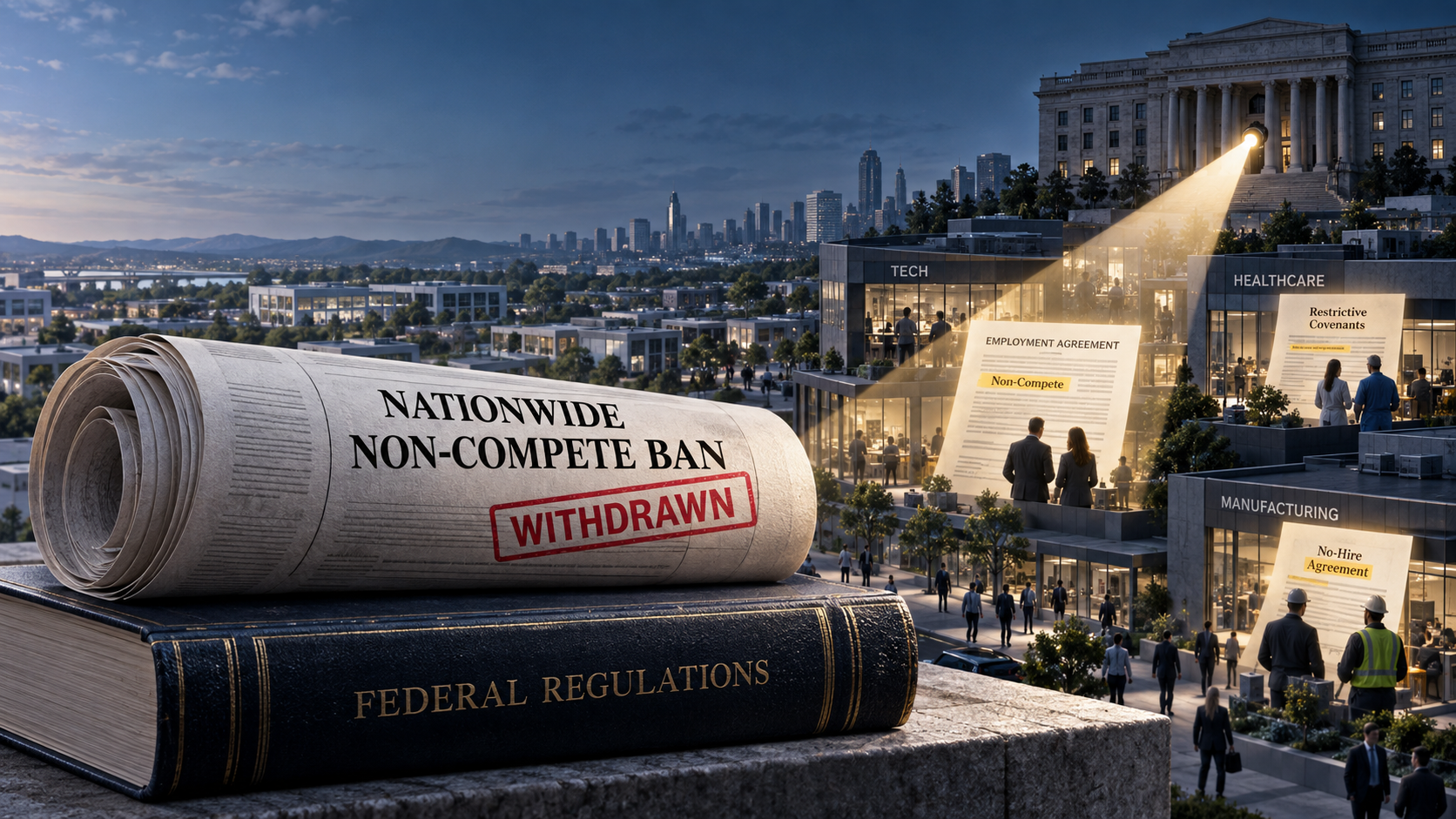
The Federal Non-Compete Ban Is Dead. The Agency That Wrote It Is Still Coming After Non-Competes.
The short answer
The Federal Trade Commission abandoned its defense of the 2024 rule that would have banned nearly all non-competes nationwide, and formally removed the rule from the Code of Federal Regulations effective February 12, 2026. It then began enforcing against non-competes case by case, including consent orders reaching more than eighteen thousand employees at a single company. The existential threat to restrictive covenant programs is gone. A narrower and better-aimed threat replaced it.
What happened, in order
September 4, 2025. The Commission issued a request for information on employer non-compete agreements, with comments due November 3.
September 5, 2025. The Commission voted three to one to dismiss its appeals and accede to vacatur of the rule. The vacatur rested on a holding that the Commission had exceeded its statutory authority.
September 10, 2025. The Chairman issued warning letters to several large healthcare employers and staffing firms, urging review of non-competes covering nurses and physicians.
November 2025. A final consent order against a pet cremation company required it to stop enforcing non-competes covering roughly eighteen hundred employees.
February 12, 2026. The Federal Register document removing the rule from the Code of Federal Regulations published and took effect.
February and June 2026. Consent orders against a building services company over no-hire agreements, and against a pest control company, the latter ending non-compete enforcement against more than eighteen thousand employees.
Our take: the exposure moved from everyone to a specific kind of employer
The instinct after a rule is vacated is to conclude the subject is closed. That instinct is wrong here, and the difference between the rule and what replaced it is the whole point.
The rule was categorical. It would have voided nearly every non-compete for nearly every worker. Its defeat means a Florida employer can build a restrictive covenant program without hedging against a federal ban, including under Florida's own statutory framework and the newer garden leave provisions.
The enforcement is targeted. Look at what the Commission actually charged: blanket covenants applied to rank and file service workers across an entire national workforce, and no-hire agreements between companies. Those are the fact patterns, and they are common in exactly the industries South Florida is full of, including healthcare staffing, building services, pest control and hospitality.
Two points that clients consistently get wrong.
A covenant can be enforceable under Florida law and still be a federal problem. Florida's statute asks whether there is a legitimate business interest and whether the restriction is reasonable in time and area. The Commission's theory is a competition theory under its own statute. Passing the first test does not answer the second.
No-hire and no-poach agreements between companies are within the scope. Many employers do not think of an agreement with a vendor or a competitor not to hire each other's people as a non-compete at all. The consent orders treat that conduct as within reach.
The practical direction is narrow tailoring and role differentiation. A covenant that binds an executive with access to strategy and customer relationships is defensible. The same covenant applied to every hourly employee in a national workforce is the thing the Commission has been buying consent orders about.
We would be candid that this enforcement posture depends on the composition of the Commission and could change. That is an argument for tailoring covenants to what you actually need to protect, which is good practice regardless of who is enforcing.
When to call a lawyer
Before rolling out a covenant across a workforce, before entering any agreement with another company about hiring, and on receipt of any inquiry from the Commission.
Why this is not a do-it-yourself problem
A restrictive covenant program now has to satisfy two different bodies of law with different tests, and passing one does not answer the other. Tailoring covenants by role, drafting them to a legitimate business interest, and keeping employer-to-employer hiring agreements out of the enforcement theory are drafting judgments that require knowing both frameworks. The employers named in the consent orders were not outliers; they were using standard forms across standard workforces.
Talk to us
HDD Law Firm drafts and litigates non-compete and other restrictive covenant agreements, and represents both employers and executives in those disputes. If you are rolling out covenants across a workforce, or you are an executive bound by one, discuss your matter with our attorneys.
Sources
● FTC, Commission files to accede to vacatur of the Non-Compete Clause Rule (September 5, 2025)
● Federal Register, removal of the Non-Compete Rule from the CFR (February 12, 2026)
● FTC non-compete enforcement page
● FTC, final order prohibiting non-compete enforcement, Gateway Services (November 2025)
Disclaimer
This post discusses publicly reported legal developments for general informational purposes. It is not legal advice, it does not create an attorney client relationship, and it does not reflect the firm's position in any pending matter. Outcomes depend on the specific facts and the governing law of the relevant jurisdiction.

Two Defamation Cases Against Netflix Show Why "We Never Said That" Is Not a Defense
The short answer
Within ten weeks, a South Carolina judge refused to dismiss a defamation claim over a true-crime documentary, and a federal court in California received a motion to strike a defamation claim by the creator of a reality series over a documentary about her own show. Neither case is about a false statement of fact. Both are about editing. That is the point worth understanding, because the same theory reaches ordinary businesses far more often than it reaches celebrities.
Why it comes up
Most people assume defamation requires someone to say something false. The more common claim in practice is defamation by implication: every individual statement is accurate, but the arrangement, juxtaposition and omission create a false impression. A profile that reports a company's true revenue decline, then cuts to an unrelated fraud investigation, may state nothing false and still convey something false.
That theory is why a business sues over a news segment, a trade publication article, a competitor's comparison chart, or a former employee's post. It is also the hardest defamation theory to defend, because the defendant cannot simply point at each sentence and say it was true.
The Murdaugh ruling
On August 27, 2026, a South Carolina judge denied motions to dismiss a defamation suit brought by Buster Murdaugh, the son of Alex Murdaugh, over a Netflix documentary that the plaintiff says connected him to the 2015 death of Stephen Smith, a Hampton County teenager. Smith's death was originally ruled a hit and run and later reclassified as a homicide. Murdaugh has never been named as a suspect.
The defendants argued the First Amendment protected reporting on the true fact that theories and speculation existed, and that the documentary posed questions and invited viewers to draw their own conclusions.
Judge Heath P. Taylor rejected that framing at the pleading stage. He wrote that the plaintiff alleges the defendants "selectively crafted and interposed interviews from law enforcement, community members and media personnel with those law enforcement reports to create the defamatory implication that Plaintiff is responsible for Stephen Smith's death." He found that the "creative liberties" taken in the production "present the information in a manner that can be reasonably interpreted by a viewer as answering the questions posed, mainly the speculation of Plaintiff's involvement in the death of Stephen Smith."
All motions to dismiss were denied and the case proceeds.
The Tyra Banks complaint
On June 13, 2026, Tyra Banks sued Netflix, the directors of its docuseries about America's Next Top Model, and the production company in the United States District Court for the Central District of California. She pleads defamation by implication, false light, breach of contract and false endorsement.
The core allegation is proportion. She sat for a three and a half hour interview; roughly sixteen minutes appeared. She alleges her comments were "stripped of context and reassembled to support a false and defamatory narrative unrelated to what she actually expressed." The specific example she cites is a sequence in which she is asked whether she remembers a contestant's account of a sexual assault, answers "um," and the screen cuts to black, which she says implies she could not remember it.
Netflix moved to strike and dismiss. Its motion argues the complaint is "about ordinary editorial decisions," that the documentary in fact shows her saying "I do remember her story," and that "a documentary expressly showing Banks remembering does not imply that she forgot." The motion also argues she signed an agreement granting the right to edit her footage, acknowledging she had "no right to review or approve" the finished documentary, and releasing claims including defamation and false light.
Our take: the release is the whole case, and most people sign one without reading it
Set the celebrity names aside and two lessons remain, both of which apply to any business owner or executive who is ever asked to comment on camera or on the record.
First, the editing is the claim. In both matters the publisher's position is that it reported accurately and made editorial choices. In both, the plaintiff's position is that the choices themselves conveyed a falsehood. The South Carolina court held that theory sufficient to survive dismissal. That is a meaningful signal: a defendant cannot reliably win at the pleading stage by parsing each statement in isolation, because the claim is about the whole.
Second, and more practically, the participation agreement decides most of these cases before they start. Netflix's lead argument is not that the documentary was accurate. It is that the plaintiff signed away the claim. That is a contract defense, and it is usually a good one. The standard participant release grants editing rights, disclaims any right of review or approval, and releases defamation and false light claims by name. Anyone who signs one and later dislikes the result is litigating against their own signature.
We should be candid about the tension between these two points. The Murdaugh defendants apparently had no release from the plaintiff, because he did not participate. The Banks defendants did. That difference may matter more than any doctrinal question about implication, and it is the reason the two cases could come out differently on similar theories.
There is also a fault question neither of these sources addresses. A public figure must prove actual malice, meaning knowledge of falsity or reckless disregard for the truth. A private figure ordinarily need not. Public figure status is a legal question decided on the facts, and general prominence does not by itself make someone an all-purpose or limited-purpose public figure as to a particular controversy. If either plaintiff is held to be one, actual malice becomes a serious obstacle, and that is a point the reporting does not reach.
What it means practically
Before you participate in any documentary, podcast, news feature or trade press profile: read the release. Ask whether you have any right of review, whether the release names defamation and false light, and whether it covers the entity as well as the individual. If the answer is that you have no approval right and have released those claims, understand that you are accepting whatever portrayal results.
If you have been portrayed unfairly and did not sign anything: the claim is about the whole piece, not one sentence. Preserve the publication, note the sequence and the omissions, and move quickly. Florida's limitations period for defamation is short, and a retraction demand under Florida's pre-suit statute may be a prerequisite to certain damages.
If you publish: the exposure is in the juxtaposition and the cut, not in the individual sentences your fact-checker verified.
When to call a lawyer
Before signing a participation agreement, and immediately after a damaging publication rather than after watching to see whether it blows over.
Sources
● WCBD News 2, Judge allows Buster Murdaugh's defamation lawsuit against Netflix to proceed
● The New York Times, Tyra Banks sues Netflix for defamation over Top Model docuseries (June 14, 2026)
● The Hollywood Reporter, Netflix files to dismiss Tyra Banks' ANTM defamation lawsuit
Disclaimer
This post discusses publicly reported legal developments for general informational purposes. It is not legal advice, it does not create an attorney client relationship, and it does not reflect the firm's position in any pending matter. Outcomes depend on the specific facts and the governing law of the relevant jurisdiction.

The Supreme Court Opened Two Doors on Helms-Burton Title III in Five Weeks
The short answer
In May and June of 2026 the Supreme Court decided two cases under Title III of the Helms-Burton Act, and both went against the defendants. The first held that a claimant may sue over the confiscated property itself even though its own interest in that property had expired. The second held that Cuban state owned entities do not get foreign sovereign immunity in these cases. Together they remove the two principal obstacles that had been keeping Title III claims out of court, and South Florida is where those claims are filed.
Why it comes up
Title III of the Cuban Liberty and Democratic Solidarity Act of 1996 gives a United States national a damages claim against anyone who "traffics" in property confiscated by the Cuban government on or after January 1, 1959. The right to sue was suspended by every administration until 2019. Since the suspension was lifted, claims have accumulated, and until this year the defenses had largely been holding.
Havana Docks Corporation v. Royal Caribbean Cruises, Ltd., No. 24-983 (May 21, 2026)
Havana Docks held a ninety nine year concession, granted in 1905 and expiring in 2004, to operate the Havana port docks. Cuba expropriated the concession in 1960, and the Foreign Claims Settlement Commission certified the loss at approximately $9 million. After the suspension was lifted in 2019, Havana Docks sued four cruise lines over their use of the docks from 2016 to 2019. The district court entered judgment of roughly $110 million per defendant. The Eleventh Circuit reversed, reasoning that the concession had expired well before the alleged trafficking.
The Supreme Court reversed, 8 to 1, in an opinion by Justice Thomas. The holding is that the statute reaches the confiscated property itself and not merely the claimant's interest in it. In the majority's phrasing, confiscated property is "tainted," and one who uses it faces liability to the holder of the prior interest. Justice Sotomayor, joined by Justice Kavanaugh, concurred, flagging the arithmetic problem of a $9 million certified loss producing potentially unlimited recoveries. Justice Kagan dissented alone, on the ground that the docks "belonged to the Cuban Government, not Havana Docks, all along." The case was remanded, and the Transnational Litigation Blog reports that the remand reaches the statutory exclusion for uses "incident to lawful travel to Cuba," a defense the lower courts had not fully addressed and which could still dispose of the judgment.
Exxon Mobil Corp. v. Corporación Cimex, S.A., No. 24-699 (June 23, 2026)
Standard Oil's Cuban operations, later Exxon Mobil's, included a refinery, product terminals and 117 service stations, all seized in 1960. An American commission certified the loss at nearly $72 million in 1969. With interest and a treble damages request, the amount in controversy runs into the hundreds of millions.
The question was whether Helms-Burton abrogates the sovereign immunity of Cuban state owned entities, or whether a claimant must also satisfy an exception under the Foreign Sovereign Immunities Act. The Court held, 6 to 3, in an opinion by Justice Kavanaugh, that Helms-Burton authorizes suit directly. "Stacking an FSIA requirement on top of the Helms-Burton Act would thwart Congress's design," the majority wrote, adding that "Congress does not ordinarily enact self-defeating statutes." Justice Kagan dissented, joined by Justices Sotomayor and Jackson, on the ground that abrogation of sovereign immunity requires "unmistakable clarity" that the statute's text does not supply.
Our take: the doors are open, and the room behind them is not empty
These decisions do not create new claims. They remove defenses. The distinction matters because the claims already exist in volume, and the practical effect is to move a large inventory of dormant Title III matters into active litigation, most of it in the Southern District of Florida.
Three points we would emphasize, including one that cuts against the plaintiffs.
First, the remaining obstacles are not trivial. Commentators have noted that abrogating immunity from suit is not the same as abrogating immunity from execution, and that the FSIA's service provisions may not follow automatically. A claimant may win a judgment against a Cuban state entity and still have nothing to collect against.
Second, the exposure runs to commercial defendants, not just the Cuban government. The cruise line case is the model. The defendants there were ordinary American companies operating under what they believed were lawful federal authorizations at the time. The Cuban state entities are the headline, but the commercial defendants are the docket.
Third, the "incident to lawful travel" exclusion is the live defense. The Havana Docks remand puts it squarely in issue. Any company that entered Cuba during the 2016 to 2019 opening did so under federal authorizations that existed at the time, and whether that fact defeats liability is now the most consequential open question in this area.
Layered on top is a changed sanctions environment. Executive Order 14404, issued May 1, 2026, created a new Cuba sanctions program under the International Emergency Economic Powers Act, separate from and additional to the Cuban Assets Control Regulations, and reaching non Cuban persons and foreign financial institutions. On June 11, 2026, OFAC designated Unión Cuba Petróleo, the state oil and gas company, under that order. A company assessing Title III exposure is now assessing sanctions exposure at the same time, and the two analyses do not have the same answers.
What it means practically
If your company had any commercial contact with Cuban property between 2016 and 2019, or has one now, three questions are worth answering before a complaint arrives:
1. What property did you touch, and is there a certified claim against it? Certification matters, because it drives treble damages.
2. What federal authorization were you operating under, and can you document reliance on it?
3. Does your current activity touch a designated entity, directly or through infrastructure that entity controls?
When to call a lawyer
Before responding to a Title III demand letter, and before any transaction touching Cuban property or Cuban counterparties. These claims can carry enhanced damages under 22 U.S.C. 6082(a)(3), but only where the claim was certified by the Foreign Claims Settlement Commission or where the claimant gave the statutory written notice at least 30 days before suit and the defendant continued trafficking afterward. Which route applies changes the settlement calculus from the first day.
Sources
● SCOTUSblog, Court rules against cruise lines in Cuban confiscation case (May 21, 2026)
● SCOTUSblog, Court rules for Exxon Mobil in Cuban confiscation case (June 23, 2026)
● Transnational Litigation Blog, Cimex
● PBS NewsHour, Supreme Court OKs ExxonMobil lawsuit over Cuban property (June 23, 2026)
● CNN, Exxon can sue Cuba over property confiscated in 1960 (June 23, 2026)
● Courthouse News Service, Supreme Court greenlights suit against cruise giants
Disclaimer
This post discusses publicly reported legal developments for general informational purposes. It is not legal advice, it does not create an attorney client relationship, and it does not reflect the firm's position in any pending matter. Outcomes depend on the specific facts and the governing law of the relevant jurisdiction.